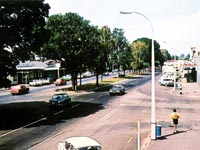
Cartier-Bresson's principles apply equally to a full colour image of a hot summer's day in Te Puke as to a grainy black and white of inner-city Paris. A Vauxhall Velox drives out of frame just as the man in walkshorts passes a rubbish bin heading for the shade of the shop verandah: the baking, silent serenity of a popsicle-melting provincial summer is captured.
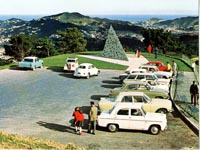
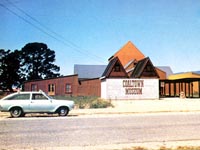
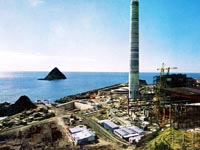
(d) Composition (rigidly geometric) and Colour (faded)
The geometry of the boringpostcard aesthetic is the legacy of the atomic growth and optimistic positivism of the postwar era. While modernism was a already dead duck in the "high" arts in the 1960s, motel owners, council architects and boringpostcardists patently still believed that the visual world could be mathematically ordered, precisely reproduced and sold for/to posterity. The newly constructed power plant is neatly framed by a slight rise in the foreground and the Tasman behind it. The horizon bisects the postcard horizontally. The chimney stands one third of the width of the card from its right edge, and is balanced perfectly by a small island lying just offshore. This is no accident. In the towns, colours are pastel. Orange, brown, beige and turquoise abound. Nature, as ever, is green and blue. < >
