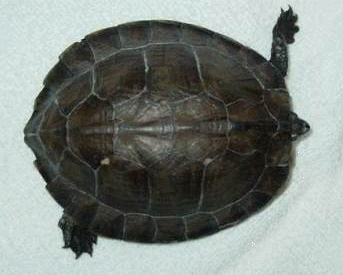
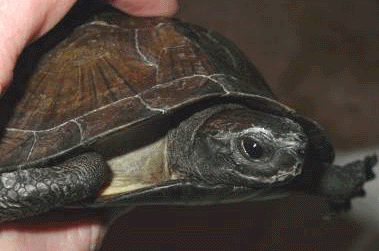
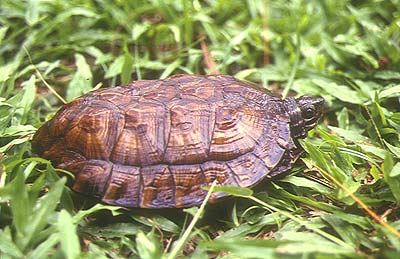
| The information that I have found on this species varies a bit, so I hope what info I can give will help anyone who is interested in or has one of these turtles. ~Range)These turtles originate in Southern Thailand, Burma, Malaysia, and the Phillipines. I have also found information saying they are also found in Kampuchea, Vietnam, Sumatra, Java and Borneo. ~Description) Average size is 9-10 in, females are slightly larger than males. Males have longer, thicker tails. Shell color varies from browns, to olive, to black, sometimes with dark radiating lines. The shell is oval shaped and depressed, and bears 3 keels. The back edge of the carapace is slightly serrated. ~Care)This species should be housed in a good size enclosure consisting of a water dish large enough for them to walk around in, but not fully submerge, a damp soil substrate (I like to use a mix of Bed A Beast and Sphagnum Peat Moss), as well as some plants and cork bark or half log to hide under. They need to be keep moist, so mist often. The water must be keep very clean also, to prevent disease. ~Temperature) The only advice I could find on a temperature to keep these turtles at was between 64F and 77F so I am not sure how accurate these temperatures are. This is a little warmer than the temperature for the Vietnamese Leaf Turtle, which like it between 59F and 70F ~Feeding)Offer leaf turtles a variety of food items including: mixed greens (green leaf, red leaf, and romaine lettuces, collard greeds, mustard greens, parsley, kale) bananas, berries, worms, snails, small fish (I recommend rosy red minnows), insects, as well as other types of sweet fruits. Cleanliness is the key to keeping this species Back |
| Asian Leaf Turtle Cyclemys dentata |
 |
 |
 |
 |
 |