
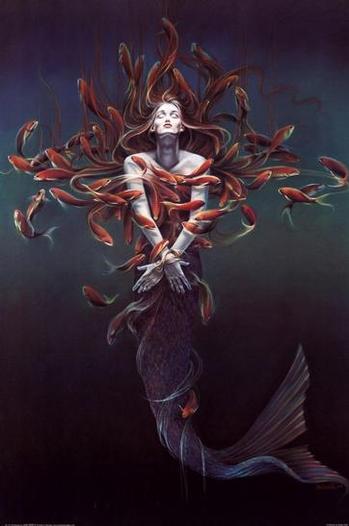

The Syrians and the Philistines were also known to have worshipped a Semitic mermaid moon-goddess. The Syrians called her Atargatis while the Philistines named her Derceto. It not unusual for them to consider the goddess of the moon some sea like creature, because the moon made the tides of the water rise and fall. It is said that Atargatis is one of the first recorded mermaids and the legend says that her child Semiramis was a normal human and because of this she was ashamed and killed her lover. Abandoning the infant she became wholly a fish.
The Greeks and Romans believe that Posiedon (Greek god of water) and Neptune (Roman god of water) were often depicted as half-man and half-fish but the most popular motif of the ancient world that depicts mermen was the representations of the tritons, Triton being the son of the powerful sea-god.
The British Isles too had their fair share of merfolk mythology. The Cornish knew mermaids as Merrymaids; the Irish knew them as Merrows or Muirruhgach and some sources write that they lived on dry land below the sea and had enchanted caps that allowed them to pass through the water without drowning, while the women were very beautiful the men had red noses, were piggy eyed, with green hair and teeth and a penchant for brandy. Other sources write that the Merrow were believed to forebode a coming storm.