
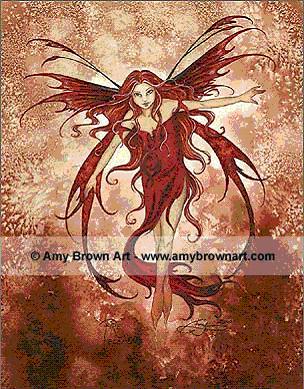
Muggles earliest myths believe that fairies were the elemental nature spirits of the trees, hills, waters. Originally the Celtic �Elf� referred to this creature, but was possibly replaced with fay and eventually fairy. Celts had different names for spirits of the different areas, for instance feld-elfen, wudu-elfen, berg-elfen, and sae-elfen refered to elves of the field, wood, mountain, and sea. The wood elves of Celtic origin are more recently considered a sub-type of faerie.
In Norse mythology, maggots emerging from the corpse of the giant Ymir transformed themselves into the Light Elves and Dark Elves. Living in the air, the Light Elves were happy and benign, but the Dark Elves who dwelt underground were evil and malicious.
Christianity says the faeries are spirits of the dead. Post Christianity myths say that faeries are the spirits of unbaptized children or fallen angels or ancient druids who grow smaller and smaller through the ages, refusing to become Christians. In all cases they are not good enough for heaven, but too good for hell. So they are expelled to live in the middle world.
The Icelandic (post Christianity) myth tell that Eve was washing her children in a river, and God spoke to her, fearful, of him, Eve hid all of her unwashed children. God asked her if all of her children were there, and Eve replied that they were. God then said that all of the children which she hid would remain hidden from man, and would become the elves, faeries, and Huldre Folk (Scandinavian). The Huldre girls were very beautiful, but only from the front.
In another myth faeries were originally immortal beings who lived in Italy, as the Roman empire spread, so did the little folk, to France, and then to the British Isles. Faeries were kept out of Greece by competition with the indigenous Nymphs and Dryads. In Cornwall they also met with armed resistance from pixies, who managed to keep them from spreading in to that area. Originally Faeries bestowed gifts upon newborn children, while punishing mean adults, but they expanded to interfere in all parts of human life.
Science
In an attempt to interpret fairies in modern terms using the sciences of archaeology and sociology, explains faeries quite nicely (and rather boringly) as the legend of an aboriginal race, which would of-course be beaten by the stronger, more advanced invaders, would be quite fearful of the iron weapons of the invading race. This would explain the two most popular traits of faeries, their by now exaggerated diminutive size, and fear of iron. The lager race might even be responsible for myths of giants as their size, and fear of power also became exaggerated through the years.
Sightings
The most famous sighting of faeries is of the Frances. It is believed that they saw faeries in a garden with a waterfall in the background. They took pictures of these faeries. Today by Muggles it is believed that these pictures are false. The truth of the matter is that the pictures are real but seem fake because if you don�t use the moving solution to develop your picture all magical beings seem like cardboard cut outs and lifeless. There reasoning for the pictures being thought fake is that items in the background were blurred and the faeries weren�t blurry at all. Faeries have like to pose for pictures.