
The first basilisk was seen by a Greek from the side while it was killing his wife. He passed done the tail to his son and his son passed in down and so on. Until Pliny wrote about it in Natural History. He wrote in the book after discussing another mythical creature the catoblepas, and its ability to kill people with its vision, �The basilisk serpent also has the same power. It is a native of the province of Cyrenaica, not more than 12 inches long, and adorned with a bright white marking on the head like a sort of diadem. It routs all snakes with its hiss, and does not move its body forward in manifold coils like the other snakes but advancing with its middle raised high. It kills bushes not only by its touch but also by its breath, scorches up grass and bursts rocks. Its effect on other animals is disastrous: it is believed that once one was killed with a spear by a man on horseback and the infection rising through the spear raising not only the rider but also the horse. Yet to a creature as marvelous as this � indeed kings have often wished to see a specimen when safely dead � the venom of weasels is fatal: so fixed is the decree of nature that nothing shall be without its match. (8. Xxxiii)�
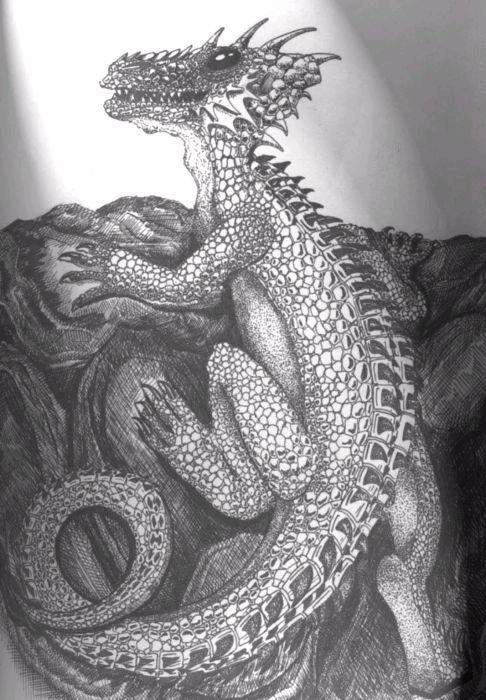
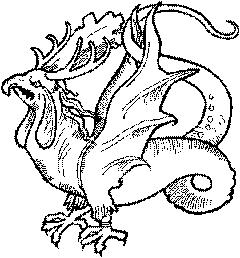
The Muggles believe that the tales of the basilisk are based on tail of the king cobra in Egypt. This cobra has a white marking on its head, powerful venom (which I believe it can spit, thus not having to bite a victim to harm him), and the ability to move with its head held upright. Thomas Bulfinch also explores the concept of the basilisk as the king of the serpents. He says, �The basilisks were called kings of serpents because all other serpents and snakes, behaving like good subjects, and wisely not wishing to be burned up or struck dead, fled the moment they heard the distant hiss of their king, although they might be in full feed upon the most delicious prey, leaving the sole enjoyment of the banquet to the royal monster.� According to Muggles the basilisk is always found in the desert. That is because in their belief (Pliny says �It kills bushes not only by its touch but also by its breath, scorches up grass and bursts rocks�.) They also believe that the skin will repel snakes and spiders. The Greek�s tied the it to Medusa a mythical person who had the power to turn people to stone. It also is the where they come up with the mirror being use to over come it, because Perseus killed Medusa by showing her refection to her. Another way that it was said that a basilisk could be defeated can be found in Claudius Aelian�s (c. 175-235 CE) On the Characteristics of Animals. In it he says that the crowing of a cock can kill a basilisk. England was once full of basilisks. Muggles had to be warned on how to kill it if they came apon one. There are references to it in old version of the Bible (not King James versions). Isaiah 59:5 reads, "They break the eggs of asps and weave the spider�s web; he who would eat their eggs, having crushed the wind egg [ourion] finds in it a basilisk." This verse is, obviously, unclear and obscure. This obscurity is reflected in subsequent translations of the Bible. The basilisk is also referred to in Psalm 91, but interestingly, by the time of the King James translation, the reference has been �watered down� to reference to an "adder.� From there, the story of its extraordinary birth enters into a more mainstream tradition with its inclusion in Pierre de Beauvais� enlarged bestiary of 1218 CE. In his version of the birth an egg forms in the body of an old cock, which lays it (secretly) in a dung heap. There, it is hatched by a toad and the animal produced has the upper body of a rooster and the lower body of a snake.11
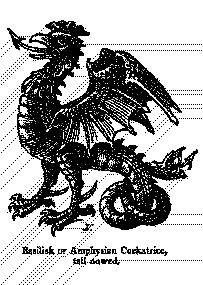
The transmission of the story of its birth through time only allowed for more detailed and more peculiar accounts. For example, in a consolidation of basilisk lore, the summary of a medieval account reads: it had to be born of an egg laid during the days of the Dog Star Sirius by a seven-year-old cock. Such and egg was easy to recognize: it did not have the normal ovoid shape but was spherical. It had no shell, but was covered by a thick skin or membrane. The egg then had to be hatched by a toad, and the result was an unbelievably poisonous monster which was basically a serpent but with some characteristics of the toad and the cock as well. At about the same time (twelfth century) the word �cockatrice� started being interchanged for basilisk. The term was an all-purpose word for just about any chimerical monster. As the artists of the middle ages took more liberties in depicting the basilisk, wings eventually became a part of the creatures accepted make-up. Origin
Most authors agree that Africa was his homeland. The basilisk is always found in a desert. This is not because he enjoys living there, but because its breath and sight are so destructive that it turns any landscape in a sand desert.
The special characteristics of the Basilisk have led many to believe that the monster has arisen from nothing more than the tales of the Egyptian cobra, whose characteristics have, from oral transmission, been exaggerated. This cobra has a white marking on its head, powerful venom that he spits without the need to bite, and the ability to move with its head held upright. The mongoose, rather like a weasel, can kill cobras.