
Easter
Danny Ong 2 April 2003
Before I start, let me say that I may not be the best person to write about Easter. I am not a theologian. A Catholic friend suggested I write about this. So, bear with me.
I did some research and found some interesting beliefs about the timing of Easter. According to some, Easter happen to be celebrated at around the same time as the pagan festival of the ancient Saxons. The ancient Saxons celebrated this festival to commemorate their goddess of offspring and springtime, Eastre (some spell it as Eostre).
In the second century, Christian missionaries venturing North to spread Christianity encountered the ancient Saxons. Apparently, to prevent unnecessary bloodshed, the missionaries allowed the early converts to continue celebrating their pagan festivals but, only in a Christian manner.
Another belief of the timing of Easter was linked to the Jewish celebration of Passover. Passover is mentioned in Exodus 12, in the Old Testament. Easter comes from the Jewish word, “pesah” which means Passover.
To Christians, Easter is about the life of Jesus Christ, Son of God; His betrayal by Judas, His persecution by Pontius Pilate, His crucifixion, His death (where He descended to the dead and spread the Good News) and His resurrection.
Easter was celebrated on different days of the week. Then, in 325AD, emperor Constantine convened the Nicaea Council. The Nicaea Council issued the Easter Rule which states that Easter shall be celebrated on the first Sunday after the first ecclesiastical full moon on or after the vernal equinox. Basically, it says Easter is to be celebrated on a Sunday between March 22 and April 25. Incidentally, Constantine also decreed that the cross was the official symbol of Christianity at the same council.
The Lenten Season
Lent is a 40-day period of spiritual preparation for Easter. The preparation includes fasting, penance, abstinence and prayer. The 40-day period is to remind Christians of the temptation of Jesus as He spent forty days and nights in the desert.
When fasting, one is allowed to drink water. Small children, the sick and the elderly are exempted from fasting.
Before the Lenten Season starts on Ash Wednesday, certain cultures hold a celebration called Mardi Gras which is French for Fat Tuesday. This celebration is designed to let the people enjoy themselves thoroughly before Lent. The Portuguese in Malacca celebrate by throwing water at each other as a sign of cleansing.
Ash Wednesday is the first day of Lent. The name is probably derived from the Roman Catholic church practice of putting ash on the foreheads of the parishioners to remind them that man is but dust.
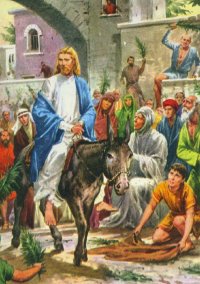
Palm
Sunday is a
week before Easter. It recalls Jesus’ entry into Jerusalem. Jesus rode into
Jerusalem on a donkey with her colt. Some of the town people spread their cloaks
on the road and some spread palm leaves on the road as Jesus rode past. Matt.
21:1 – 11.
Holy Monday was the day when Jesus went to the temple and chased away the money-changers and other profiteering people. Then, He healed the blind and the crippled. Matt. 21:12 – 17.
Holy Tuesday was the day Jesus instructed His disciples of the coming of the Kingdom of God. Matt. 24:3 – 14.
Holy Wednesday (which used to be called Spy Wednesday) reminds us of Judas Iscariot’s decision to betray Jesus for thirty pieces of silver. Matt. 26:14 – 16.
Maundy Thursday is also known as Holy Thursday. “Maundy” comes from the Latin word, “mandatum” meaning commandment of God (John 13:34 – 35). Maundy Thursday reminds us of the Last Supper and of the New and Everlasting Covenant. Matt. 26:26 – 30. Maundy Thursday also reminds us of Jesus’ agony in the Garden of Gethsemane. This also reminds us of Jesus’ commitment to His Father when He said, ….if it is possible, take this cup of suffering from me. Yet not what I want, but what You want. Matt. 26:36 – 39. On Maundy Thursday, priests would wash the feet of a few parishioners during Mass. After Mass, hot Cross Buns are normally sold or distributed to the parishioners.
Good Friday reminds us of Jesus’ death on the cross so that sins may be forgiven. Jesus Christ was crucified with two thieves on either side of Him. The thief on His right called Dismas who repented was promised salvation. Dismas became St. Dismas, patron saint for repented thieves. St. Dismas’ feast day is on 25 March. The other thief, Gestas did not repent.
The origin of the word “good” has been lost. Some people claim that it came from the word “God” being “God’s Friday”. Others believe “good” refers to the blessings on humanity which came from Jesus’ crucifixion.
Holy Saturday marks the end of the Holy Week and of Lent. Some churches baptise their converts during the Easter Virgil after a year’s instruction at RCIA (Rites of Catholic Initiation for Adults) classes. Once, baptised, these converts are considered as full-fledged members of the church and can take part in holy communion.
Easter Sunday marks the resurrection of Jesus. Some church baptise their converts on this day. Easter Sunday reminds us of the day when Mary Magdalene and the women went to Jesus’ tomb and was told by the angel that Jesus had been raised. Matt. 28:1 – 10.
Ascension Day (Feast of the Ascension) commemorates the joy of Jesus’ ascension to heaven. It is celebrated thirty-nine days after Easter Sunday. Acts 1:6 – 11.
Pentecost (Whit Sunday) which comes from the word “pentecoste” (Greek for fifty days) is celebrated seven weeks after Easter Sunday. Originally, it is a Jewish celebration marking 50 days after Passover.
Picture: The Entry into Jerusalem, Illustration from The Children Bible, Golden Press

