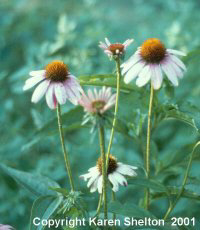
Photo by Karen Bergeron Copyright 2000
Echinacea
Echinacea purpurea
Other Names: Purple coneflower, Black Sampson, Coneflower, Eastern Purple Coneflower, Indian head, Kansas Snakeroot, Missouri Snakeroot, Rudbeckia, Scurvy root
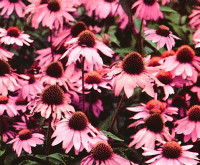
Photo by Deb Jackson Copyright 2000
Perennial native to N. America from Virginia to Ohio and Michigan, south to Georgia and Louisiana. Found growing in open fields, dry open woods, prairies and barrens. Cultivation is easy Echinacea prefers light, loamy, well-drained soil and a sunny position, tolerates shade. A very ornamental plant, it attracts butterflies to the garden, but watch out for slugs they seem to love this plant. Daisy-like flowers with large rich purple or pink rays surround a high brownish-orange cone, the flower heads can reach 4 to 5 inches in diameter. Stems are long 2 to 3 feet high, slender but stout, rough and bristly. Leaves are also bristly, dark green, lanceolate, alternate, and long petioled at the base, more sessile near the top of the stem. The roots are tapering, cylindrical, slightly spiral, and fibrous with as aromatic smell. It is in flower from July to October. Gather root and entire plant in fall or when in bloom, dry for later herb use.
Echinacea was used extensively by Native Americans and the early American settlers also adopted its use. It has been used for years in alternative medicine to support the immune system, and to purify the blood, especially during season changes and during the cold and flu season. Scientific studies have confirmed the presents of natural chemicals, echinacosides, which increase white blood cell activity. Other valuable constituents include betaine, echinolone, inulin, humulene, polysaccharides, two phytosterols and fatty acids, oleic, cerotic, linolic and palmatic. Extracts of Echinacea were found to enhance the cellular immune function of normal individuals and patients with AIDS and chronic fatigue syndrome. Unlike antibiotics, which directly kills bacteria, Echinacea makes our own immune cells more efficient in attacking bacteria, viruses and abnormal cells, including cancer cells. The root now confirmed by modern science as adaptogen, alterative, anti-inflammatory, antibiotic, antiseptic, aphrodisiac, depurative, diaphoretic, digestive, sialagogue. Echinacea is considered to be a most effective detoxicant for the urinary tract, circulatory, lymphatic, and respiratory systems. The roots and the whole plant are considered particularly beneficial in the external treatment of psoriasis, eczema and inflammatory skin conditions, sores, wounds, burns, and sore throat, possessing cortisone-like and antibacterial activity as well as showing skin regenerating properties. It also contains chemicals that are highly insecticidal particularly to mosquitoes and house flies. Folklore
Once used as an antidote to treat snakebites and other venomous bites by Native Americans. Believed in old English herbals to cure syphilis and rabies.
Recipe
Infusion: To 1 tbls. dry herb add 1
cup boiling water, steep 20 min., drink in mouthful doses throughout the
day, at the beginning of a cold or for general fatigue.
Article by Deb Jackson & Karen Bergeron
