
Russian provinces on the territory of Litva
The Russian occupational administration fought the old heraldic traditions of Litva. Traditional civic arms and provincial arms were replaced by symbols newly invented by Russian bureaucrats.
Grodno (Harodnia) province
|
|
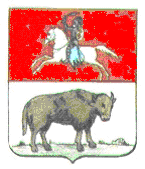
the Grodno province was established in 1801. The arms was approved on July 11, 1802. |
|
|
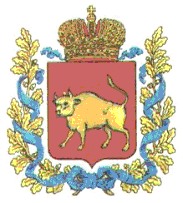
the new Grodno provincial arms of July 5, 1878 |
Minsk (Miensk) province
|
|
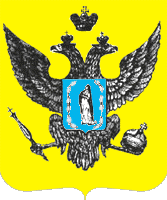
On January 22, 1796 the newly annexed Miensk region, united into the Minsk general-governance district, got this arms. It is a rare case when the traditional arms (Virgin Mary) was kept, though, of course, surrounded by the Russian imperial eagle. |
|
|
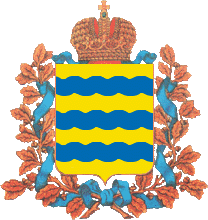
On July 5, 1878 the new arms of the Minsk province was approved. |
Mogilev (Mahiloŭ) province
|
|
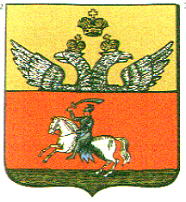
In 1772, after Russian annexing of Mahiloŭ, the Mogilev oblast inside the Pskov province was established. In 1777 or 1778 it was transformed into the Mogilev general-governance district. On August 16 1781 the district and the city of Mogilev got its new arms. In the lower half is the Pahonia as the symbol of Litva and above it is the Russian double-headed Eagle as a symbol of Russian dominance. |
|
|
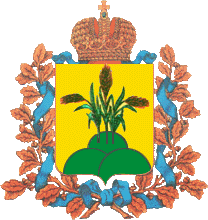
In 1796 the region of Mahiloŭ became part of the new White Ruthenia province, but in 1802 the Mogilev province was established again. On July 5, 1878 the new arms of the Mogilev province was approved. |
Wilno (Vilnia) province
|
|
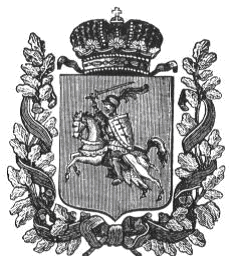
Arms of the Wilno province, approved in 1878. An interesting detail: instead of the traditional Litvan cross of St. Euphrasynne the knight has the Russian orthodox cross on his shield |
Vitebsk (Viciebsk) province
|
|
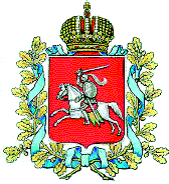
Arms of the Vitebsk province, approved in 1856 |
� Bartolomaeus Horbač Anno Domini 2003