EE
176 VHDL 03/11/04 Lecture #6 Thursday
VHDL
Operators
Last Week: VHDL Signals/data types
Today: The main VHDL operators for performing operators base on signals/data type.
q LOGIC
OPERATORS
not (higher precedence)
---------------------------------------
and (equal precedence)
or
nand
nor
xor
To overcome precedence, use ()
Ex. Z<= a and not(b or c)
Z=
q
Legal Type
Operands and Results
o Predefined in package (STANDARDS)
Boolean
Bit
Bit_vector
o Extended by IEEE 1164 (in package std_logic_1164);
A B
std_ulogic
? Z Z


 std_logic
std_ulogic_vector
 std_logic_vector
o Extended by IEEE 1176.3 (in package numeric_bit/_std );
Unsigned-TYPE unsigned IS ARRAY(natural range( ) of bit ;
Signed - TYPE signed IS ARRAY(natural range( ) of std_logic;
q
NOTE (for
logic operator)
1. Type of operands and results must match
2. For array operands
a. Sizes of operands and results must match
b. Operands are applied to matching elements by position
EX: :
:
SIGNAL a_bus, b_bus, z_bus:std_ulogic_vector( 3 downto 0);
Z_bus<=a_bus AND b_bus;

Equals
Z_bus(3) <=a_bus(3) AND b_bus(3);
Z_bus(2) <=a_bus(2) AND b_bus(2);
Z_bus(1) <=a_bus(1) AND b_bus(1);
Z_bus(0) <=a_bus(0) AND b_bus(0);
q
Relational
Operator
= Equal
/= Not Equal
< Less then
<= Less then and equal to
> Greater then
>= Greater then and equal to
q Legal operand and results
o Predefined in STANDARD package
o Extended by IEEE 1176.3 (in package numeric_bit/_std );
=
/= (Any Type)
-------------------------------
< (Any Scalar type: integer, Boolean, char, real, time, etc)
<= or
> 1-D array of integer/enumerated type (Boolean, bit, char, etc)
>=
q NOTE
1.
Usage of relational operators
a.
Mostly in “if-else” statement
2.
Array operands can be of different lengths and if so, the
operands are aligned to the LEFT and compared to the right.
1011 ßà 111
111
3.
Outputs are always in Boolean
4.
In VHDL, vector signal DOES NOT have a numerical value.
q ARITHMATIC
OPERATOR
o Extended
by IEEE 1176.3 (in package numeric_bit/_std );
+ addition
- subtraction
* multiplication
/ division
** exponent
abs absolute value
rem remainder x= L rem R sign(x)=sign(L)
mod mod x= L rem R sign(x)=sign(R)
1. As in VHDL vectors do not require a numerical values, these operators CANNOT be used w/ types
BIT_VECTOR
STD_ULOGIC_VECTOR
STD_LOGIC_VECTOR
2. In general, operand and results needs to be in the same type.
EX: Exception
Integer * time
3. Range of results need to specified (be careful!)
EX: ENITY ADD IS
PORT(a, b:integer Range 0 to 7;
Z:out integer range 0 to 15);
ARCHITECTURE arithmetic ADD is
Z<=a+b;
END arithmetic;
q OTHER
OPERATOR-SHIFT/ROTATE OPERATOR
o Not predefined in STANDARD PACKAGE
o Need
to include package
SLL Shift Left Logic
SRL Shift Right Logic
SLA Shift Left Arithmetic
SRA Shift Right Arithmetic
ROL Rotate Left
ROR Rotate Right
q CONCEPT
OF OVERLOADING
o VHDL allows multiple functions to be defined with the same name, but different in their input/output
Type x {

Type y {

Type y {

o When apply overloading concept to operators, we can define multiple version for a specific operator (eg. “and”, “+”, etc) to deal with different types of operands/results

o Overloading done by IEEE 1176.3 (in package numeric_bit/_std );
(also called the IEEE synthesis Package)
o Example:
Let v={unsigned and signed} vector
S={integer, natural}
Opa={abs, +, -, * , /, mod, rem} (set of arithmetic operation)
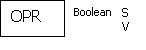
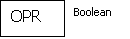
Opr={=, /=, <, <=, >, >=} (relational)
V V OPA V S V OPA OPA V


V V OPR



 l
l

 l
l

