2001, 3001, AND THE CUBE
Part 1 of 2
A friend asked that this article be posted on the website. I hereby honor his request. —H.B.
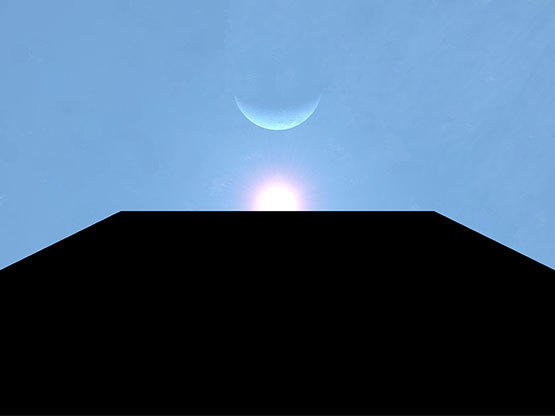
Sun rises over monolith in Stanley Kubrick's 2001 (1968).
Two men looked out through prison bars
One saw mud—the other, stars.
— Frederick Langbridge
In the beginning was the Monolith.
There it stood, at the dawn of mankind, entrancing Moon-Watcher and his fellow apemen, doing strange things to them, preparing them for intelligence and civilization. There it (or rather, its counterpart) stood again, eons later, as Heywood Floyd beheld it, this time on the moon, under the name of Tycho Magnetic Anomaly-1. It was a vertical slab of jet-black material, about ten feet high and five feet wide: a perfect, symmetrical rectangular block, reflecting almost no light at all. And it stood yet again on the surface of Japetus, a moon of Saturn (the movie version has it floating in space near Jupiter), this time as the mile-high big brother of TMA-1: TMA-2, beheld by astronaut David Bowman.
“Call it the Star Gate,” says Arthur C. Clarke in his novel, 2001: A Space Odyssey (1968), so brilliantly depicted by Stanley Kubrick in the movie of the same name. Clarke also calls it “the Sentinel,” after his 1948 short story on which the novel was based. As astronaut Bowman watched, the thing inverted, turned itself inside out; it was no longer a rectangular block but a hollow shaft, and Bowman had time for just a single broken remark: “The thing’s hollow—it goes on forever—and—oh my God—it’s full of stars!”
“The Star Gate opened,” writes Clarke. “The Star Gate closed.” And that was the last Mission Control back on earth ever heard of Bowman.
What follows in the movie is the most dazzling sequence of images that depict a transfinite celestial journey, unsurpassed even after all these years of development in cinematographic technology and computer graphics. What Kubrick shows us on the screen is nothing less than a view of a spiritual Ascension, even if still only a pale copy of the latter.
Beyond time and space, Bowman is transported to a location where he ages prematurely—old age is perennially understood to be a sign of wisdom—and, on his deathbed (“Die before you die”—Mohammed), comes face to face for the last time with the black Monolith, which acts as midwife in his rebirth as the “Star-Child” in the vicinity of the earth.
As Master Ahmet Kayhan explained: "I experienced Observation of the Compassionate. Thank God. I became real with the Real, thank God. I became one day old. I knew and saw my Lord. The universe ceased to exist, it became ashes, it burned up, only God remained. The name ‘Ahmet’ remained, he himself ceased to exist. Only God was left. The universe was filled with joy.” (Bayman, The Teachings of a Perfect Master (2012), p. 453. Emphasis added.)
What is it in 2001 that held generations of movie-goers spellbound? What was the reason for its astounding success?
A symbol, according to psychologist Carl G. Jung, is something that is never directly comprehensible at first glance. It excites the psyche of man in a way that does not readily lend itself to logical analysis. And Kubrick was careful to film the movie so that many of the clues in the novel were left out, as primarily a visual experience which let watchers view it without tying it down finally to anything definite—which is what made 2001 a great work of art. But this brings up the further question of the role in modern society of the science fiction genre as a whole.
Most science fiction, of course, projects the present into the future tense. It rephrases contemporary issues of society and technology in a future setting. But science fiction at its most profound—like all great works of art and literature—speaks to the mythic dimension in man. With all due respect to Freud and his achievements, rockets and aliens address depths of the psyche unplumbed by Freudian symbolism. Why does sci-fi enthrall many of us to such a degree? Because at its best, science fiction is,whether we realize it or not, the mythology of our time. In ages past, myths and fairy tales referred back to a previous time or beginning. In keeping with our contemporary progressive world view, science fiction is forward-looking, but this really does not make much of a difference, for what is in our past is in our future as well: as the Koran puts it, “You have come from God, and you shall return to Him.” Perhaps, in situating major themes in the future instead of the past, it is even more apt; for what is past is past, and for us the really significant things still remain in the future.
Science Fiction as Future-Oriented Myth
To the perceptive eye, great science fiction betrays mythological sources from the very first step. Mary Shelley’s Frankenstein (1818), the first work of fiction to bear all the characteristics of the genre, is a retelling, in physical terms, of the Cabalistic legend of the Golem. In Robert Heinlein’s Stranger in a Strange Land, Mike’s return recalls the Second Coming of Christ; in Walter Miller’s Canticle for Leibowitz, Rachel’s primal innocence recalls the Creation story. In Childhood’s End, another Clarke novel, Karellen the alien, with his “sheer size” and “voice like an organ” upon whom “no man may look and live” (Exodus 33:19), plays God to Stromgren’s Moses. The Overlords, to whose race Karellen belongs, are like angels in that unlike man, they cannot attain immortality but can only act—in a similar way to 2001—as midwives in his rebirth, and hence are finally inferior to him. The “Total Breakthrough” which spreads through mankind like an epidemic at the end of the book recalls apokatastasis (the restoration of all souls to a state of blessedness) and the Descent of Grace: “In a real sense, those no-longer-humans floating off into space are entering a heaven.” [1] In George Lucas’ Star Wars movie series, Luke Skywalker plays the archetypal role of the hero; it comes as no surprise that director George Lucas was studying the works of mythologist Joseph Campbell at the time. And “the Force,” according to Lucas, is “a distillation of a lot of mythological religious teachings.” [2]
As a further example, just consider H. G. Wells’ The Time Machine. The Time Traveller goes hundreds of thousands of years into the future, there to find the earth transformed into a Garden of Delights and inhabited by the peaceable Eloi, while beneath the earth, in infernal regions, dwell the repulsive and brutal Morlocks. What are the Eloi but angels in Heaven, and the Morlocks demons in Hell?
Naturally, all these authors tap rich sources of the Western cultural heritage, although when it comes to myth, we find that similar themes are sounded in all the mythologies of the world. But something is going on here that lies deeper than the inheritance or imagination of any science-fiction writer. Mankind has always had stories of other worlds and other beings. But whereas these worlds and beings were originally located in the spiritual realm, they are now transposed, due to modern man’s alienation from his spiritual wellsprings, into the physical universe. The “higher worlds” have now become planets circling stars in other galaxies, and there are two types of aliens: angelic (such as Spielberg’s E.T.) and demonic (the whole class of bug-eyed monsters). Is it a coincidence that, just when we erased the spiritual world from our minds, we began to think about extraterrestrial life in three-dimensional space? Is it a coincidence that, just when we decided to dismiss fairies, elves, demons and the djinn, people began reporting UFOs and alien abductions? (The two form an almost unbroken temporal continuity.) Having renounced another, invisible, parallel world accessible to his consciousness, modern man now projects such things into the physical world. This may not only be erroneous, in the sense that we have misplaced these objects of our attention—extraterrestrial physical life may not actually exist and thus continue to remain unproved. It may also be dangerous, in the sense that forming the wrong conception about a phenomenon prevents the possibility of coping with it effectively.
The Symbolism of the Monolith
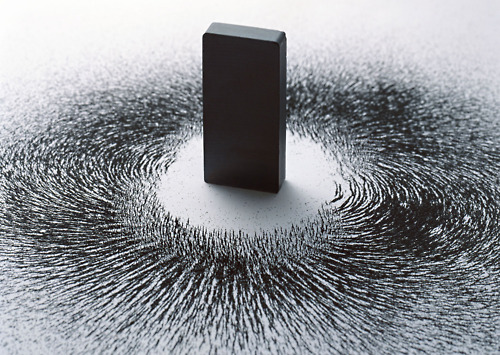 So let us return to 2001. In this novel, Clarke has made use of four major mythical/spiritual themes. The first is the death-rebirth experience of the soul, common to all the major traditions of humanity. The second is the Star-Child—the Child of the Heart (walad al-qalb) of Islamic Sufism, the Golden Child (hiranyagarbha) of Hinduism, etc., which is the outcome of the rebirth. The third is the Ascension that one experiences as the result of this spiritual rebirth. These all indicate that Clarke is tapping the deepest levels of the human psyche. There remains only one theme to discuss: the Monolith. Inscrutable, enigmatic, it baffles any immediate attempt to unwrap its mystery. What can it symbolize?
We obtain a clue when we realize that Clarke has endowed this black stone, resembling nothing so much as a flattened and elongated United Nations building, with the proportions of 1-4-9, or 12-22-32. Thus it stands, Clarke tells us, for the squares of the first dimension (width), the second dimension (length), and third dimension (height), respectively, and he goes on to imply that the sequence is continued beyond three dimensions. Hence, we discover that the Monolith has to do with dimensionality, and if we do not square them, we have the sequence 1-2-3. Note that the notion of “squaredness” is implicit in Clarke’s numbers: we have a square in length, a square in width, and a square in height. Now these squares naturally lead one to think of an object whose faces are composed of squares, which is a cube. Moreover, in three dimensions the simplest regular geometrical solid resembling the Monolith is a cube, and in two dimensions the simplest corresponding figure is a square, both of which are mathematically simpler and aesthetically more appealing than the slab. Our problem is thus reduced to a treatment of the square/cube, and its blackness. Let us tackle the square first.
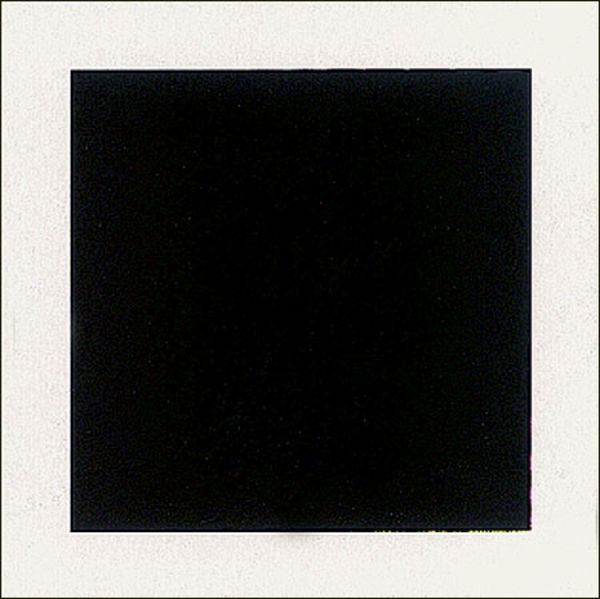
Kazimir Malevich: Black Square, 1915. Malevich declared it to be
the “zero of form,” and claimed that it eclipsed all previous art.
Square, Circle, Cube, Sphere
As soon as we “renormalize” Clarke’s rectangular prism to the square/cube, we find ourselves on familiar ground. For in addition to its geometrical import, it has frequently been used as a symbol of the psyche in many cultures and traditions. Closely related to the square is the circle in two dimensions and to the cube, the sphere in three dimensions, which are perhaps of even greater symbolic significance.
In what follows we shall make use of—but not confine ourselves to—the findings of Jungian analysis. [3] To begin with, the square (and often the rectangle, like Clarke’s “panel”) represents the four classical elements (Air, Water, Earth, Fire) and is thus a symbol of earthbound matter, of the body and physical reality. Its four corners suggest differentiation, and thus the created universe. Furthermore, Pythagoras associated the square with the soul; the saying that the soul is a square and that four is the number of all living things was attributed to him by his pupils. The quadrangle also stands for the realization of wholeness in consciousness.
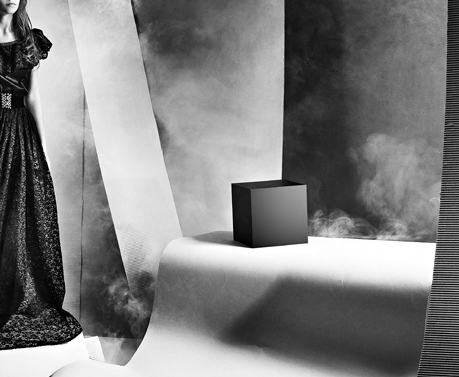
The Black Cube, first exhibited in 2010. Its website states: "It is black – deep and mysterious. It is cubic – shiny on every side with sharp edges, it has the most rational and most perfect shape. It is nicely crafted – high-quality materials, premium finish, beautiful and elegant, pure class. Its versatility is endless... just start dreaming and then turn this thing into whatever you might desire it to be. It is what we all have secretly been waiting for, for such a long time – an overdue revelation... [the] conclusion of the process of modernization."
The Black Cube "was created by an anonymous collective of German designers who[se] agenda is to develop radical design solutions for a sustainable future... Stepping into its showroom one could already sense a sublime atmosphere. Sacral sounds were filling the air... the cube could be used [as] a fetish object or an altar."
The cube is the extension of the two-dimensional square into three dimensions. Cartesian in its simplicity, the cube is the basic building block of Euclidian 3-space and architecture. It thus symbolizes matter, and more specifically, solid stone. The cube is also the simplest structure that is architecturally feasible. Now stone, whether precious or otherwise, is a symbol of the Self. According to Mircea Eliade, the stone is an archetypal image expressing absolute reality, [4] out of which relative or conditioned reality is born; for the Chinese Taoists, the entire universe proceeded out of the “uncarved block.” Man is mortal; stone is impervious to the passage of time and hence a symbol of immortality (just remember the pyramids of Egypt). The medieval alchemists, who were psychologists and mystics more than chemists, symbolized their famous “philosopher’s stone” by a cube, because of the perfection of its proportions. The philosopher’s stone is the stone that transmutes other materials into gold when it comes in contact with them, and symbolizes—gold being the most precious metal—the Purified Self of the Master, the Perfect Man or Universal Man of the Sufis or the True Man of the Chinese, who perfects the souls of other human beings when allowed to shine on them. The cube is thus the symbol of completion and perfection.
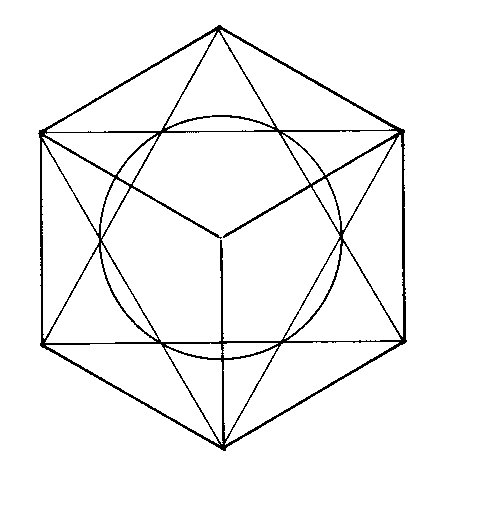
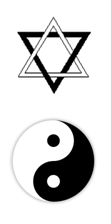 The Star of David (also called the Seal of Solomon), the Jewish symbol, is composed of two equilateral triangles inscribed in a hexagon, one standing on its base (symbolizing Fire) and the other on its apex (symbolizing Water). Thus the Star as a whole, like the Chinese Tai-gi-tu, symbolizes the union of opposites. Now the hexagon in which it is inscribed can also be seen as a cube in three dimensions, viewed directly from above one vertex; and the cube itself unfolds to yield
  the Latin Cross, composed of six squares in two dimensions. If either the top or the bottom is omitted, the cube unfolds into a Greek Cross with equal branches. Thus, the cube is a synthesis in three dimensions of the two-dimensional symbols of Judaism and Christianity.
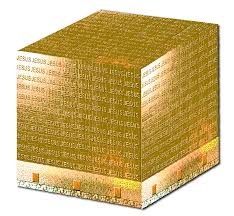
The New Jerusalem or Heavenly Jerusalem (Revelation 21:1-10) is often depicted in the form of a cube, much like the Kaaba. Of course, it is conceived to be much larger, and could cover almost 60 percent of the continental United States. It could be a veiled reference to the original Kaaba in Heaven, the House of Splendor (Bayt al-Mamoor), which God, if He so wished, could expand to any size.
In the Biblical Book of Revelation, the Heavenly Jerusalem has a square ground plan. No temple is at its center, for God’s immediate presence is the center of it. St. John of the Cross describes how, in a vision, he saw the Heavenly City in the form of a perfect cube, equal in length, breadth and height. The “Holy of Holies” (Sanctum Sanctorum), the inmost sanctuary of the Hebrew Temple, was likewise constructed in the form of a perfect cube, symbolizing Heaven and the wholeness of God. It contained the Ark of the Covenant, and was entered only once a year, by the High Priest alone. [5] Since the Temple plans were revealed to David by God (2 Chronicles,28:19), we have to conclude that it, too, was part of God’s Revelation. And Solomon affirms that the altar is “a resemblance of the holy tabernacle which Thou hast prepared from the beginning” (Wisdom of Solomon, 9:8).
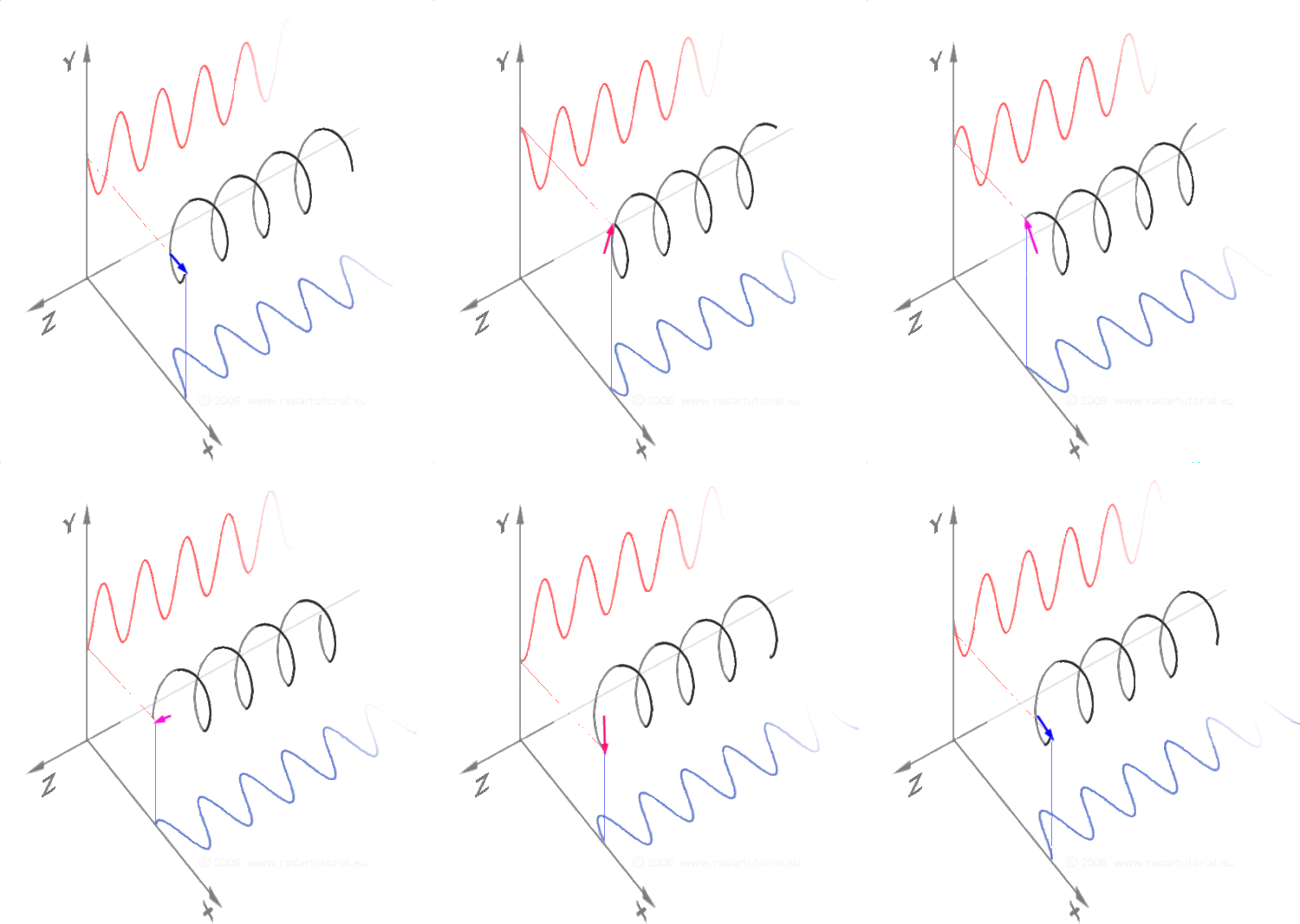
Like the stone cube, the circle, too, is a symbol of the Self. It is a symbol of Unity because, unlike the straight line which has two ends, its ends are united as one. Its roundness stands for wholeness, whether psychic or natural. It expresses the totality of the psyche in all its aspects. In Zen, it stands for enlightenment and human perfection. In contrast to the sharp-cornered square, it suggests nondifferentiation and is thus a symbol of the divine. Because one can go around and around it forever without any interruption, it also stands for infinity and eternity, or eternal return and cyclic time. Further, stretched out into three dimensions, circular motion provides the basis for the spiral, the helix, and the rhythmic oscillation of the sine wave. The ring and the tail-eating serpent ouroboros are “isotopes” of (types of equal value as) the circle. The Chinese tai-gi-tu disk comprises both Yin and Yang, thus representing Totality. In non-Christian cultures, sun-wheels are a frequent occurence, which leads us on to the sun disk, considered to be divine ever since the Egyptians. Gold takes its color from the sun, and thus stands for solidified light. The ancient Indian texts never tire of telling us that “gold is immortality.”
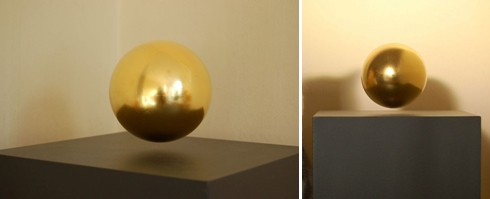
Gold sphere over black cube.
The dazzling globe of the sun provides our entry point for a discussion of the sphere, the three-dimensional counterpart of the circle. (Sipihr in Persian originally meant the hemisphere of the sky.) Like the circle but even more so, it is a symbol of completion and perfection, encountered frequently in nature (such as in planets, stars, and various kinds of fruit). For Plato, the sphere symbolized the psyche. Empedocles thought of God as the sphairos, “a rounded sphere enjoying a circular solitude.” [6] This precedes the remark by such luminaries as St. Bonaventure and Nicholas of Cusa that “God is an intelligible sphere whose center is everywhere and whose circumference is nowhere.” For a long time, the sky was conceived as a hemisphere covering the earth.
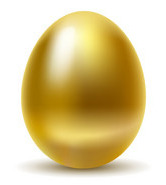 In this connection, the ovoid is also worth mentioning, obtained when the sphere is distorted into an oval shape. This is the “Cosmic Egg” from which the universe was created, according to the conception of many peoples. In modern science, it still commands our attention as the Primordial Fireball or “white hole” that exploded with the Big Bang to produce the physical universe.
 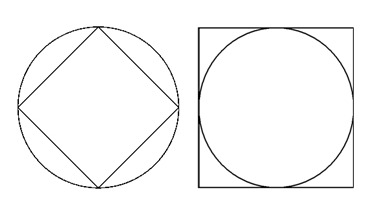 Now it is interesting that human beings have always and everywhere not remained content with only the circle or only the square, but have striven to combine the two. For the Chinese, the symbol of Heaven is a circle, while the symbol of earth is a rectangle. [7] The simplest such combination, appealing in its symmetry, is a square inscribed in a circle or a circle inscribed in a square. This is the basic “mandala” form, evidenced everywhere from the sand paintings of the Amerindians to Hindu and Buddhist India and Tibet, while in the Chinese Secret of the Golden Flower the “golden mandala” is a squared circle. The vision and understanding of the Hermetic philosophers likewise led to the concept of the squared circle, and the alchemists were for a time preoccupied with the mathematically insoluble problem of “squaring the circle.” This may strike us as quaint nowadays, but to them it represented a valid—if unattainable—symbol, and those who knew that it signified the descent of spirit into matter or the divine into the human (and thus psychic completion—what Jung calls “individuation”) never bothered with the geometrical exercise at all—just as they disdained the mundane aspiration to transform physical lead into physical gold. For mundane gold was mere chickenfeed to them, compared to the incomparably nobler and more exalted goal of cultivating the “Star-Child,” the “glorious body” (which recalls the “diamond body” of the Buddha), the True Gold of which the ordinary version was only a simile.
  An old alchemical drawing depicts a square nested in a circle, with a small circle at the center, out of which radiate, along the diagonals of the square, four lines dividing the figure into four sections. As Jung has shown, these correspond to the four classical elements, while the disk in the middle is the quintessence, the fifth element. The Chinese accepted gold as this fifth element (their classification contains five elements, not four), and as the alchemists have always cautioned: “Our gold is not ordinary gold.”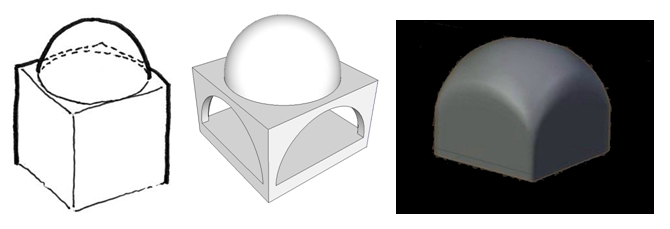

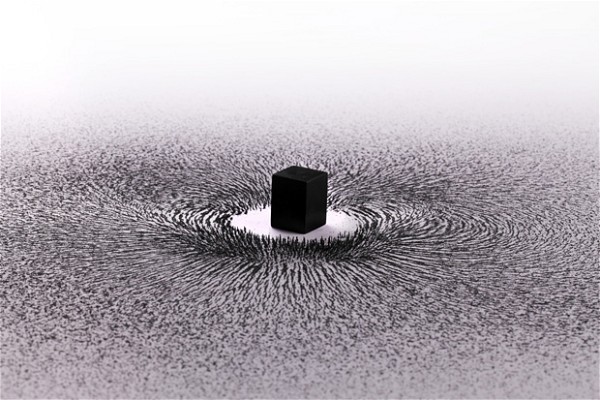
Ahmed Mater: Magnetism III, 2012.
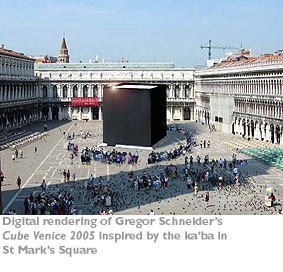
This proposal for a 15-meter-high (50-foot) black cube at the
2005 Venice Biennale was not, ultimately, realized.
The Sacred History of the Kaaba
To make sense of the Pilgrimage without its metahistorical precedents would be a vain attempt, so we begin with a short outline.
“The first house built for men,” says God in the Koran, “is the Kaaba in Mecca, which shows the Right Way and is a blessing for the worlds” (3:96).
It is said that the archetypal original of the Kaaba is the House of Splendor (or Prosperity: bayt al-mamoor, mentioned in 52:4) in Heaven. The House of Splendor is the Heavenly Kaaba, and the Kaaba we know is the projection or shadow on earth of this House located in spiritual space. In Sufism, the House of Splendor, or “the house that has been perfectly constructed,” is known as the Heart of the Perfect Man.
Adam saw the House of Splendor in Paradise for the first time in the shape of a tabernacle or shade. Angels were ceaselessly circumambulating the pavilion. This shaded canopy with a seat of honor at its center consisted of a gigantic ruby, supported by four columns of emerald. Inside it was a shining white stone. This stone, consisting of white ruby, was Adam’s throne. When Adam “fell” to earth, this stone likewise descended to where the Kaaba now stands. A better way of saying this might be that like the Kaaba, the stone, too, is a shadow or projection of its heavenly counterpart. The original earthly Kaaba was formed when Adam surrounded this stone with a wall of stones.
Because it absorbed the sins of countless people who touched it down the eons, this white stone became darkened and blackened in time. This is the famous Black Stone that now forms the Kaaba’s Cornerstone on its Eastern corner.
When Adam and Eve were expelled from Heaven, they landed on earth in widely separate geographical locations. They longed for and searched for each other, but it was forty years before they were reunited. In search of Eve, Adam finally arrived in Mecca. Here he first built the Kaaba by surrounding the Black Stone (still white then) with other stones, and then honored it by circumambulating it seven times. From here he proceeded eastward, to the plain now called Arafat. Meanwhile, Eve too was headed in the same direction, and they finally came together on top of the Mount of Mercy at Arafat. A white pillar marks this point today.
The Kaaba (meaning, as we have seen, “Cube”) is the House of God (bayt Allah). This does not mean that God, who is Omnipresent, can be confined in it, but that He has designated it as the locus of veneration for human beings: when Moslems prostrate themselves towards the Kaaba, they are not worshiping the Kaaba’s gray stones or drapery, but God.
The reason that the earthly Kaaba, in contrast to its heavenly archetype, is constructed of stones and earth is due to the fact that Adam, too, was created of clay or earth. A little secret lies buried here.
Even though Adam was made of clay, the angels, who were made of light, were commanded to bow down to the ground to him. Gold, silver and precious stones are not more valuable in God’s sight than clay. A thing gains value only as God values it.
The foundations of the Kaaba were preserved during Noah’s Flood, but with the passage of time all traces of it were obliterated.
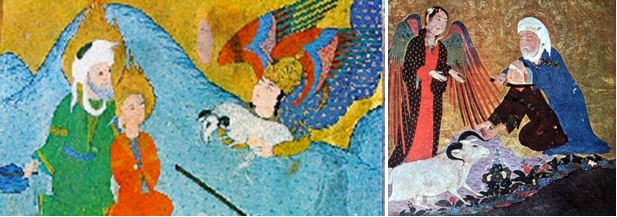
Two Islamic depictions of Abraham's sacrifice. The fiery halo around prophets'
heads used to denote that they "burned" with the spiritual love of God.
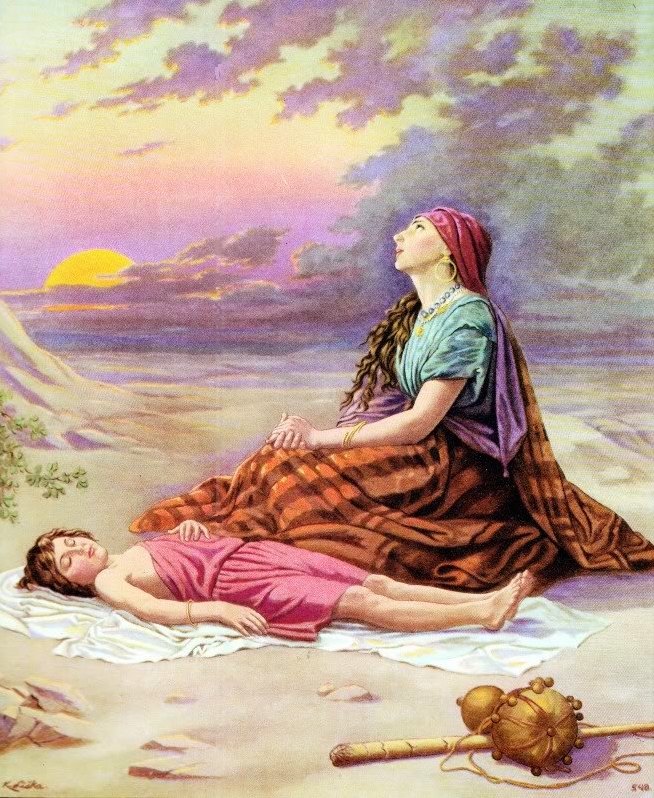 Hagar looked around. There was nothing and no one in sight. She began to wait. Abraham had left them some food and water, but when these ran out there was nothing else around they could eat or drink. In the blinding light of the desert sun, hunger and thirst soon overcame them. Still no one arrived. Time passed. Then Hagar saw that her little boy was about to die of thirst.
 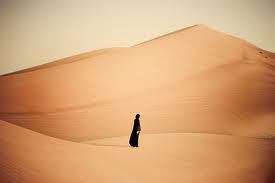 With increasing desperation, Hagar ran seven times from one hill to the other, praying to God for salvation, looking for a trace, however small, of water, trying to find a place from which rescue might arrive. Sweating, panting with increasing exhaustion, she displayed a stupendous struggle for survival. By the time she climbed the second hill for the last time, she was on the verge of collapse.
 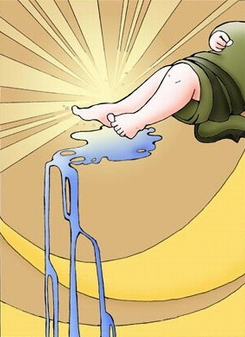 Then God in His mercy told Archangel Gabriel to strike the ground with his wing under the baby’s heel. Suddenly, water gushed forth. Hagar was made aware of it through the strange, humming sound it emitted, and ran over. The water spewed forth, the flow getting fiercer every second, until Hagar felt compelled to cry: “Stop, stop!” The water calmed down at this, and settled into a leisurely bubbling. Zamzam, the name of this water, means either “stop” or “humming.” As Gershom Scholem, the eminent scholar of Jewish mysticism, has noted, the Hebraic root zimzum means “contraction, withdrawal,” [13] which would favor the former meaning. The first hill Hagar ran up is called Safa, and the second Merva (or Marwa).
 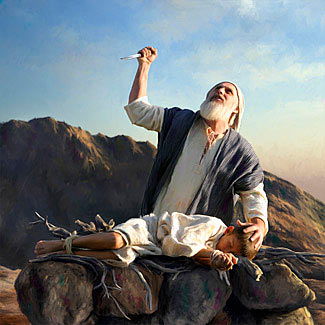 He struck the rock, and behold, the knife sliced through it as if it were made of butter. Abraham decided there was nothing wrong with the blade, and attempted the sacrifice a second time. Again the same thing happened.
  Both father and son were overwhelmed with gratitude. Crying, they embraced each other, and gave thanks to the Lord. While they were thus occupied, the ram ran off in the direction of Mina, where they were finally able to corner it and accomplish the sacrifice.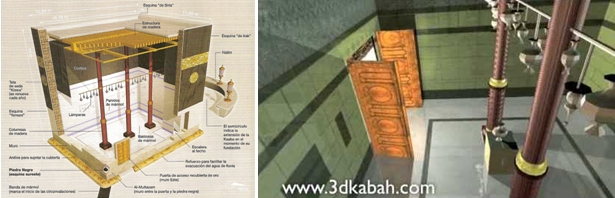
What's inside the Kaaba? An enigma for generations of Moslems, this is no longer unknown. In pagan times, it housed a number of idols. The Prophet of God threw them all out in 630 AD. Today, there are three pillars that support the roof inside the Kaaba, a stairwell that leads up to the flat roof, and a few Arabic-script prayers on the inside walls. An animation can be found here. A real-life, though low-resolution, video is here. Prostration toward the Kaaba is actually prostration to God, not to this stone structure that houses practically nothing inside.
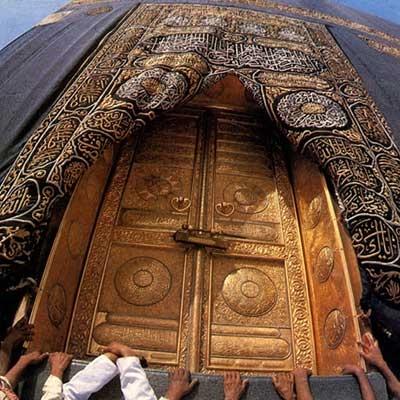
The Door of Hope ("Only those who lack faith despair of God's mercy"—12:87).
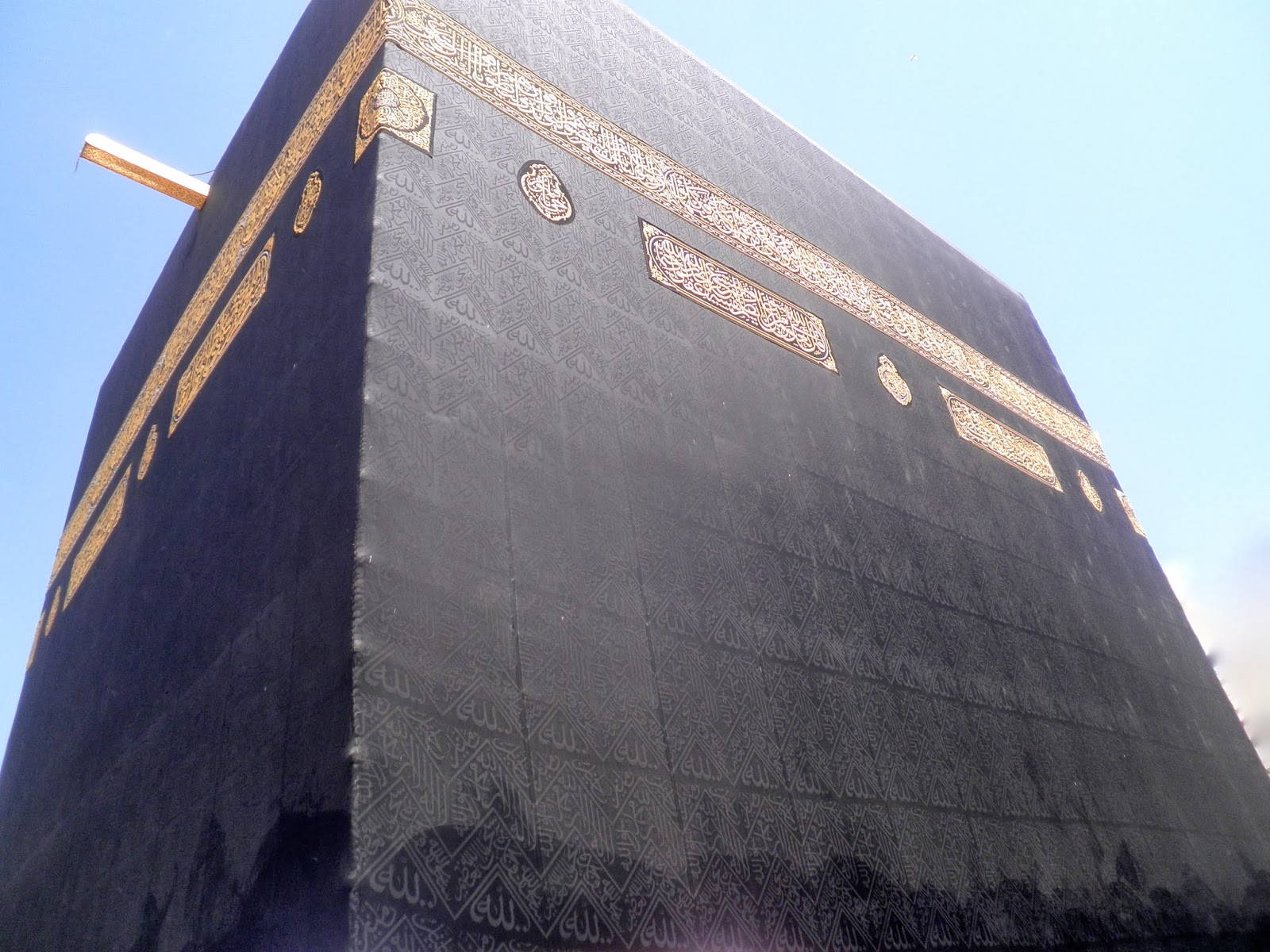
The Kaaba, up close and personal. (The pipe at top left is for draining rainwater from the roof.)
You raise your eyes, and there it is—the Kaaba in all its dazzling radiance, draped in black if it is the time of the Lesser Pilgrimage (practically all the year round), in white if it is time for the Great Pilgrimage. The courtyard is paved with white marble, so clean you can walk on it barefoot. You may sense an invisible vortex of energy extending about halfway up the Kaaba.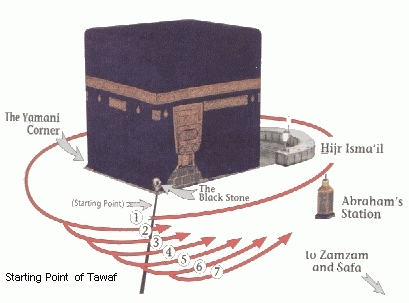
The seven circumambulations (tawaf) around the Kaaba.
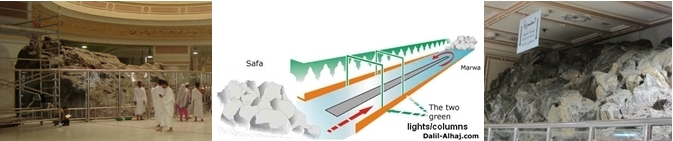
The hills of Safa (left) and Marwa (right), between which the Pilgrims walk or run seven times (or 3.5 full circuits), emerging from Marwa at the end.
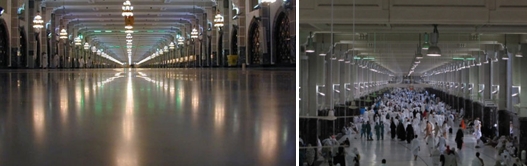
The Corridor of Labor (Ar. say) that connects the two hills.
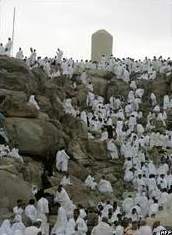
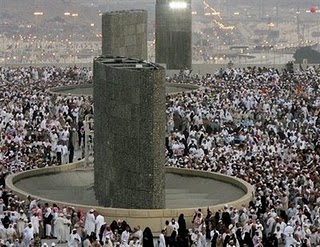
The three stone pillars (jamras) representing the devil.

UPDATE APR 5, 2020
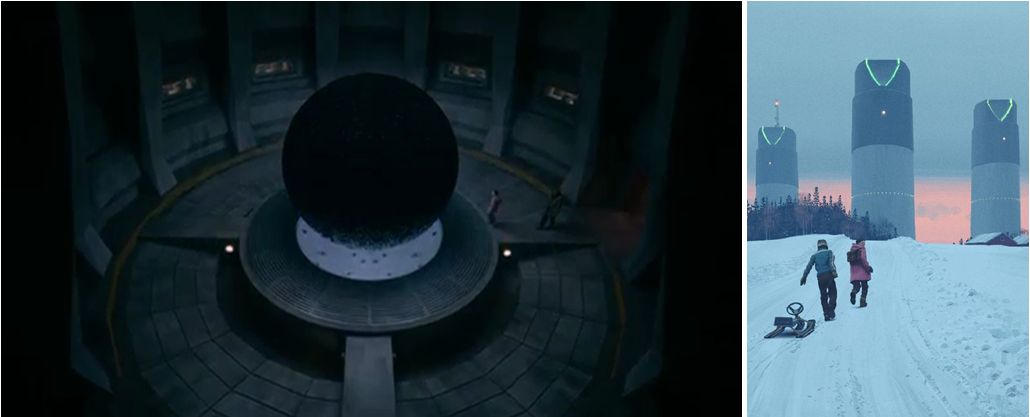
A spherical version of the Kaaba is featured as a mysterious object called “the Eclipse” at the center of a ring particle accelerator in the sci-fi series
Tales From the Loop (S01E01). Outside, the three cooling towers are highly suggestive of the three jamras (right).
[1] Robert Scholes & Eric S. Rabkin, Science Fiction: History-Science-Vision (New York: Oxford University Press, 1977), pp. 165-69, 220.
[2] Time, 3.17.1997, p. 82.
[3] C. G. Jung, Man and his Symbols (New York: Doubleday, 1964), as well as Jung's other writings.
[4] Mircea Eliade, The Forge and the Crucible (New York: Harper Torchbooks, 1971) [1956], p. 43.
[5] Alan Watts, Myth and Ritual in Christianity (London: Thames & Hudson, 1983) [1954], p. 244.
[6] Kathleen Freeman (ed.), Ancilla to the Pre-Socratic Philosophers (Oxford, 1948).
[7] See the Richard Wilhelm translation of the I Ching, K'un, "the Receptive."
[8]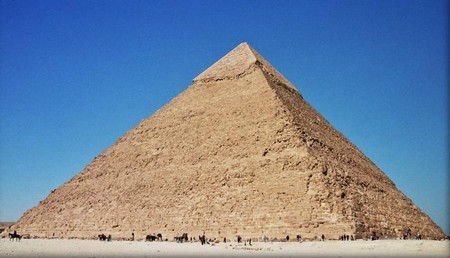 An alternative structure to the hemispherical dome is the four-sided pyramid with a square base, the shape of the Egyptian pyramids, which is another form of the Cosmic Mountain (see below). The pyramid is, in fact, the alchemists' diagonally divided square expanded into three dimensions—the four corners representing the four elements of creation, with the quintessence, the Source, at the apex. This is mentioned because "The Sentinel," on which 2001 was based, involved a pyramid instead of the Monolith. Many temples and buildings involve such a pyramid resting on a cube.
[9]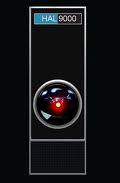 Another interesting correlation is that the renegade computer bent on killing the astronauts was named HAL, which means (spiritual) “state” in Sufism and is related to the meaning “to turn off.” This means that a “state” can be experienced only when the Base Self, together with its egotistical drives, computational thinking, and mechanistic cogitation, is turned off, recalling the Zen doctrine of “no-mind” and requiring a leap of faith. (The reason is that all mentation is based on an implcit assumption of multiplicity, whereas one has to go beyond all mutiplicity and all dualities in order to experience pristine Unity). If the spaceship in 2001 is taken to represent the ecology of the personality, the dismantling of the AI (Artificial Intelligence) machine by Bowman symbolizes the Spirit’s conquest of the Base Self; it is only afterwards that the Spirit can embark on the Great Journey. Clarke could not have conjured an apter metaphor if he had consciously planned to do so, which of course he did not.
[10] Joseph Campbell, Myths to Live By (New York: Bantam, 1972), p. 98.
[11] Mircea Eliade, The Sacred and the Profane (New York: Harcourt, Brace & World, 1959, tr. Willard Trask) [1957], p. 95. (All further quotations from Eliade in this article are from this source.)
[12] Ibid.
[13] Gershom Scholem, Kabbalah (New York: Dorset Press, 1987) [1974], pp. 129-30.
[14] Hajj: A spiritual journey involving struggle.