
Father: Francesco Tornabuoni
Mother: Selvaggia Alessandrini
Husband: Piero I de' Medici
Married: 1444
Age: 19
Children: Maria (1445-1470), Lorenzo, Bianca (1446-1488),
Lucrezia (Nannina) (1450-1493), Giuliano (1453-1478)
Died: 1482
Age: 57
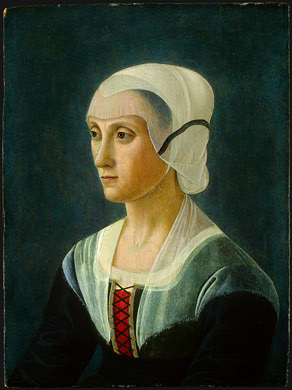
Over the next ten years, Tornabuoni bore six children, four of who survived to adulthood; she also raised an older illegitimate daughter of Piero. The couple and their children lived with Piero's parents, his brother and sister-in-law, and over 50 retainers, at the Medici palace in Florence or at one of the outlying villas. Except for a few years in the mid-1450s when the Medici were out of power, their influence only increased as the years went by. Despite his own ill-health, Piero was at Cosimo's side or traveling as his representative, while Tornabuoni and her children lived quietly.
In 1464, Cosimo died, and since Piero's more active younger brother had died the previous year, it fell to Piero to maintain the family fortune and political position. Since illness often kept him at home, those who sought his support came to the Medici palace; soon it, rather than the government offices, became the seat of power. Scholars and artists came as well: like his father, Piero supported vernacular literature and the work of local artists. As a result of all this activity at her home, Tornabuoni began to play a role closer to that of the duchesses of the princely Italian states than to that of the wife of a republican merchant-banker. Favor-seekers asked for her intercession with Piero; vernacular poets read her their work and exchanged sonnets with her. It may have been at this period that she began to take her own writing seriously.
After five years, Piero died, and their elder son Lorenzo became, at 20, the head of the family---and of Florence. Before his death Piero had assigned to his wife the right to distribute as charity the income from some of the Medici properties, an unusual role for a non-royal woman. With this and with her influence over the young Lorenzo, Tornabuoni became a powerful person. She also became involved in business, investing her own capital in real estate projects and financing small traders and artisans. Her profit went in large measure to charity, most frequently to help the powerless---nuns in poor convents, girls in need of a marriage dowry, the lower ranks of the clergy. Such gifts had the effect of expanding the Medici's political base, but there is no evidence that they were made cynically; Tornabuoni's letters indicate that she truly believed that what was good for the Medici was good for Florence and her territories.
In 1478, Florentine opponents of the Medici tried to murder both of Tornabuoni's sons; her younger son was killed, but Lorenzo escaped. In the battles that followed and the plague that followed the battles, Tornabuoni stayed in Florence by Lorenzo's side. She died nearby in 1482.
http://www.tl.infi.net/~ddisse/tornabuo.html