
Father: Cosimo III
Mother: Marguerite-Louise of Orleans
Grand Duke: 1723-1737
Age: 52
Wife: Anna Maria Franziska of Saxe-Lauenburg (1697)
Children: No
Died: 1737
Age: 66
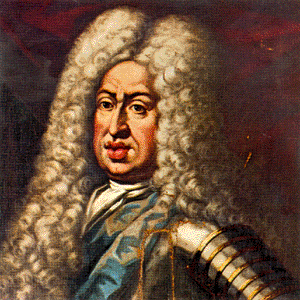
Before their marriage, 16-year-old Margu�rite Louise had fallen in love with her cousin Charles of Lorraine (1643-1690) and possibly took him as her lover 1. Cosimo III, however, was averse to physical contact and feared that "sexual activity would undermine his health". Sophia of Hanover reported: "He sleeps with his wife but once a week, and then under supervision of a doctor." Margu�rite Louise repeatedly refused to share her bed with her grave husband for months and around 1665 she was temporarily exiled from court. During her pregnancies she unsuccessfully tried to induce a miscarriage and while she was pregnant of her third child, Gian Gastone, Margu�rite Louise even tried to starve herself. Four years after Gian Gastone's birth she left for France, never to return. There she lived on a pension supplied by her husband.
As a child Gian Gastone was neglected by both his parents, while his elder siblings ignored him, too. He grew up as a studious and solitary youth. For months he could be dreary and listless, alternated by short periods of cheerfulness and ironic witticisms. Contemporaries noted that he often seemed taciturn and sad, weeping alone in his chamber. Some wondered whether he was wholly sane, but Gian Gastone was actually quite smart. He received the same education as his elder brother, Ferdinando (1663-1713), and appeared to be good at languages and literature in particular. He was also interested in botany and experimented with rare spacies of herbs. His father appointed him as governor of the university of Pisa.
In 1697 Cosimo III wanted Gian Gastone to marry Anna Maria of Saxe-Lauenburg (1672-1741, to the right), a wealthy widow2 with a daughter. She is described as "appalling and immensely fat" with "ungainly massive limbs". Her main interests were hunting and horses. She had no particular wish to remarry and had no intention of leaving her Bohemian estates. The homosexual Gian Gastone meekly obeyed his fathers wishes, but soon his reaction to married life was one of horror. He took an immediate dislike to Bohemia, to the smell of horses and to possible intercourse with his wife. Like his mother had found his father unbearable, Gian Gastone found his wife unbearable and complained about her "capriciousness, peevish faces and sharp words". Anna Maria probably looked upon Gian Gastone as an effeminate weakling. She ordered him about and claimed that he was impotent. Nevertheless, she tried to loose some weight to improve the chance of conception.
For comfort Gian Gastone turned not only to liquor and gambling, but also to his lackey Guiliano Dami, a man of humble birth. He would exert great influence over Gian Gastone for the remainder of his life. After ten months Gian Gastone could bear his wife no longer and hired a residence in Prague. He travelled to France to see his mother, who received him coldly, and visited his sister3. Back in Prague, Guiliano Dami introduced him to pretty young students, lackeys and footmen. Gian Gastone wandered the streets at night and visited taverns, drinking fiery liquor and rossolis. Through such frivolities he could temporarily put out of his mind his repellent wife and his austere father. Alcoholism, gambling and sex were doubtful cures for his depression. From time to time Gian Gastone returned to his wife, pressed by his father to beget an heir. His wife busied herself rebuilding Ploskovice Castle, adding artificial grottos with baroque fountains.
In 1704 Gian Gastone seemed utterly depressed, inert and withdrawn, spending most of his time simply gazing out of the window. He would not even sign his letters. By 1705 he was back in Italy permanently and there no longer seemed any possibility of a Medici heir being born to him.
Even in Florence Gian Gastone was seldom seen in public during the daylight hours. Occasionally, he did things that made people believe him to be mad. One day, for example, he bought the entire stock of a peasant selling brooms and ordered them to be delivered to the municipal offices "for future use". The eccentric, but witty Gian Gastone probably thought that it would be a good thing to clean-up the corrupt city administration.
In 1713 Gian Gastone's popular elder brother, Ferdinando, died lame and insane as a result of syphilis. The egocentric Margu�rite Louise died in 1721, leaving all her property to a distant relative instead of to her children. When the gloomy Cosimo III died two years later, Gian Gastone succeeded him as Grand Duke of Tuscany. He had little interest in governmental matters, but he chose his ministers well and soon Florence flourished again.
As a result of his curious and unusual lifestyle, Gian Gastone was a prematurely aged, fat drunkard, who looked at the world through a more or less permanent haze of intoxication. Once he went to a reception given by his brother's widow, Violante of Bavaria (1673-1731), and became so drunk that he uttered all kinds of obscenities and was pushed vomiting into his coach, wiping his mouth with his wig. In contrast to his father's religious fanatism, Gian Gastone's contempt for the Church became notorious.
Guiliano Dami acted as a pimp for Gian Gastone's orgies, seeking out young men and boys. They were called the 'ruspanti', because they were paid a fee from one to five ruspi for their services. In the last years of his life Gian Gastone had around 370 ruspanti, some well born, some women. To endure the dubious embraces of their master they had to be pretty, young, strongly sexed, sufficiently immune to good taste and blessed with a limited sense of smell. It was Gian Gastone's habit to invite the chosen youth to his bed-chamber, examine his teeth, provide him with drink and examine and touch his private parts to see if they were well shaped and likely to blossom rapidly. Then the boy was initiated and if he did not seem to penetrate sufficiently, Gian Gastone used to shout: "Press in, boy, press in." Thereafter he would call him 'you', and finally descend to the familiarity of 'thou', while hugging and kissing him. Somethimes he would order his ruspanti to adopt pompous attitudes and call them by the well-known names of grave counsellors and revered matrons. Then he would exclaim to one of them: "Well, my Lord Marquess, how does the Marchioness yonder appeal to you? You admire her, do you not? To business! Tumble her!" The addressed youths merrily yielded to his wishes and Gian Gastone, between roars of laughter, liked to encourage them loudly with the cries of a huntsman.
In 1730 Gian Gastone sprained his ankle and took to his bed and from then on he left it only on some very rare occasions. His bed became the centre of his existence. He lunched in bed around 5 o'clock in the evening and had supper in it around 2 in the morning. The dogs slept with him in bed and it stank of tobacco, drink, vomit and excrement. From time to time his brother's widow organised the cleaning of his bed until she died in 1731. In his later years Gian Gastone became nearly blind and could hardly walk anymore. He let his fingernails, toenails and beard grow. Gradually he became senile. In June 1737 he became seriously ill, suffering from a large stone in the bladder. He died within a month.
Copyright � 1997, 2000, 2001 by J.N.W. Bos. All rights reserved
http://www.xs4all.nl/~kvenjb/madmonarchs/giangastone/giangastone_bio.htm