
On 10th of August 1566, the iconoclasm in the Netherlands breaks out, this was the beginning to the civil and religious war of the Protestants against Spanish troops of Philip II and the Duke of Alva.
Two days afterwards, on 12th of August, Elisabeth gave birth to a daughter, Isabella Clara Eugenia, in Segovia. Her first name is an ode to Philip�s important great-grandmother, Isabella of Castile; Clara was given since she was born on the feast-day of Saint Clara.
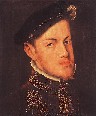
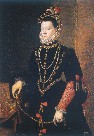
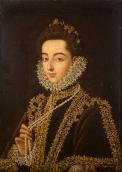
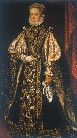
In July of that same year, the successor Don Carlos, son of Philip by his first wife, Manuela of Portugal, had died too. Isabella and Catalina were therefore the only successors left.
In 1571, Anna of Austria, daughter of Maximilian II of Austria and Mary of Spain, married her uncle Philip. In her travel-company, there are her brothers Albrecht and Wenzel.
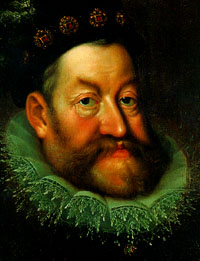
In April of 1578, a new prince was born: Philip. His father made new plans for marriages of the little prince�s two sisters. He had found a new candidate for Isabella: the 24-year-old king of Portugal, Sebastian. But In August, the young king disappeared in the battle of Alcazar-el-Kebir (Morocco).
In 1580 Philip of Spain also became Philip of Portugal. His visit to his new empire, however, was postponed by the death of Queen Anna.
In 1581 the Protestant Rebellions called out their independence as the Republic of the United Provinces. The most important leader of the Republic is William of Oranje-Nassau. In 1584 he was murdered and his son Maurits followed as stadtholder and commander-in-chief of the army.
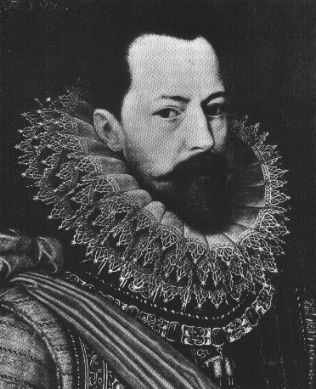
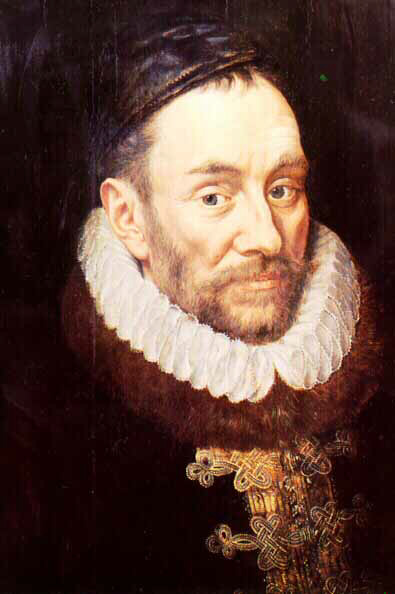
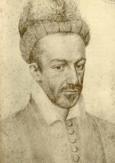
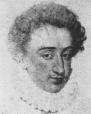
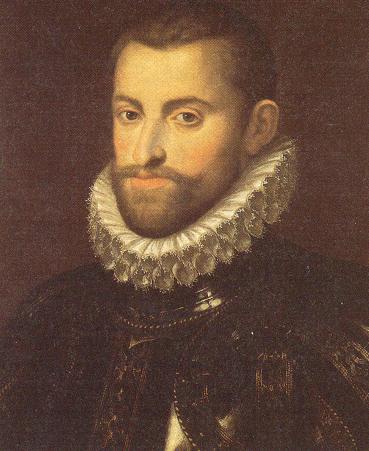
Philip was now also involved in the French religious war, he wanted to prevent by any means necessary that the Protestant successor, Henri of Navarra, shall not claim the throne. Therefore, he claimed Isabella as a contender to the throne because of her mother Elisabeth, who was a sister of Henri III. But he failed. Philip promised the new governor of (Southern) Netherlands, archduke Ernst of Austria, the hand of his daughter Isabella, with plans made to eventually crown them king and queen of France. But again, his plan failed. In 1593 Henri of Navarra, now Henri IV of France, converted to Catholicism. In 1595 he officially declared war on Spain. After the death of archduke Ernst, Philip had to change his plans. Ernst�s brother, archduke Albrecht, archbishop of Toledo, is now named the new regent of The Netherlands. Immediately he started to claim back the lands Spain lost during the war with the Protestants. Albrecht was successful. But, the campaign had to be stopped: Spain was officially bankrupt for the third time of Philip�s reign.
In 1597, Philip engaged Albrecht with his only surviving daughter Isabella, with the Netherlands as her dowry. In the following year, Spain and France signed a peace-treaty, which also gave a full detailed accordance for the marriage of Isabella. She had to marry her cousin Albrecht, had to stay loyal to the catholic faith and had to follow the regime of Spain. The Netherlands was now officially in the hands of the Archdukes Albrecht and Isabella. Philip�s plan was to start a new monarchy in the Netherlands.
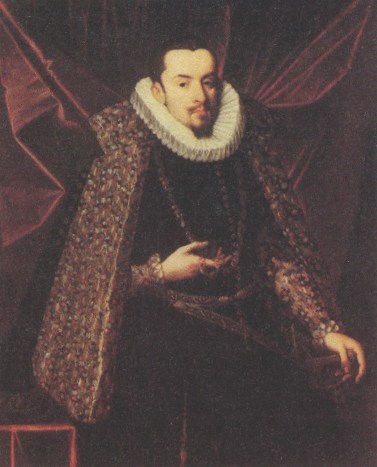
Albrecht married, by proxy, the Infata Isabella on 15th of November in Ferrara. At the same ceremony, his cousin Margaret married Philip III by proxy. In 1599 the marriage was officially consecrated in Valencia. After a long journey via Genua, Milan, Zurich, Colmar and Nancy, the archdukes set foot on the Netherlands on 20th August, in Thionville. On 5th September they entered into Brussels, the capitol of the Southern Netherlands.
The reign of the archdukes didn�t go smoothly, for there were still struggles and battles with the Northern Netherlands. Maurits sets foot on Flanders and took in the coastline.
In Brussels, however, people were more concerned about the infertility of the archdukes. Albrecht and Isabella made a pilgrimage every Sunday to Our-Lady of Laken.
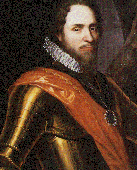
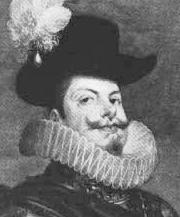
In 1605 officials reported that Isabella was pregnant, but had a miscarriage.
In 1609, the Republic of the Northern Netherlands, the Archdukes and Spain signed a peace treaty for twelve years. This was an unofficial acknowledgement of the North as independent and both Netherlands could start rebuilding again. Especially since the South had suffered a lot from the war. Gratefully, the archdukes built a new prestigious church on the place of pilgrimage of the Holy Virgin Mary, in Scherpenheuvel. But still, things didn�t go the way the archdukes wanted.
After the death of the chancellor, Spain interfered more in the politics of the archdukes. When the archdukes grant asylum to the prince of Cond� and his wife, France made plans of attack on the Southern Netherlands. But in 1610, Henri IV was murdered in the streets of Paris. The regent-mother of the new king Louis XIII, Maria de�s Medici, wanted to have the best contacts with the archdukes and Spain, for she was also a Habsburgian on her mother�s side. In 1611, she engaged her son to the Spanish princess Anna, and her daughter Elisabeth was to marry the Spanish successor Philip (IV).
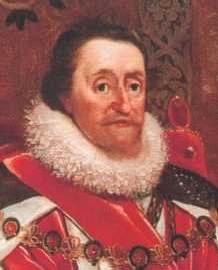
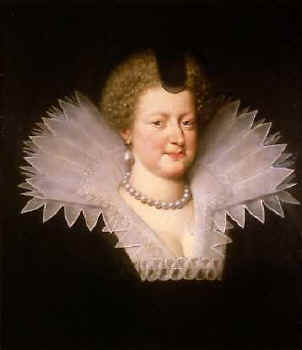
Medici
In 1616, the archdukes have had no hope on the birth of a child anymore, so they made the leaders of the most important parts of their land to swear an oath to the king of Spain as their future ruler. That way, they hoped to avoid crisis after their deaths.
On 31 march 1621 Philip III of Spain dies. With him, the peace politics die too. His son, Philip IV, preferred military options. The Treaty of Twelve Years reached its end. Despite efforts of the archdukes to renew it, war went on once again.
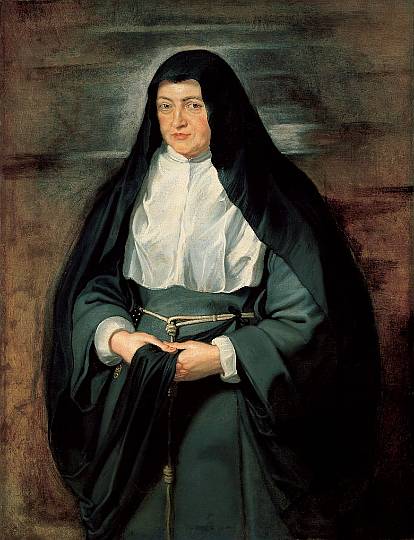
On 13th of July of the same year, Albrecht died in Brussels, aged 61. Isabella lost her title of ruling sovereign. She wanted to withdraw in the cloister of Descalzas Reales, after taking the habit of the Third Order of Saint Francis. But on request of her nephew Philip, she stayed governess of the Southern Netherlands, until her death in 1633.