
Franche Comt�, in northern Cisjurane Burgundy, was part of the territory ruled by Lothair I. It passed to the Holy Roman Empire in 1033, but control was thereafter contested by other European powers. From 1295 to 1477 the region was influenced by France; after 1477 it passed to the Spanish line of the Habsburg family, and in 1678 it was permanently joined to France.
The duchy of Burgundy was a part of the first kingdom of Burgundy and was a possession of France after 1015. Until 1361 it was ruled by the house of Capet, and after 1363 by Philip the Bold of France and his successors, the dukes of Burgundy. The duchy was expanded to the English Channel and included several provinces in the Low Countries. By the middle of the 15th century the duchy dominated French affairs. The antagonism between the dukes of Burgundy and the kings of France reached a climax in 1465, when Charles the Bold, the last duke, attempted to restore the kingdom of Burgundy. The struggle ended in 1477 during a battle near Nancy in which Charles was killed. A dispute over possession of the ducal territories developed subsequently, and a large portion of the territory known as the Circle of Burgundy became part of the Holy Roman Empire. The rest of the duchy was a province of France from 1678 until the French Revolution (1789). Subsequently the province was divided into the departments of Ain, C�te-d'Or, Sa�ne-et-Loire, and part of Yonne. The region is well known for its Burgundy wines.
"Burgundy," Microsoft (R) Encarta. Copyright (c) 1994 Microsoft Corporation. Copyright (c) 1994 Funk & Wagnall's Corporation.
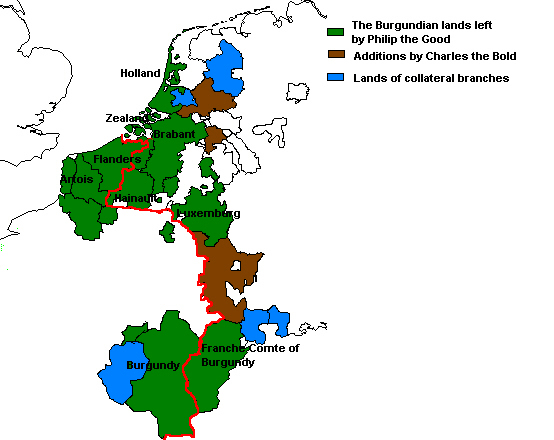
http://home.wanadoo.nl/gerard.vonhebel/burgundy.htm