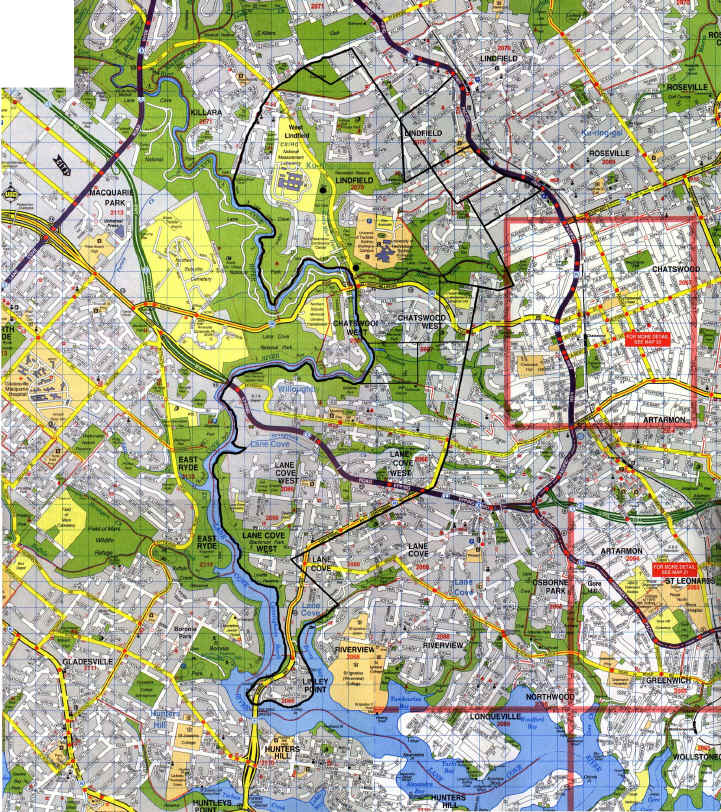






William Henry
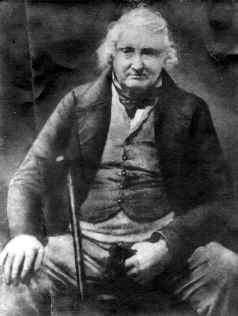 William
Henry led a colourful life on both sides of the law before and after he and Jane
Carr arrived in Australia as convicts in 1801. For his services to the colony
Governor William Bligh granted William 1,000 acres in Lane Cove. After Bligh was
ousted by rebels William spent the next 35 years trying unsuccessfully to prove
his claim. Part of his original grant is now included in Lane Cove National
Park.
William
Henry led a colourful life on both sides of the law before and after he and Jane
Carr arrived in Australia as convicts in 1801. For his services to the colony
Governor William Bligh granted William 1,000 acres in Lane Cove. After Bligh was
ousted by rebels William spent the next 35 years trying unsuccessfully to prove
his claim. Part of his original grant is now included in Lane Cove National
Park.
William Henry Quick Facts
 |
Served as a Royal Marine against Napoleon. |
|
Sentenced to 7 years transportation in 1801 for stealing goods worth 12 pounds. |
|
Rose to become superintendent under Governor William Bligh. |
|
Granted 1,000 acres at Lane Cove by Bligh in 1806 |
|
Remained loyal to Bligh during Rum Rebellion when Bligh was unlawfully arrested by John McArthur's rebels. |
|
Occupied a total of 2,000 acres of Lane Cove from approx 1820 (view the map) until forcibly ejected in 1850. |
|
Land grant disputed for 35 years until Henry Parkes inquiry of 1860 recommended liberal compensation for wrongful dispossession of his 1,000 acre grant. |
|
Died at age 85 before compensation made |
|
Credited with building Burns Bay Rd |
|
Part of descendants' house survives in Lane Cove Park on Jenkins Hill |
Named in his memory:
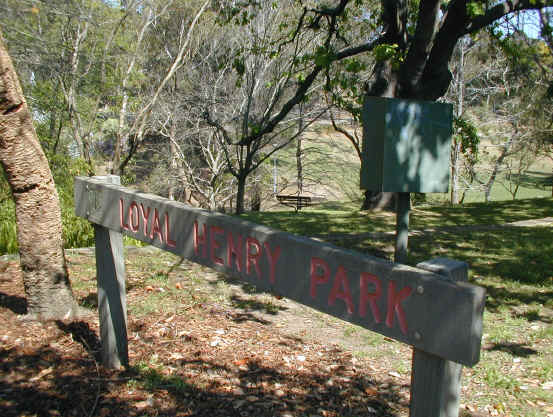 Loyal Henry Park, Roseville
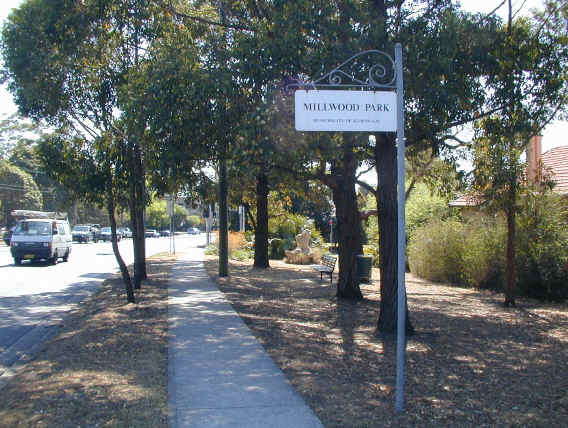 Millwood Park, Roseville
Millwood Road, Chatswood
(possibly) William Henry St, Ultimo

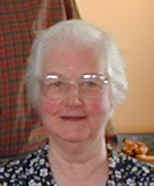 Below: Edited version of A Respected Colonist (1987) by Sister Claudia
Doyle contributed as an introduction for the book William Henry's 40 Acres by David Richards (2000)
Below: Edited version of A Respected Colonist (1987) by Sister Claudia
Doyle contributed as an introduction for the book William Henry's 40 Acres by David Richards (2000)
Early Life in England
In September 1796, 18 year-old labourer William Henry enlisted in the Marines at Plymouth, Devon. He claimed to be from Enniskillen, Northern Ireland, but was entered as a native of Lynn, Norfolk. He had sandy hair, hazel eyes and a freckled complexion and was tall for his time at 5 feet 9 inches.
In October he joined the Duke with a detachment of marines. He was issued with slops - ready made clothing, a bed and tobacco - to a value of L2.10.1 1/2p. A week after
joining the Duke, Henry was charged with drunkenness and neglect of duty and given 24 lashes.
Later, he joined the Flora, which sailed for the Mediterranean to assist in the war against France. The Flora engaged in her first action in May 1798 near the Ionian Islands.
Henry recalled this fight where he was 'one of 83 volunteers who cut out the national brig Le Moudoir of 16 guns, from under a battery of 17 pieces of heavy ordinance in four open boats commanded by James Russell, first Lieutenant of HMS Flora'.
When he returned to England he was admitted to hospital at Deptford, Kent with fever. Once recovered, he quartered with with an S Thomas at Deptford. It appears that on 7 March 1800, William Henry entered the dwelling house of William Farley, in the Parish of St Paul and 'with force and arms feloniously did steal, take and carry
away money and property to the value of L12.16s.8p.' For this crime Henry was sentenced to seven years transportation beyond the seas on 10 March at Maidstone, Kent.
Life Beyond The Seas
Henry was sent to the hulk Stanislaus and was employed on government works for a penny a day. After 3 months in the hulk he was selected with others to go to New South Wales
aboard the Earl Cornwallis. Jane Carr was among the female convicts selected. She had been apprehended at Kingston-on-Hull in the East Riding of Yorkshire for stealing a large quantity of merchandise from Thomas and Charles Espener, who had employed her as their housekeeper. She admitted her guilt at York
Castle and on 8 March 1800 was found guilty of Grand Larceny within the benefit of the Statutes and sentenced to be transported for seven years. The Earl Cornwallis anchored in Sydney Cove on 12 June 1801. William Henry and Jane Carr's son James was born in 1802.
Henry was assigned to William Ramsay from the First Fleet who had a grant in the Dundas area. On 20 November 1803 the Sydney Gazette reported that 'William Henry, a prisoner taken off stores by J Ramsay, was brought before the bench and stood charged with having deviated from his duty as a government servant, in such cases presented, having been in the habit of absenting himself from the farm and employing himself on his account'. He was ordered to be returned to government labour.
On 25 November 1804, it was reported that he had been committed to gaol charge with riotous and disorderly conduct and with keeping a house for the reception and entertainment of persons of bad character. As he was still a prisoner and his sentence did not expire until 1807, he was ordered to hard labour at Castle Hill.
After his release from Castle Hill, Henry was set to go on another voyage, this time with sealers. In April 1805 the Governor Hunter, owned by Australia's first postmaster Isacc Nicholls, sailed for Tasmania. The sealing gang was left at Oyster Bay on Maria Island, but their provision ran out and they sailed to Hobart on 30 October expecting a schooner to come with supplies. As no food was available, the sealers returned to Sydney. There was no mention of any women in the group, but according to her
death certificate, Maria, the eldest daughter of Henry and Jane Carr, was born in Hobart in October 1805.
Loyalty to Governor Bligh
At some period in 1806, William Henry came to the attention of Governor Bligh. Henry admired Bligh, especially for his concern regarding the Hawkesbury settlers after the severe floods of 1806. William states that Bligh granted him 1000 acres as well as offering him government employment to act under Devine (who was superintendent of convicts) as principle overseer of public works. Henry took immediate possession of the land on the north side of Lane Cove
River along Blue Gum Creek. In the muster of 1806, he is listed as having a ticket of leave and being self-employed. Jane Carr also had a ticket of leave and was living with him and their two children.
Early in 1806, Henry continued his seagoing life. In February he sailed to King's Town, Tasmania aboard the Contest, a sloop of 44 tons. In September he boarded the Sophia to Port Dalrymple and by October he was part of a crew going to Otaheite, again on the Contest.
Meanwhile Bligh had incurred the wrath of those who had held offices and preferrments under the previous Governor, Philip King, by replacing them with
his own men. On 26 January 1808, Major Johnston arrested Bligh and placed him under house arrest at Government House. At the Select Committee of Grievances on 1 March 1860, Henry was questioned by John
Dunmore Lang as to his whereabouts on that day. He replied 'I was over at the North Shore, giving directions to my men, and just at sundown I looked up over to Government House and saw the dirty, ragged regiment all drawn up. I went over to see what it was all about, and found that Major Johnston had seized the Governor.' He went on to say that after Bligh's arrest, 'Major Johnston sent for me and wanted me to sign the requisition to put Governor Bligh under arrest. I said that Governor Bligh was arrested already and how could I sign to put him under
arrest?' Henry was offered strong inducements to sign. 'He (Johnston) told me that any station in the government I was capable of filling he would give me, or lands or cattle, or anything else I proposed. He said that I was a young man, and that I had a rising family, and that I had better take his offer, for that Governor Bligh would not be able to do anything for me.' Henry was given 14 days in which to consider these offers, but his mind was made up. When he refused an offer that was ten times greater than the previous one he was told that his services were no longer required.
Henry communicated with Bligh while he was detained on the Porpoise. 'I went to him and at his request, held communication for him with the officers of the civil service on shore, though at the hazard of my life. I used to lay out in Cockle Bay pretending to be fishing, and the constables used to come down and watch me over the rocks to see if I was pulling in fish or not, when they were satisfied and went away, I used to deliver my despatches. I used to have the despatches hidden in my boots in case of being overhauled, but I always went well prepared and woe to the man who ventured to interfere with me'.
Bligh was removed to the Derwent in March 1809 and remained there until Governor Macquarie arrived late in 1809. Sometime prior to Macquaries's arrival Henry was asked to undertake a
secret journey to the Derwent. The rebel government however, were suspicious and the acting Judge Advocate tried to press Henry into divulging any plans made to restore Bligh to office. Henry refused to do this, even though he was promised a reward. His retribution was swift. On 4 April 1809, he was brought before the Bench of Magistrates and ordered to the Coal River for six months.
Henry was to suffer dearly for his loyalty to Bligh - his house was ransacked, he was put in irons torn from his wife and infant family, dragged through the streets, forcibly put on board a miserable river craft and transported to Newcastle under the care of Lieutenant Lawson. At Newcastle he refused to work for a government of rebels and received 100 lashes.
Captain and Trader
By November 1809, Henry was back in the colony and signed on the Halcyon, a schooner owned by Garnham Blaxcell, sailing to Otaheite for pork. The following year, he and Jane had their last child, named Jane. In January 1810, Governor Macquarie released William Henry, and Jane Carr was
granted her Certificate of Freedom in March 1811. William bought a 44 ton sloop called the Whale, and engaged in grain and spirit trade on the Hawkesbury River.
In October 1811, the Whale reached Portland Reach and anchored near the farm of the Dunn family. He traded some spirits to be paid in pigs and coins at the rate of 15 shillings a bottle. When the boat left Portland Reach, a young girl called Nancy Dunn was on board. Her mother and a neighbour followed the boat on shore and William sent his nine
year old son James over to row Mrs Dunn to the sloop. Nancy remained on board after her mother left. She returned home soon after, but Mrs Dunn had already been to Sydney and made a deposition before Darcy Wentworth. For this misdemeanour, Henry was committed to trial before the next sitting of the criminal court. No record of this trial has been found. The Whale was advertised to be auctioned in
November 1811.
The year 1812 contains no mention of any events in the life of William Henry and Jane Carr and it is possible he was serving a sentence for the abduction of
Nancy Dunn. In May 1813 Henry sailed on the James Hay to the Pearl Islands and Otaheiti. His son, James
Henry, was one of the crew.
A respected Colonist
After this voyage it would seem that Henry finally decided to become a settler. In October 1813 he applied to Governor Macquarie for a further grant of 40 acres which was approved. It adjoined his 1000 acre grant from Governor Bligh where the family home Millwood was built at the junction of Blue Gum Creek and the Lane Cover River. The flats were cultivated and an orchard planted. In 1828 Henry was able to lease a further 1000 acres with a rental of 2s.6p per 100 acres.
His land now stretched from Fiddens Wharf Rd to Fig Tree Bridge.
In 1817 William placed an advertisement in the Sydney Gazette:
Caution: All persons are hereby prohibited from Trespassing on the FARM and LANDS of William Henry situate in the district of Lane Cove nearest the vicinity of Sydney; being bounded on one side by an inlet called the Blue Gum Creek, being within Lane Cove, and all suspicious Boats found thereat, supposed for the purpose of taking away wood, or any other illegal Purpose, will be detained and seized, under penalty of seizure and rigid prosecution.
From 1826 Henry supplied warships with billet wood (burning wood). The ships' boats would come to shore at the deep water wharf at Burns Bay to collect the wood. William Henry is credited with building the present Burns Bay Road.
In December 1828, Henry sold his 40 acre grant to Timothy Goodwin Pittmen for L100. His reason was that 'the grant was not enough to maintain me and my family and I parted with it. I sold it and laid out the money I got for in improving the other land that I claimed'.
In 1831 Robert Ball applied for 100 acres - part of the 1000 acres Henry was leasing - as a grant. When Henry objected, he was told he should have vacated the land by 31 July 1829, though no effort seems to have been made then to get him to leave. Henry then began a lengthy correspondence to successive Governors attempting to have his claim recognised and receive title for the land. He remained at Millwood Farm and in 1841 appealed to Thurston, one time secretary to Macquarie, to attest to
his claim that Macquarie told Meehan to survey the 1000 acres. This Thurston did. A similar appeal was met by William Gore, and another from Maurice O'Connell, Bligh's grandson, and shows Henry's determination to gain his right to the land. Jane Carr died in 1849 and in the Sydney Directory of 1851, William and James Henry are described as gardeners of Lane Cove.
None of Henry's efforts prevailed in the end, however, and he was turned out of Millwood Farm on 5 September 1851. Mr Benn, the Government surveyor, who
accompanied Simeon Pearce, the Commissioner of the Crown Lands on that day, has left this description of the property. 'Defendant has a comfortable cottage and orchard; defendant's son has a cottage on the same ground; defendant resides about half a mile from him; there are huts near his son's residence; there are fruit trees near the son's orchard; defendant's orchard attached to his house might be two acres; he land between
defendant's house and his son's has been cultivated in part; defendant's son has what appears to be an orchard with
full grown trees; saw Henry's orchard about 12 years ago' he land is fenced in part; knew defendant resided there upwards of 20 years ago; never heard he was turned out of possession of this land from that period to the present time'.
Henry said that at the time he was turned out Pearce threw everything he possessed into the open and lastly, pulled down his house. Henry then went to live with his eldest daughter Maria at Lane Cove.
In his petition of 10 February 1860 to the Legislative Assembly of New South Wales, Henry said that he had resided on Millwood Farm for nearly 40 years, reared a large family, cultivated, planted vineyards and
erected houses on the land he was promised half a century ago, and looked upon as his own, under the sanction of the constituted authorities of the Colony. This was followed by a hearing at the Court of Claims. The Chairman of the inquiry, Henry Parkes, said at the conclusion on 3 July 1860, 'Your Committee consider that the fidelity of Henry to the government of the day, in a time of successful rebellion justly entitled him to the grant of land, which he alleges was promised to him; and looking into all the facts, and the reasonable probabilities of the case, they are of the opinion that such promise was made as alleged. They, therefore, think he was unlawfully dispossessed, and is entitled to liberal compensation from the present Government for the injury he sustained'.
Henry, however, did not live to have retribution made. He died on 8 November 1862, aged 85, at Maria's residence in Lane Cove - an old and respected colonist of 62 years. William Henry and Jane Carr are remembered in the area in which they lived by Millwood Park, a small recreation area on the Pacific Hwy, and by the Loyal Henry Park in Roseville, both near his grant from Governor Macquarie. These were designated by the Ku-Ring-Gai Council in their Golden Jubilee year in 1978.
Reference: Edited version from A Respected Colonist (1987) by Sister Claudia Doyle. Above version was contributed by Claudia Doyle to appear as an introduction in the book William Henry's 40 Acres by David Richards (2000)