 |
 |
 |
الصفحة الرئيسية من أنا عيادتى عائلتى أتصل بى وطنى الصور مواقع طبية زملائى الدليل الطبى
According to traditional Chinese medicine,
life is the flow of vital energy through the body in a continuous circuit. 14 Channels, namely Meridians, comprise the circuit
in a human body.
Each is pertaining to specific "internal organs," external body parts and physiological functions;
acupressure points lie along the meridians which control or influence the energy flow. Sudden shock, illness or disease
interferes with the flow of energy...
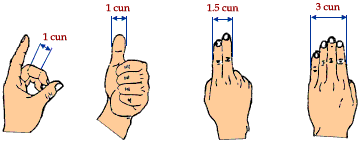
FINGER
MEASUREMENT SYSTEM
This is a method to
locate points by measuring the distance with either the length or width of the
patient's fingers. 1 cun (tsun) = approximately 1.3
inches
Middle finger measurement: When the middle finger is flexed, the distance
between the radial ends of the two interphalangeal creases of the patient's
middle finger is taken as 1 cun.
This measurement system should be used in combination with simple landmarks on the basis of the bone proportional measurement system.
|
|
|
|
|
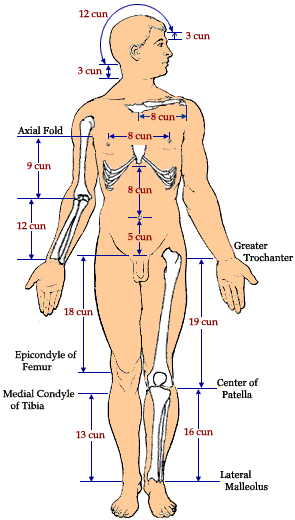
BONE PROPORTIONAL MEASUREMENT
Head
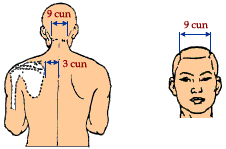
From the midpoint of the anterior hairline to the midpoint of the
posterior hairline = 12 cun
FACE
From the anterior hairline to the mental protuberance = 10 cun
Thorax
From the suprasternal fossa (Tiantu R22) to the midpoint of the
sternoxyphoid symphysis = 9 cun
Upper Abdomen
From the xyphoid process to the umbilicus = 8 cun
Lower Abdomen
From the umbilicus to the the pubic symphysis = 5 cun
Back
From the medial border of the scapula to the posterior midline = 3 cun
Upper Limb
From the anterior end of the axilliary fold to the dorsal crease of the
wrist = 9 cun
Lower Limb
From the pubic symphysis to the medial epicondyle = 18
cun
The Lung Meridian (Yin/Upper
Limb)
Synopsis: Man's
breathing connects the Qi of heaven & earth in order to form the true Qi of
the body.
Course: The Lung Channel originates its
superficial course in the upper part of the chest. It runs distally on the
anterior & lateral aspect of the upper arm & forearm to reach the wrist,
where it lies lateral to the radial pulse. Then it runs near the lateral border
of the palm to end near the lateral edge of the base of the nail of the
thumb.
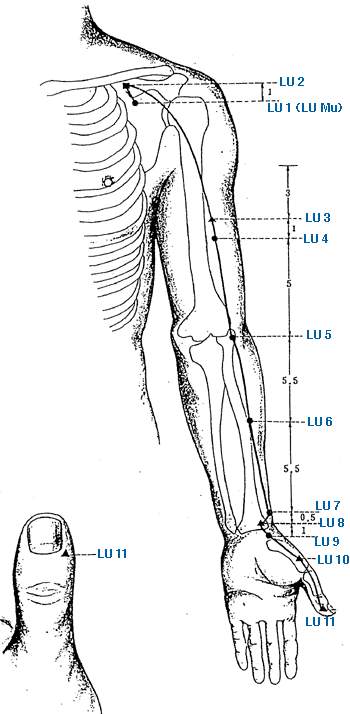
L1: ZHONG FU
Location: On the
lateral aspect of chest, in the interspace of the 1st & 2nd rib, 6 cun
lateral to midline of chest.
Indications: Cough, dyspnea, pumonary
tuberculosis, pain in chest, shoulder & back pain, etc.
L2: YUN MEN
Location: Below the
acromial extremity of the clavical in the depression lateral to the triangle of
the pectoralis, 6 cun lateral to midline of chest.
Indications: Cough,
asthma, fullness of chest, pain in the chest, pain in the shoulder & back,
etc.
L3: TIAN FU
Location: On the
medial aspect of the upper arm, 3 cun below the anterior axillary fold, on the
radial side of the biceps brachii, 6 cun above Chize (L5).
Indications:
Asthma, epistaxis, pain in the medial aspect of upper arm, etc.
L4: XIA BAI
Location: On the
medial aspect of the upper arm, antero-lateral to the humerus, on the radial
side of the the biceps brachii, 1 cun below Tianfu (L3).
Indications: Cough,
shortness of breath, pain in chest, pain in the medial aspect of upper, etc.
L5: CHI ZE
Location: In the
cubital crease, on the radial side of the tendon of the biceps brachii, flex
elbow slightly to locate the point.
Indications: Cough, asthma, hemoptysis,
tonsillitis, pain & swelling of elbow & arm, etc.
L6: KONG ZUI
Location: On the
radial aspect of the forearm, 7 cun above the wrist crease.
Indications:
Cough, asthma, hemoptysis, tonsillitis, pain & motor impairment of elbow
& arm, etc.
L7: LIE
QUE
Location: Above the styloid process of the radius, 1.5 cun above the
transverse crease of the wrist. Or, when the index fingers & thumbs of both
hands are crossed, the point is in the depression right under the tip of the
index finger.
Indications: Headache, stiff neck, cough, asthma, facial
paralysis, etc.
L8: JING
QU
Location: 1 cun above the transverse fold of the wrist, in the medial
aspect of the styloid process of the radius.
Indications: Cough, asthma, pain
in the chest, sore throat, pain in the wrist & hand, etc.
L9: TAI YUAN
Location: On the
palmar surface, at the tip of the transverse crease of the wrist, in the
depression on the radial side of the radial artery.
Indications: Asthma,
chest pain, pain in the back & shoulder, etc.
L10: YU JI
Location: On the palmar
surface, in the middle of the 1st metacarpal bone, at the junction of the "white
& red" skin.
Indications: Cough, asthma, hemoptysis, sore throat, fever
arm, etc.
L11: SHAO SHANG
Location: On the
radial side of the thumb, about 0.1 cun posterior to the corner of
nail.
Indications: Tonsillitis, coma, respiratory failure, epilepsy, fever,
etc.
The Large Intestine Meridian (Yang/Upper Limb)
Synopsis: The Large Intestine transmits & drains the
wastes.
Course: The Large Intestine Channel
originates its superficial course near the lateral edge of the base of the nail
of the forefinger. It travels up proximally to the opposite side of the face,
along the posterior & lateral aspect of the arm & the side of the neck,
to end lateral to the nostril of the opposite side. The Channels of the 2 sides
cross each other on the upper lip.
LI1:
SHANG YANG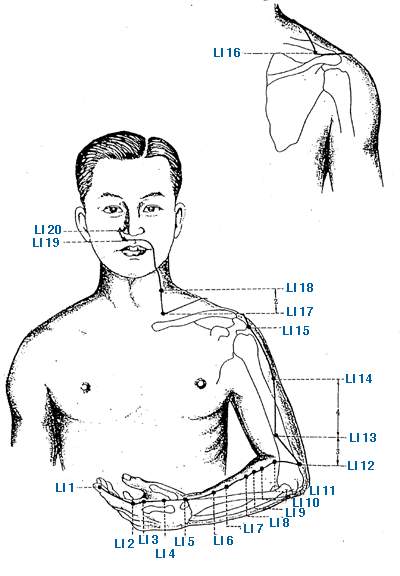
Location: On the radial side of the index finger, 0.1 cun
posterior to the corner of the nail.
Indications: Febrile diseases, coma,
apoplexy, pain & swelling of throat & pharynx, etc.
LI2: ER JIAN
Location: In the
depression distal to the 2nd metacarpo-phalangeal joint on the radial side.
Clench fist to locate the point.
Indications: Epistaxis, toothache, sore
throat, facial paralysis, febrile diseases, shoulder & back pain, etc.
LI3: SAN JIAN
Location: On the
radial side of the index finger in a depression proximal to the head of the 2nd
metacarpal bone. Clench fist to easily locate point.
Indications:
Ophthalmalgia, lower toothache, sore throat, trigeminal neuralgia, redness &
swelling of fingers & back of hand, etc.
LI4: HE GU
Location: At the
highest spot of the muscle when the thumb & the index finger are brought
close together.
Indications: Headache, toothache, tonsillitis, rhinitis,
pharyngitis, ophthalmalgia, facial paralysis, simple thyroid goitre, arthritis
of mandible, hyperhydrosis, hypohydrosis common cold with fever, pain &
paralysis of the upper extremities, etc.
LI5:
YANG XI
Location: On the radial side of the back of the wrist. When the thumb
is tilted upward, it is in the hollow between the tendons of the extensor
pollicis brevis & longus.
Indications: Headache, ophthalmalgia, deafness,
tinnitus, toothache, pain in wrist & hand, dyspepsia in children &
infants, etc.
LI6: PIAN LI
Location: 3 cun
above the Yangxi (LI 5) point.
Indications: Tonsillitis, facial paralysis,
pain in the forearm, epistaxis, edema, etc.
LI7:
WEN LIU
Location: 5 cun above Yangxi (LI5) on the line connecting Yangxi
(LI5) & Quchi (LI11) points.
Indications: Stomatitis, parotitis,
glossitis, aching of shoulder & arm, etc.
LI8: XIA LIAN
Location: 4 cun
below Quchi (LI11).
Indications: Pain in the elbow & arm, abdominal pain,
mastitis, etc.
LI9: SHANG LIAN
Location: 3 cun
below Quchi (LI11).
Indications: Aching of shoulder & back, tingling
& numbness of upper extremities, borborygmus, abdominal pain, etc.
LI10: SHOU SAN LI
Location: On a
line connecting Yangxi (LI5) & Quchi (LI11) points, 2 cun directly below the
latter.
Indications: Pain in the shoulder & arm, tremor, hemiplegia, etc.
LI11: QU CHI
Location: In the
depression at the lateral end of the transverse cubital crease. Midway between
Chize (L5) & the lateral epicondyle of the humerus, when elbow is half
flexed.
Indications: Pain in the shoulder & arm, paralysis of upper
extremities, fever, hypertension, chorea, eczema, neurodermatitis, disorder of
the cubital joint & its surrounding soft tissue, etc.
LI12: ZHOU LIAO
Location: Superior
to the lateral epicondyle of the humerus, on the lateral border of the
humerus.
Indications: Pain, constriction & numbness in the elbow &
arm, etc.
LI13: WU LI
Location: On the
antero-medial border of the humerus bone, 3 cun above the elbow
crease.
Indications: Pneumonia, peritonitis, pain in elbow & arm,
tuberculosis of cervical lymph nodes, etc.
LI14:
BI NAO
Location: At the lower end of the thedeltoideus of the humerus, in
line with Quchi (LI11) & Jianyu (LI15) points.
Indications: Pain &
impairment of movement of elbow & arm, disorder of shoulder joint & its
surrounding soft tissue, etc.
LI15: JIAN
YU
Location: The point is in the depression of the acromion when arm is in
full abduction.
Indications: Pain & impairment of movement of elbow &
arm, disorder of shoulder joint & its surrounding soft tissue, etc.
LI16: JU GU
Location: In the
depression between the clavico-acomial extremity & the spine of
scapula.
Indications: Pain in shoulder, back & upper extremities, etc.
LI17: TIAN DING
Location: About 1
cun below the Futu (LI18) point, at the posterior border of
sterno-cleido-mastoideus muscle, when sitting straight with the head tilted
back.
Indications: Sore throat, tonsillitis, tuberculosis of the cervical
lymph nodes, etc.
LI18: FU
TU
Location: 3 cun lateral to the thyroid cartilage, between the sternal head
& the clavicular head of the sterno-cleido-mastoideus
muscle.
Indications: Cough, excessive sputum, sore throat, etc.
LI19: HE LIAO
Location: 0.5 cun
lateral to Renzhong (DU26) point.
Indications: Epistaxis, nasal obstruction,
facial paralysis, etc.
LI20: YING
XIANG
Location: Between the naso-labial groove & the midpoint of the
outer border of the nasal ala.
Indications: Rhinitis, sinusitis, facial
paralysis, ascariasis of the bile duct, etc.
The Stomach Meridian (Yang/Lower
Limb)
Synopsis: Liquid
& solid enter the Stomach. The 5 Zang & 6 Fu organs are replenished with
Qi from the Ling Shu.
Course: The Stomach Channel
orginates its superficial course below the eye & then a U-turn outwards on
the face. It continues lowest point of the "U" downwards, 4 cun lateral to the
midline along the nipple line. In the abdomen it travels downwards 2 cun lateral
to the midline. Then it runs along the anterior aspect of the lower limb, to end
at the base of the nail of the 2nd toe.
S1: CHENG QI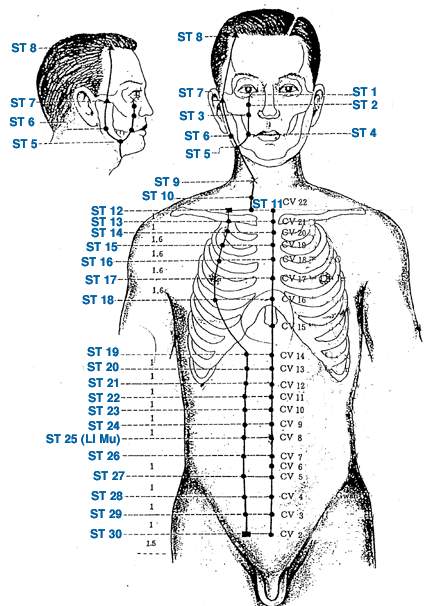
Location: Between the
eyeball & the midpoint of the infra-orbital ridge.
Indications:
Conjunctivitis, thermal burns, myopia, optic atrophy, etc.
S2: SI BAI
Location: 0.7 cun below
Chenqi (S1), in the depression at the infra-orbital foramen.
Indications:
Facial paralysis, eye disease, twitching of eyelids, headache, etc.
S3: JU LIAO
Location: Directly
below Sibai (S2), at the level of the lower end of the ala nasi, lateral to the
naso-labial groove.
Indications: Facial paralysis, epistaxis, toothache, pain
& swelling of lips & cheek, etc.
S4:
DI CANG
Location: 0.4 cun lateral to corner of mouth.
Indications: Facial
paralysis, trigeminal neuralgia, salivation, etc.
S5: DA YING
Location: Anterior to
the angle of jaw, at the lower border of the masseter where the artery of the
mandible groove can be palpated.
Indications: Toothache, parotitis, facial
paralysis, etc.
S6: JIA
CHE
Location: Anterior and superior to the angle of jaw at the prominence of
the masseter muscle when the jaw is shut tight.
Indications: Toothache,
facial paralysis, parotitis, spasm of masseter muscle, etc.
S7: XIA GUAN
Location: In the
depression at the lower border of the zygomatic arch, anterior to the condyloid
process of the mandible. Locate the point with mouth closed.
Indications:
Facial paralysis, trigeminal neuralgia, toothache, mandible arthritis, etc.
S8: TOU WEI
Location: 0.5 cun
within the anterior hairline at the corner of the forehead.
Indications:
Migraine, ophthalmalgia, lacrimation, etc.
S9:
REN YING
Location: Posterior to the common carotid artery on the anterior
border of the sterno-cleido-mastoideus, lateral to the thyroid
cartilage.
Indications: Hypertension, asthma, sore throat, etc.
S10: SHUI TU
Location: On the
anterior border of the sterno-cleido-mastoideus, midway between Renying (S9)
& Qishe (S11) points.
Indications: Sore throat, asthma, etc.
S11: QI SHE
Location: Directly
below Renying (S9) on the superior border of the clavicle.
Indications: Sore
throat, dyspnea, stiff neck, etc.
S12: QUE
PEN
Location: In the middle of the supraclavicular fossa, on the mammillary
line.
Indications: Sore throat, asthma, pleuritis, costal neuralgia, etc.
S13: QI HU
Location: Below the
midpoint of the clavicle, 4 cun lateral to Xuanji (R21).
Indications: Asthma,
bronchitis, chest and back pain, hiccup, dyspnea, etc.
S14: KU FANG
Location: In the 1st
intercostal space, 4 cun lateral to Huagai (R20).
Indications: Bronchitis,
distention & pain in the chest & hypochondriac region, etc.
S15: WU YI
Location: In the 2nd
intercostal space, 4 cun lateral to chest Zigong (R19).
Indications:
Bronchitis, asthma, distention & pain in chest & costal region, etc.
S16: YING CHUANG
Location: In the
3rd intercostal space, 4 cun lateral to Yutang (R18).
Indications: Cough,
asthma, pain in the hypochondriac region, diarrhea, mastitis, etc.
S17: RU ZHONG
Location: In the
centre of the nipple, in the 4th costal interspace, midline of the
clavicle.
Indications: This point only serves as a marking for measurement in
locating the points on the chest & abdomen.
S18: RU GEN
Location: Directly
below the nipple in the depression of the mammillary groove, in the 5th
intercostal space.
Indications: Mastitis, deficient lactation in mothers,
chest pain, etc.
S19: BU
RONG
Location: 6 cun above the umbilicus, 2 cun lateral to Jujue
(R14).
Indications: Gastrectasis, intercostal neuralgia, etc.
S20: CHENG MAN
Location: 5 cun
above the umbilicus, 2 cun lateral to Shangwan (R13).
Indications: Acute
& chronic gastritis, gastralgia, pain & spasm of the the rectus
abdominis, etc.
S21: LIANG
MEN
Location: 4 cun above umbilicus, 2 cun lateral to Zhongwan
(R12).
Indications: Gastric or duodenal ulcer, acute & chronic gastritis,
gastric neurosis, etc.
S22: GUAN
MEN
Location: 3 cun above umbilicus, 2 cun lateral to Jianli
(R11).
Indications: Abdominal pain or distention, anorexia, borborygmus,
diarrhea, edema, etc.
S23: TAI
YI
Location: 2 cun above umbilicus, 2 cun lateral to Xiawan
(R10).
Indications: Gastralgia, hernia, enuresis, mental disorder, etc.
S24: HUA ROU MEN
Location: 1 cun
above umbilicus, 2 cun lateral to Shuifen (R9).
Indications: Nausea and
vomiting, gastralgia, mental disorder, etc.
S25:
TIAN SHU
Location: 2 cun lateral to umbilicus.
Indications: Acute and
chronic gastro-enteritis, dysentery, constipation, intestinal paralysis,
diarrhea in children & infants, paralysis of the abdominis, appendicitis,
acute intestinal obstruction, etc.
S26: WAI
LING
Location: 1 cun below the umbilicus; 2 cun lateral to the abdomen
Yinjiao (R7) point.
Indications: Abdominal pain, menorrhalgia, etc.
S27: DA JU
Location: 2 cun below
umbilicus; 2 cun lateral to Shimen (R5).
Indications: Cystitis, abdominal
pain, dysentery, spermatorrhea, etc.
S28: SHUI
DAO
Location: 3 cun below umbilicus; 2 cun lateral to Guanyuan
(R4).
Indications: Nephritis, cystitis, retention of urine, testitis, etc.
S29: GUI LAI
Location: 4 cun below
Tianshu (S25); 2 cun lateral to Zhongji (R3).
Indications: Amenorrhea,
menorrhalgia, prolapse of uterus, acute epididymitis, chronic pelvic
inflammation, hernia, etc.
S30: QI
CHONG
Location: 5 cun below the umbilicus; 2 cun lateral to Qugu
(R2).
Indications: Urogenital diseases, hernia, etc.
S31: BI GUAN
Location: Directly
below the anterior superior iliac spine, in a line level with the lower border
of the pubic symphysis.
Indications: Paralysis of lower extremities,
hemiplegia, rheumatism, etc.
S32: FU
TU
Location: 6 cun above the superior border of the patella. On the anterior
side of the thigh & on the line connecting the anteriosupeior iliac spine
& the superiolateral corner of the patella, 6 cun above this
corner.
Indications: Pain, paralysis of lower extremities, hemiplegia, etc.
S33: YIN SHI
Location: In a
depression 3 cun above the supero-lateral border of the patella.
Indications:
Aching or paralysis of the knee joint & leg, etc.
S34: LIANG QIU
Location: In a
depression 2 cun above the supero-lateral border of the patella, directly above
the Dubi (S35) point.
Indications: Gastralgia, diarrhea, mastitis, disorders
of knee joint & its surrounding soft tissue, etc.
S35: DU BI
Location: The point is
in the depression just below the patella, lateral to the patellar ligament when
bending the knee joint. In the depression beside the large
ligament.
Indications: Arthritis of the knee joint, etc.
S36: ZU SAN LI
Location: 3 cun
below Dubi (S35), one finger breadth from the anterior crest of the
tibia.
Indications: Gastralgia, nausea & vomiting, abdominal distention,
constipation, bacillary dysentery, diseases of the digestive tract, etc. Also
for general tonic purposes.
S37: SHANG JU
XU
Location: 6 cun below Dubi (S35), one finger breadth from the anterior
crest of the tibia.
Indications: Abdominal pain, diarrhea, appendicitis,
paralysis of lower extremities, etc.
S38: TIAO
KOU
Location: 8 cun below the knee; 2 cun below Shangjuxu
(S37).
Indications: Paralysis or aching of lower extremities, gastric &
abdominal pain, arthritis of shoulder, etc.
S39:
XIA JU XU
Location: 3 cun directly below Shangjuxu (S37).
Indications:
Paralysis of lower extremities, abdominal pain, etc.
S40: FENG LONG
Location: 8 cun
below the knee; one finger breadth lateral to Tiaokou (S38).
Indications:
Cough, excessive sputum, dizziness & vertigo, schizophrenia, epilepsy,
paralysis & numbness of lower extremities, hemiplegia, dyspepsia, etc.
S41: JIE XI
Location: On the
midpoint of dorsum of foot at the transverse malleolus crease, between the
tendons of the extensor digitorum longus & hallucis longus.
Indications:
Paralysis of lower extremities, disorders of the malleolus joint & its
surrounding soft tissue, etc.
S42: CHONG
YANG
Location: 1.5 cun distal to Jiexi (S41), at the highest spot of dorsum
of foot, the artery can be palpated.
Indications: Pain in dorsum of foot,
paralysis of lower extremities, toothache, gingivitis, epilepsy, etc.
S43: XIAN GU
Location: In the
depression distal to the junction of the 2nd & 3rd metatarsal
bones.
Indications: Facial swelling, edema, borborygmus, abdominal pain, pain
& swelling of dorsum of foot, tonsillitis, dysentery, etc.
S44: NEI TING
Location: 0.5 cun
proximal to the web margin between the 2nd & 3rd toes.
Indications:
Gastralgia, headache, tonsillitis, dysentery, toothache, etc.
S45: LI DUI
Location: On the
lateral side of the tip of the 2nd toe, 0.1 cun posterior to the corner of toe
nail.
Indications: Febrile diseases, dream-disturbed sleep, epilepsy, etc.
The Spleen Meridian (Yin/Lower Limb)
N1: YIN
BAI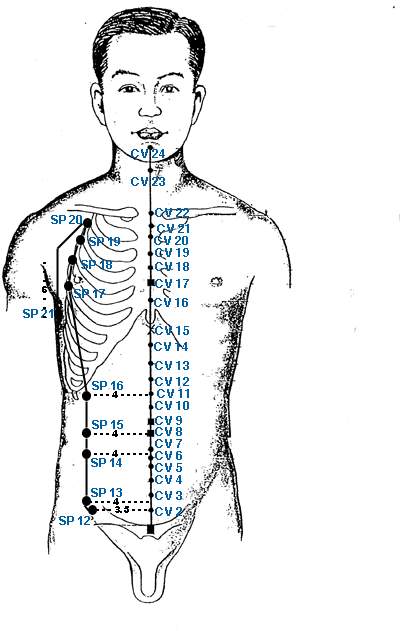
Location: On the medial side of the big toe, 0.1 cun posterior to the
corner of toe nail.
Indications: Abdominal distention, irregular
menstruation, insomnia, dream-disturbed sleep, mental disorder, etc.
N2: DA DU
Location: On the medial
side of the great toe, anterior & inferior to the 1st metatarso-phalangeal
joint, at the junction of the "red & white" skin.
Indications: Abdominal
distention, abdominal pain, high fever, hypopydrosis, etc.
N3: TAI BAI
Location: At the
medial aspect of foot, posterior & inferior to the head of the first
metatarsal bone, at the junction of the "red & white" skin.
Indications:
Gastralgia, abdominal distention, dysentery, constipation, vomiting &
diarrhea, etc.
N4: GONG SUN
Location: On the
medial aspect of foot, in a depression at the anterior & inferior border of
1st metatarsal bone, at the junction of the "red & white"
skin.
Indications: Gastralgia, dyspepsia, vomiting, diarrhea, menorrhalgia,
etc.
N5: SHANG QIU
Location: Draw a
straight line along the anterior & the inferior border of the medial
malleolus respectively. The point is where the two lines cross.
Indications:
Gastritis, enteritis, dyspepsia, pain in the ankle joint, etc.
N6: SAN YIN JIAO
Location: 3 cun
above the tip of the medial malleolus just posterior to the tibial
border.
Indications: Abdominal distention, loose stool, irregular
menstruation, nocturnal emission, impotence, spermatorrhea, orchitis, enuresis,
frequency of urination, retention of urine, hemiplegia, etc.
N7: LOU GU
Location: 3 cun in the
depression above Sanyinjiao (N6), at the posterior border of the
tibia.
Indications: Abdominal distention, borborygmus, numbness &
chilliness of the leg & knee, etc.
N8:
DI JI
Location: 3 cun below Yinlingquan (N9), at the posterior border of the
tibia.
Indications: Lumbago, abdominal distention, menorrhalgia or
menorrhagia, etc.
N9: YIN LING
QUAN
Location: In the depression on the lower border of the medial condyle of
the tibia, on a level with the tuberosity of the tibia.
Indications:
Abdominal distention, edema, dysuria, enuresis, nocturnal emission, irregular
menstruation, dysentery, etc.
N10: XUE
HAI
Location: 2 cun above the superior border of the patella, at the middle
of the bulge of the the vastus medialis.
Indications: Irregular menstruation,
functional uterine bleeding, urticaria, etc.
N11: JI MEN
Location: 6 cun above
Xuehai (N10), medial to sartorius muscle.
Indications: Dysuria, enuresis,
inflammation of the inguinal lymphnodes, etc.
N12: CHONG MEN
Location: On the
lateral side of the femoral artery, 3.5 cun lateral to the midpoint of the
superior border of the pubic symphysis.
Indications: Orchitis, spermatitis,
endometritis, hernia, etc.
N13: FU
SHE
Location: 0.7 cun above Chongmen (N12); 4 cun lateral to abdominal
midline.
Indications: Abdominal pain, hernia, appendicitis, constipation,
etc.
N14: FU JIE
Location: 1.3 cun
below Daheng (N15); 4 cun lateral to abdominal midline.
Indications:
umbilical pain, hernia, diarrhea, etc.
N15:
DA HENG
Location: 4 cun lateral to umbilicus, directly below the nipple, on
the lateral side of the rectus abdominis muscle.
Indications: Abdominal pain,
dysentery, constipation, intestinal paralysis, diarrhea, intestinal parasitosis,
leukorrhagia, ascariasis, etc.
N16: FU
AI
Location: 3 cun above Daheng (N15), 4 cun lateral to Jianli
(R11).
Indications: Abdominal pain, dyspepsia, constipation, dysentry, etc.
N17: SHI DOU
Location: In the 5th
intercostal space, 6 cun lateral to abdominal midline.
Indications: Pain
& distention of chest & hypochondriac region, etc.
N18: TIAN XI
Location: In the 4th
intercostal space, 6 cun lateral to abdominal midline.
Indications:
Thoracalgia, cough, mastitis, deficient lactation, etc.
N19: XIONG XIANG
Location: In the
3rd intercostal space, 6 cun lateral to abdominal midline.
Indications: Pain
& distention of chest, costal & hypochondriac region, etc.
N20: ZHOU RONG
Location: In the
2nd intercostal space, 6 cun lateral to abdominal midline.
Indications: Pain
& distention of chest, costal & hypochondriac region, cough, etc.
N21: DA BAO
Location: On the
mid-axillary line, in the 6th intercostal space.
Indications: Pain in chest,
costal & hypochondriac region, dyspnea, general aching, weakness of limbs,
etc.
The Heart Meridian (Yin/Upper Limb)
H1: JI QUAN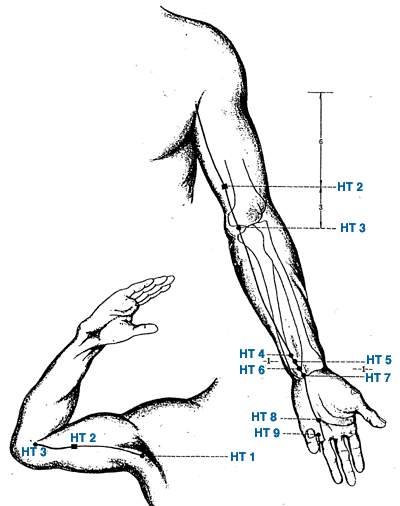
Location: At the
centre of the axilla, on the medial side of the axillary artery.
Indications:
Pain in arm, paralysis of upper extremities, deficient lactation, pain in the
cardiac region, disorder of shoulder joint & its surrounding soft tissue,
etc.
H2: QING LING
Location: 3 cun
above the elbow, in the groove medial to the biceps brachii.
Indications:
Pain in the costal & hypochondriac regions, shoulder & arm, etc.
H3: SHAO HAI
Location: Between the
medial end of the transverse cubital crease & the medial epicondyle of the
humerus bone when elbow is bent.
Indications: Numbness of hand & arm,
tremor of forearm, angina pectoris, disorders of the cubital joint & its
surrounding soft tissue, etc.
H4: LING
DAO
Location: On the ulnar aspect proximal to the wrist, on the radial side
of the tendon of the flexor carpi ulnaris, 1.5 cun above Shenmen
(H7).
Indications: Angina pectoris, ulnar neuralgia, pain in joints,
hysteria, etc.
H5: TONG LI
Location: On the
ulnar side of the wrist, on the radial side of the tendon of the flexor carpi
ulnaris, 1 cun above Shenmen (H7).
Indications: Hoarseness of voice, aphasia,
stiffness of tongue, insomnia, palpitation, pain in wrist and arm, etc.
H6: YIN XI
Location: On the ulnar
side of the wrist, on the radial side of the tendon of flexor carpi ulnaris
muscle, 0.5 cun above Shenmen (H7).
Indications: Neurasthenia, angina
pectoris, palpitation, night sweating, etc.
H7:
SHEN MEN
Location: At the ulnar end of the crease of the wrist, & in the
depression on the radial side of the tendon of the ulnar flexor muscle of the
wrist.
Indications: Dream-disturbed sleep, insomnia, anxiety, palpitation,
hysteria, etc.
H8: SHAO FU
Location: In the
palmar surface, between the 4th & 5th metacarpal bones, just between the
ring & small fingers when making a fist.
Indications: Palpitation,
thoracalgia, pruritus vulvae, dysuresis, enuresis, elevated temperature in palm
of hand, etc.
H9: SHAO CHONG
Location: On the
radial side of the tip of the small finger, about 0.1 cun posterior to the
corner of the fingernail.
Indications: Palpitation, thoracalgia, apoplexy,
coma, etc.
The Small Intestine Meridian (Yang/Upper Limb)
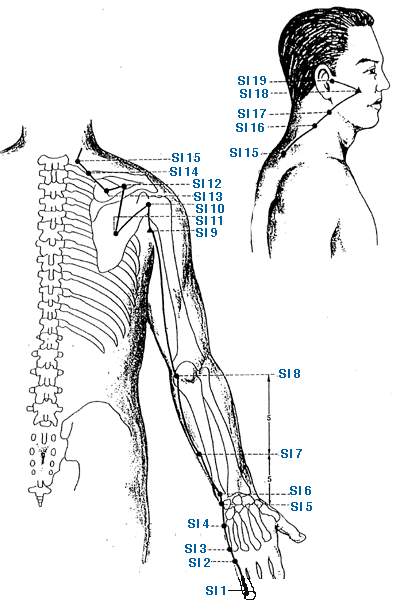 .
.
SI1: SHAO ZE
Location: At the
ulnar side of the small finger, about 0.1 cun posterior to the corner of the
nail.
Indications: Headache, eye diseases, mastitis, deficient lactation in
mothers, etc.
SI2: QIAN GU
Location: In the
depression anterior to the ulnar side of the 5th metacarpo-phalangeal
joint.
Indications: Pain in the arm. numbness of the fingers, febrile
diseases, eye diseases, tinnitus, etc.
SI3:
HOU XI
Location: At the end of the transverse crease proximal to the 5th
metacarpo-phalangeal joint when hand is half-clenched.
Indications: Stiffness
or rigidity of neck, tinnitus, deafness, occipital headache, lumbago, paralysis
of upper extremities, night sweating, epilepsy, malaria, etc.
SI4: WAN GU
Location: At the ulnar
border of the palm in the depression between the base of the 5th metacarpal bone
& the trigonal bone. At the junction of the "red & white"
skin.
Indications: Arthritis of the elbow, wrist and finger joints, headache,
tinnitus, vomiting, cholecystitis, etc.
SI5:
YANG GU
Location: At the ulnar side of the wrist in the depression between
the styloid process of the ulna & the pisiform bone.
Indications:
Swelling of the neck & submaxillary region, pain in the lateral aspect of
the arm & wrist, mental disorders, deafness, tinnitus, etc.
SI6: YANG LAO
Location: Flex elbow
with palm placed on the chest; the point is on the bony cleft on the radial
aspect of the styloid process of the ulna.
Indications: Failing eyesight,
paralysis of upper extremities, pain in the wrist & back, etc.
SI7: ZHI ZHENG
Location: 5 cun
proximal to the wrist, on the line connecting Yanggu (SI5) with Xiaohai
(SI8).
Indications: Rigidity or stiffness of neck, pain in elbow, arm &
fingers, mental disorders, etc.
SI8: XIAO
HAI
Location: In the posterior aspect of the cubital joint, in a depression
between the olecronon of the ulna and tip of the medial epicondyle of the
humerus. Flex the elbow to locate the point.
Indications: Pain in the small
finger, elbow joints, shoulders & back, etc.
SI9: JIAN ZHEN
Location: With arm
at the side, the point is 1.0 cun superior to the posterior axillary
fold.
Indications: Pain in arm, paralysis of the upper extremities, disorders
of the shoulder joint & its surrounding soft tissue, etc.
SI10: NAO SHU
Location: With arm
at the side, it is directly above the posterior axillary fold, on the lower
border of the scapular spine.
Indications: Pain and weakness of shoulder
& arm, etc.
SI11: TIAN
ZONG
Location: It is in the centre of the infra-scapular fossa forming a
bilateral triangle with Naoshu (SI10) & Jianzhen (SI9).
Indications: Pain
in the shoulder & the postero-lateral aspect of the elbow & arm, etc.
SI12: BING FENG
Location: In the
centre of the suprascapular fossa, directly above Tianzong (SI11). A depression
is formed when the arm is lifted.
Indications: Pain in the shoulder joint,
numbness & aching of upper extremities, etc.
SI13: QU YUAN
Location: On the
medial end of the suprascapular fossa (the curved bone), midway between Naoshu
(SI10) & the spinous process of the 2nd thoracic vertebra.
Indications:
Pain and constriction of shoulder join, etc.
SI14: JIAN WAI SHU
Location: 3 cun
lateral to the lower border of the spinous process of the 1st thoracic vertebra
(Taodao, D13), on the vertical line drawn from the vertebral border of the
scapula.
Indications: Aching of scapular joint, stiffness & pain in the
neck, etc.
SI15: JIAN ZHONG SHU
Location: 2
cun lateral to the lower border of the spinous process of the 7th cervical
vertebra (Dazhui, D14).
Indications: Pain in shoulder & back, stiffness
& pain of the neck, bronchitis, asthma, etc.
SI16: TIAN CHUANG
Location: Below
the angle of the mandible, posterior to Futu (LI18), in the depression where the
pulsation is palpable.
Indications: Deafness, tinnitus, sore throat, rigidity
& stiffness of neck, etc.
SI17: TIAN
RONG
Location: Posterior to the angle of jaw on the anterior border of the
sterno-cleido-mastoideus muscle.
Indications: Tonsillitis, sore throat, etc.
SI18: QUAN LIAO
Location: Directly
below the outer canthus, in the depression below the lower border of the
zygomatic bone.
Indications: Facial paralysis, toothache, trigeminal
neuralgia, etc.
SI19: TING
GONG
Location: In the depression shown between the tragus & mandible
joint when the mouth is slightly opened.
Indications: Tinnitus, deafness,
otalgia, etc.
The Urinary Bladder Meridian (Yang/Lower Limb)
Synopsis: The Kidneys unite at the Bladder, where the fluid is stored.
Urine is the surplus of the fluid of the body.
Course: This channel begins at the medial corner of the eye
& runs over the top of the head, close to the midline. At the nape of the
neck, it divides into two branches. The branch (the one more often used in
therapy) courses down the back of the trunk at a distance of 1.5 cun from the
midline, till it reaches the level of the 4th posterior secret foramen. Here it
abruptly reverses direction & runs obliquely & medially to the first
posterior secret foramina from where it descends vertically over all the other
posterior sacral foramina. It then deviates obliquely to the midline &
reaches the coccyx, thereafter it descends over the back of the leg. The lateral
branch of the Channel descends from the neck on a line parallel to the medial
branch but at a distance of 3 cun from the midline. It passes over the buttock
& posterior aspect of the thigh to reach the midpoint of the popliteal
fossa, then reuniting with the medial branch at this point, descends over the
calf muscle & reaches the foot after passing behind the lateral malleoius.
After traversing the lateral border of the foot it ends near the lateral corner
of the little toe-nail.
UB1: JING
MING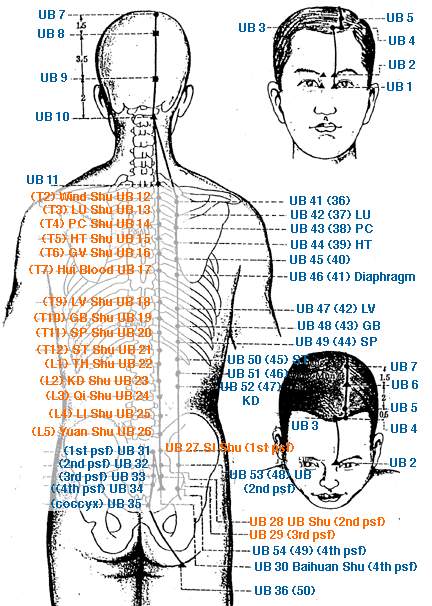
Location: 0.1 cun lateral & superior to the inner canthus, near the
medial orbital border.
Indications: Eye diseases, facial paralysis, etc.
UB2: ZAN ZHU
Location: In the
depression proximal to the medial end of the eyebrow, directly above inner
canthus.
Indications: Headache, eye diseases, facial paralysis, etc.
UB3: MEI CHONG
Location: Directly
above Zanzhu (UB2), 0.5 cun inside the hairline.
Indications: Headache,
lacrimation, redness & swelling of eye, blurring of vision, leucoma, etc.
UB4: QU CHAI
Location: 1.5 cun
lateral to Shenting (D24) 0.5 cun inside the hairline.
Indications: Frontal
headache, nasal obstruction, epistaxis, etc.
UB5: WU CHU
Location: 0.5 cun
above Quchai (UB4).
Indications: Headache, epilepsy, etc.
UB6: CHENG GUANG
Location: 1.5 cun
posterior to Wuchu (UB5).
Indications: Headache, dizziness, leucoma, common
cold, etc.
UB7: TONG TIAN
Location: 1.5 cun
posterior to Chengguang (UB6).
Indications: Vertical headache, sinusitis,
rhinitis, etc.
UB8: LUO QUE
Location: 1.5 cun
posterior to Tongtian (UB7).
Indications: Rhinitis, epistaxis, vertical
headache, chronic bronchitis, etc.
UB9: YU
ZHEN
Location: On the lateral side of the superior border of the external
occipital protuberance, 1.3 cun lateral to Naohu (DU17).
Indications:
Dizziness, vertical headache, myopia, etc.
UB10:
TIAN ZHU
Location: 1.3 cun lateral to Yamen (D15) on the lateral side of the
trapezius muscle.
Indications: Occipital headache, stiffness & rigidity
of neck, insomnia, etc.
UB11: DA
SHU
Location: 1.5 cun lateral to lower border of the spinous process of the
1st thoracic vertebra.
Indications: Cough, fever, aching of the shoulder
joint, etc.
UB12: FENG MEN
Location: 1.5 cun
lateral to lower border of the spinous process of the 2nd thoracic
vertebra.
Indications: Common cold, bronchitis, urticaria, etc.
UB13: FEI SHU
Location: 1.5 cun
lateral to lower border of the spinous process of the 3rd thoracic
vertebra.
Indications: Cough, pulmonary tuberculosis, pneumonia, lessions of
the soft tissue of the back, etc.
UB14: JUE
YIN SHU
Location: 1.5 cun lateral to lower border of the spinous process of
the 4th thoracic vertebra.
Indications: Neurasthenia, fullness of chest,
thoracalgia, vertical headache, pericarditis, hiccough, etc.
UB15: XIN SHU
Location: 1.5 cun
lateral to lower border of the spinous process of the 5th thoracic
vertebra.
Indications: Neurasthenia, cardiac diseases, epilepsy,
schizophrenia, etc.
UB16: DU
SHU
Location: 1.5 cun lateral to lower border of the spinous process of the
6th thoracic vertebra.
Indications: Endocarditis, borborygmus, abdominal
pain, hiccough, falling of hair, pruritus of skin, etc.
UB17: GE SHU
Location: 1.5 cun
lateral to lower border of the spinous process of the 7th thoracic
vertebra.
Indications: Chronic hemorrhagic diseases, anemia, hiccough,
neurotic nausea & vomiting, pain in the back, paralysis of diaphragm muscle,
urticaria, etc.
UB18: GAN
SHU
Location: 1.5 cun lateral to lower border of the spinous process of the
9th thoracic vertebra.
Indications: Infective hepatitis, hepatomegaly,
cholecystitis, back pain, schizophrenia, dream-disturbed sleep, chronic eye
diseases, etc.
UB19: DAN SHU
Location: 1.5 cun
lateral to lower border of the spinous process of the 10th thoracic
vertebra.
Indications: Infective hepatitis, cholecystitis, back pain, etc.
UB20: PI SHU
Location: 1.5 cun
lateral to lower border of the spinous process of the 11th thoracic
vertebra.
Indications: Gastric pain, gastric ulcer, dyspepsia, chronic
diarrhea, hepatitis, malaria, chronic hemorrhagic diseases, edema, paralysis of
the abdominis, etc.
UB21: WEI
SHU
Location: 1.5 cun lateral to lower border of the spinous process of the
12th thoracic vertebra.
Indications: Gastralgia, gastric ulcer, dyspepsia,
nausea & vomiting, gastroptosis, chronic diarrhea, paralysis of the
abdominis, etc.
UB22: SAN JIAO
SHU
Location: 1.5 cun lateral to lower border of the spinous process of the
1st lumbar vertebra.
Indications: Gastralgia, dyspepsia, enteritis,
nephritis, neurasthenia, lumbago, enuresis, etc.
UB23: SHEN SHU
Location: 1.5 cun
lateral to lower border of the spinous process of the 2nd lumbar
vertebra.
Indications: Nephritis, enuresis, nocturnal emission, impotence,
irregular menstruation, chronic diarrhea, lumbago, deafness, tinnitus, etc.
UB24: QI HAI SHU
Location: 1.5 cun
lateral to lower border of the spinous process of the 3rd lumbar
vertebra.
Indications: Lumbago, hemorrhoids, etc.
UB25: DA CHANG SHU
Location: 1.5
cun lateral to lower border of the spinous process of the 4th lumbar
vertebra.
Indications: Lumbago, sprain of the lumbar region, diarrhea,
dysentery, constipation, sciatica, paralysis of lower extremities, etc.
UB26: GUAN YUAN SHU
Location: 1.5
cun lateral to lower border of the spinous process of the 5th lumbar
vertebra.
Indications: Lumbago, diarrhea, urogenital diseases, etc.
UB27: XIAO CHANG SHU
Location: 1.5
cun lateral to the midline of back, level to the 1st posterior sacral foramen,
in the depression between the medial border of the posterior superior iliac
spine & the sacrum.
Indications: Lumbago, pain in the lumbo-sacral
region, disorder of the ilio-sacral joint, enteritis, hematuria, leukorrhea,
etc.
UB28: PANG GUANG SHU
Location:
Level with 2nd posterior sacral foramen, 1.5 cun lateral to Du Channel, in the
depression between the lower medial border of the posterior superior iliac spine
& the sacrum.
Indications: Retention of urine, enuresis, pain in the
lumbo-sacral region, etc.
UB29: ZHONG LU
SHU
Location: At the level of the 3rd posterior sacral foramen, 1.5 cun
lateral to back midline.
Indications: Enteritis, pain in the lumbo-sacral
region, sciatica, etc.
UB30: BAI HUAN
SHU
Location: At the level of the 4th posterior sacral foramen, 1.5 cun
lateral to back midline.
Indications: Sciatica, sacral neuralgia,
endometritis, spermatorrhea, leukorrhea, hernia, etc.
UB31: SHANG LIAO
Location: In the
1st posterior sacral foramen, about midway between the posterior superior iliac
spine & the Du Channel.
Indications: Orchitis, irregular menstruation,
dysuresis & other urogenital diseases, lumbago, sciatica, hemorrhoids,
neurasthenia, etc.
UB32: CI
LIAO
Location: In the 2nd posterior sacral foramen, about midway between the
inferior aspect of the posterior superior iliac spine & the Du
Channel.
Indications: Orchitis, irregular menstruation, dysuresis & other
urogenital diseases, lumbago, sciatica, hemorrhoids, neurasthenia, etc.
UB33: ZHONG LIAO
Location: In the
3rd posterior sacral foramen, midway between Zhonglushu (UB29) & the Du
Channel.
Indications: Orchitis, irregular menstruation, dysuresis & other
urogenital diseases, lumbago, sciatica, hemorrhoids, neurasthenia, etc.
UB34: XIA LIAO
Location: In the
4th posterior sacral foramen, midway between Baihuanshu (UB30) & the Du
Channel.
Indications: Orchitis, irregular menstruation, dysuresis & other
urogenital diseases, lumbago, sciatica, hemorrhoids, neurasthenia, etc.
UB35: HUI YANG
Location: Lateral
to the lower end of the coccyx, 0.5 cun lateral to midline.
Indications: Back
pain during menstruation, leukorrhea, impotence, diarrhea, hemorrhoids, etc.
UB36: CHENG FU
Location: Midpoint
of the gluteal fold.
Indications: Sciatica, paralysis, of lower extremities,
hemorrhoids, etc.
UB37: YIN
MEN
Location: On a line connecting the midpoints of the gluteal transverse
crease & the popliteal transverse crease, 6 cun below the
former.
Indications: Sciatica, back pain, paralysis of lower extremities,
etc.
UB38: FU XI
Location: 1 cun above
Wei Yang (UB39).
Indications: Cystitis, constipation, dysuresis, paralysis of
lateral aspect of lower extremities, etc.
UB39:
WEI YANG
Location: On the lateral end of the popliteal crease, lateral to Wei
Zhong (UB40), on the medial side of the tendon of the biceps
femoris.
Indications: Spasm of the gastrocnemius, back pain, etc.
UB40: WEI ZHONG
Location: Exact
midpoint of the popliteal transverse crease.
Indications: Sciatica, back
pain, paralysis of lower extremities, disorder of the femoral joint and its
surrounding soft tissue, heat stroke, etc.
UB41:
FU FEN
Location: 3 cun lateral to the lower border of the spinous process of
the 2nd thoracic vertebra.
Indications: Intercostal neuralgia, numbness of
elbow and arm, etc.
UB42: PO
HU
Location: 3 cun lateral to the lower border of the spinous process of the
3rd thoracic vertebra.
Indications: Bronchitis, asthma, pleuritis, vomiting ,
shoulder pain, pulmonary tuberculosis, etc.
UB43:
GAO HUANG
Location: 3 cun lateral to the lower border of the spinous process
of the 4th thoracic vertebra.
Indications: Pulmonary tuberculosis,
bronchitis, pleuritis, neurasthenia, general weakness, etc.
UB44: SHEN TANG
Location: 3 cun
lateral to the lower border of the spinous process of the 5th thoracic
vertebra.
Indications: Cardiac diseases, bronchitis, asthma, shoulder &
back pain, etc.
UB45: YI
XI
Location: 3 cun lateral to the lower border of the spinous process of the
6th thoracic vertebra.
Indications: Pericarditis, intercostal neuralgia,
hiccough, vomiting, dizziness and vertigo, asthma, etc.
UB46: GE GUAN
Location: 3 cun
lateral to the lower border of the spinous process of the 7th thoracic
vertebra.
Indications: Intercostal neuralgia, vomiting, hiccough, pain in the
spinal column, etc.
UB47: HU
MEN
Location: 3 cun lateral to the lower border of the spinous process of the
9th thoracic vertebra.
Indications: Liver diseases, pleuritis, endocarditis,
gastralgia, dyspepsia, etc.
UB48: YANG
GANG
Location: 3 cun lateral to the lower border of the spinous process of
the 10th thoracic vertebra.
Indications: Diarrhea, borborygmus, abdominal
pain, jaundice, etc.
UB49: YI
SHE
Location: 3 cun lateral to the lower border of the spinous process of the
11th thoracic vertebra.
Indications: Back pain, abdominal distention,
dyspepsia, liver diseases, vomiting, etc.
UB50:
WEI CANG
Location: 3 cun lateral to the lower border of the spinous process
of the 12th thoracic vertebra.
Indications: Gastralgia, vomiting, abdominal
distention, constipation, pain in the spinal column, etc.
UB51: HUANG MEN
Location: 3 cun
lateral to the lower border of the spinous process of the 1st lumbar
vertebra.
Indications: Upper abdominal pain, constipation, mastitis,
hepatomegaly, splenomegaly, etc.
UB52: ZHI
SHI
Location: 3 cun lateral to the lower border of the spinous process of the
2nd sacral vertebra.
Indications: Spermatorrhea, impotence, dysuresis, edema,
stiffness & pain in back & lumbar region, etc.
UB53: BAO HUANG
Location: 3 cun
lateral to the Du Channel, level to the 2nd posterior sacral
foramen.
Indications: Enteritis, abdominal distention, back pain, retention
of urine, etc.
UB54: ZHI BIAN
Location: 3 cun
lateral to the Du Channel, level to the 4th posterior sacral
foramen.
Indications: Cystitis, hemorrhoids, sciatica, paralysis &
numbness or pain of lower extremities, etc.
UB55:
HE YANG
Location: 2 cun directly below Weizhong (UB40), on the line
connecting Weizhong with Chengshan (UB57).
Indications: Lumbago and leg pain,
paralysis of lower extremities, etc.
UB56: CHENG
JIN
Location: Midway between Heyang (UB55) & Chengshan (UB57) in the
centre of the belly of the gastrocnemius.
Indications: Leg pain, hemorrhoids,
stiffness & pain in back & lumbar region, etc.
UB57: CHENG SHAN
Location: Midway
between Weizhong (UB40) & the heel, on the groove 8 cun below
Weizhong.
Indications: Sciatica, prolapse of rectum, spasm of the
gastrocnemius, pain in the sole, paralysis of lower extremities, etc.
UB58: FEI YANG
Location: 7 cun
directly above Kunlun (UB60), posterior to the external
malleolus.
Indications: Ophthalmalgia, lumbago leg pain, nephritis, cystitis,
weakness in legs, etc.
UB59: FU
YANG
Location: 3 cun above Kunlun (UB60), posterior to the external
malleolus.
Indications: Headache, pain in the lumbo-sacral region, pain &
swelling of the ankle region, etc.
UB60: KUN
LUN
Location: Between the posterior border of the external malleolus &
the medial aspect of tendo calcaneus, at the same level as the tip of
malleolus.
Indications: Paralysis of lower extremities, lumbago, sciatica,
disorder of the ankle joint & surrounding soft tissue, etc.
UB61: PU SHEN
Location: 1.5 cun
inferior to the external malleolus, directly below Kunlun (UB60), posterior to
the calcanem, at the junction of the "red & white" skin.
Indications:
Painful heel, weakness or paralysis of lower extremities, etc.
UB62: SHEN MAI
Location: Directly
below the tip of the external malleolus & 0.5 cun lateral to its lower
border.
Indications: Epilepsy, headache, dizziness & vertigo, etc.
UB63: JIN MEN
Location: Anterior
and inferior to Shenmai (UB62), in the depression posterior to the tuberosity of
the 5th metatarsal bone.
Indications: Pain around the ankle joint, lumbago,
pain in leg, infantile convulsions, epilepsy, etc.
UB64: JING GU
Location: Below the
tuberosity of the 5th metatarsal bone, at the junction of the "red & white"
skin.
Indications: Headache, dizziness & vertigo, lumbago & leg pain,
epilepsy, etc.
UB65: SHU GU
Location:
Posterior and inferior to the small head of the 5th metatarsal
bone.
Indications: Headache, dizziness, lumbago, leg pain, epilepsy, etc.
UB66: TONG GU
Location: In the
depression anterior & inferior to the 5th metatarso-phalangeal
joint.
Indications: Headache, dizziness, epistaxis, dyspepsia, etc.
UB67: ZHI YIN
Location: On the
lateral side of the tip of the small toe, about 0.1 cun posterior to the corner
of the toe nail.
Indications: Malposition of fetus, difficult labour, etc.
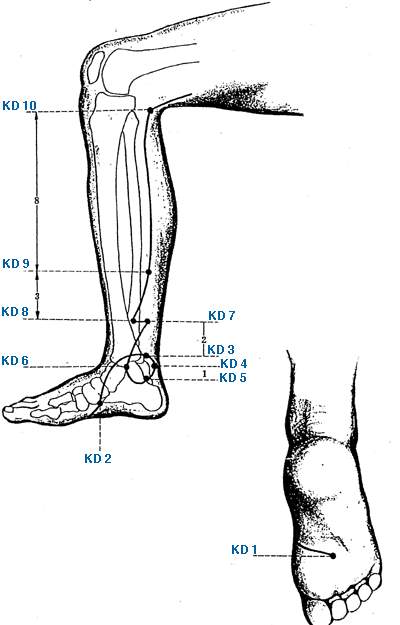
The Kidney Meridian (Yin/Lower Limb)
K1: YONG QUAN (Bubbling Well
Point)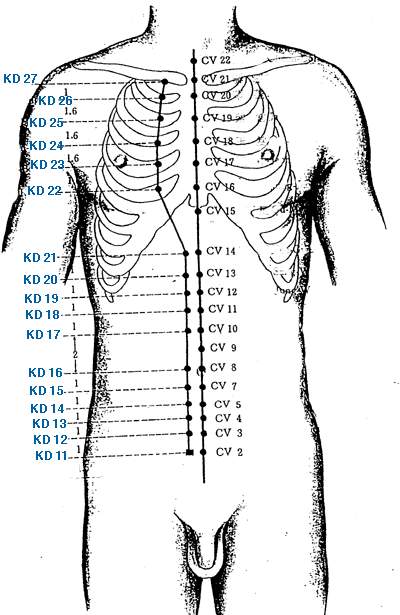
Location: In the depression at the junction of anterior & middle
third of the sole, in the depression between the 2nd & 3rd joint when the
toes are flexed.
Indications: Coma, shock, mania, hysteria, epilepsy,
infantile convulsion, unchecked nausea & vomiting, sore throat, etc.
K2: RAN GU
Location: Anterior
& inferior to the medial malleolus, in the depression at the anterior &
inferior border of the navicular bone.
Indications: Cystitis, irregular
menstruation, diabetes, sore throat, etc.
K3:
TAI XI
Location: Midway between the tip of medial malleolus & tendo
calcaneus.
Indications: Nephritis, cystitis, enuresis, irregular
menstruation, sore throat, toothache, nocturnal emission, impotence, paralysis
of lower extremities, etc.
K4: DA
ZHONG
Location: Inferior & posterior to medial malleolus, in the
depression medial to the attachment to the tendo calcaneus, 0.5 cun slightly
posteriorly below Taixi (K3).
Indications: Neurasthenia, hysteria,
hemoptysis, asthma, dysuresis, constipation, painful heel, etc.
K5: SHUI QUAN
Location: 1 cun
inferior to Taixi (K3), in the depression anterior & superior to the medial
side of the tubercle of the calcaneum.
Indications: Irregular menstruation,
prolapse of the uterus, dysuresis, myopia, etc.
K6: ZHAO HAI
Location: In the
depression 1 cun directly below the inferior border of the medial
malleolus.
Indications: Irregular menstruation, prolapse of the uterus,
tonsillitis, neurasthenia, epilepsy, etc.
K7:
FU LIU
Location: 2 cun above Taixi (K3), on the anterior border of the tendo
calcaneus.
Indications: Nephritis, orchitis, night sweating, diarrhea,
lumbago, paralysis of lower extremities, etc.
K8:
JIAO XIN
Location: 2 cun above Taixi (K3), 0.5 cun anterior to Fuliu (K7),
posterior to the medial border of the tibia.
Indications: Irregular
menstruation, functional uterine bleeding, diarrhea, constipation, pain &
swelling of the testis, etc.
K9: ZHU
BIN
Location: 5 cun above Taixi (K3), about 1 cun posterior to the medial
border of the tibia.
Indications: Spasm of the gastrocnemius, epilepsy,
mental disorder, etc.
K10: YIN
GU
Location: At the medial end of the popliteal transverse crease, between
the tendons of the semitendinosus & the semimembranosus.
Indications:
Knee pain, lower abdominal pain, disorders of the genital system, etc.
K11: HENG GU
Location: In the
lower abdomen, on the superior border of the pubic symphysis, 0.5 cun lateral to
Qu Gu (R2).
Indications: Dysuresis, enuresis, hernia, spermatorrhea,
impotence, etc.
K12: DA
HE
Location: 1 cun above Henggu (K11), 0.5 cun lateral to Zhong Ji
(R3).
Indications: Pain in the external genitalia, spermatorrhea, etc.
K13: QI XUE
Location: 2 cun above
Henggu (K11), 0.5 cun lateral to Guan Yuan (R4).
Indications: Irregular
menstruation, diarrhea, etc.
K14: SI
MAN
Location: 3 cun above Henggu (K11), 0.5 cun lateral to Shimen
(R5).
Indications: Uterine bleeding, postpartum abdominal pain, diarrhea,
etc.
K15: ZHONG ZHU
Location: 1 cun
below the umbilicus, 0.5 cun lateral to abdomen Yinjiao (R7).
Indications:
Irregular menstruation, lower abdominal pain, constipation, etc.
K16: HUANG SHU
Location: 0.5 cun
lateral to umbilicus.
Indications: Jaundice, gastralgia, hernia,
constipation, menorrhalgia, etc.
K17: SHANG
QU
Location: 2 cun above Huangshu (K16), 0.5 cun lateral to Xiawan
(R10).
Indications: Gastralgia, abdominal pain, anorexia, hernia, etc.
K18: SHI GUAN
Location: 3 cun
above Huangshu (K16), 0.5 cun lateral to Jianli (R11).
Indications:
Gastralgia, hiccough, constipation, postpartum abdominal pain, etc.
K19: YIN DU
Location: 4 cun above
Huangshu (K16), 0.5 cun lateral to Zhongwan (R12).
Indications: Borborygmus,
abdominal distention, abdominal pain, etc.
K20:
TONG GU
Location: 5 cun above Huangshu (K16), 0.5 cun lateral to Shangwan
(R13).
Indications: Vomiting, diarrhea, abdominal distention, abdominal pain,
etc.
K21: YOU MEN
Location: 6 cun above
Huangshu (K16), 0.5 cun lateral to Jujue (R14).
Indications: Thoracalgia,
belching, vomiting, diarrhea, etc.
K22: BU
LANG
Location: In the 5th intercostal space, 2 cun lateral to the Ren
Channel.
Indications: Intercostal neuralgia, pleuritis, bronchitis, etc.
K23: SHEN FENG
Location: In the
4th intercostal space, 2 cun lateral to Shanzhong (R17).
Indications:
Intercostal neuralgia, pleuritis, bronchitis, mastitis, etc.
K24: LING XU
Location: In the 3rd
intercostal space, 2 cun lateral to the Ren Channel midway between the sternal
& mammillary lines.
Indications: Pain in chest and costal region, cough,
vomiting, mastitis, etc.
K25: SHEN
CANG
Location: In the 2nd intercostal space, 2 cun lateral to the Ren Channel
midway between the sternal & mammillary lines.
Indications: Cough,
vomiting, intercostal neuralgia, etc.
K26: YU
ZHONG
Location: In the 1st intercostal space, 2 cun lateral to the Ren
Channel, midway between the sternal & mammillary lines.
Indications:
Cough, chest pain, vomiting, etc.
K27: SHU
FU
Location: In the depression between the 1st rib & the lower border of
the clavicle, 2 cun lateral to the Ren Channel.
Indications: Cough, chest
pain, asthma, vomiting, etc.
The Pericardium Meridian (Yin/Upper Limb)
P1: TIAN CHI
Location: 1 cun
lateral to the nipple in the 4th intercostal space.
Indications: Fullness in
chest, pain in the hypochondriac region, tuberculosis of lymph nodes, etc.
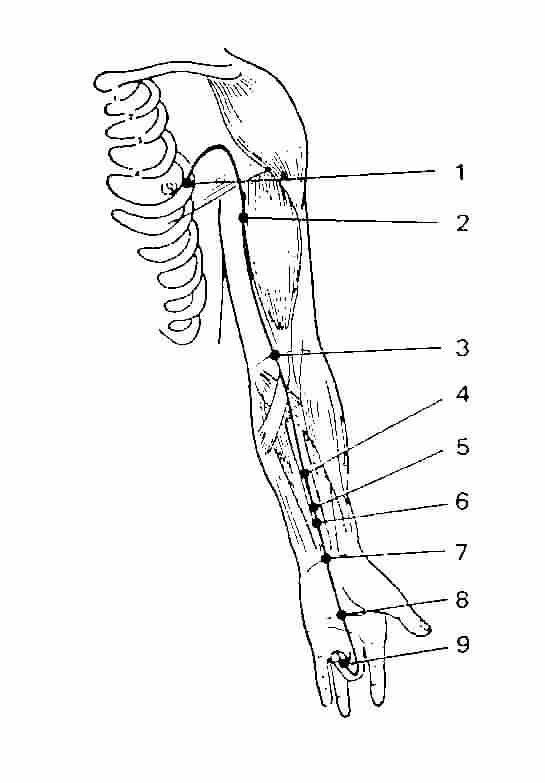
P2: TIAN QUAN
Location: 2 cun
below the anterior end of the axilliary fold, between the two heads of the
biceps brachii.
Indications: Pain in chest & the hypochondriac region,
cough, pain in back & in the medial aspect of arm, etc.
P3: QU ZE
Location: In the middle
of the transverse cubital crease, at the ulnar side of the tendon of the biceps
brachii.
Indications: Gastralgia, fever, palpitation, angina pectoris, etc.
P4: XI MEN
Location: 5 cun above
the transverse crease of wrist, between the tendons of the palmaris longus and
the flexor carpi radialis.
Indications: Tachycardia, angina pectoris,
pleuritis, mastitis, neurasthenia, etc.
P5:
JIAN SHI
Location: 3 cun above the transverse crease of wrist, between the
tendons of the palmaris longus & the flexor carpi radialis.
Indications:
Palpitation, angina pectoris, malaria, epilepsy, schizophrenia, etc.
P6: NEI GUAN
Location: 1 cun below
Jianshi (P5), 2 cun above the wrist.
Indications: Vomiting, gastralgia,
insomnia, palpitation, angina pectoris, hysteria, epilepsy, pain in the chest,
hiccup, etc.
P7: DA LING
Location: At
midpoint of the transverse crease of wrist between the tendons of the palmaris
longus & the flexor carpi radialis.
Indications: Insomnia, palpitation,
epilepsy, disorders of the wrist joint & its surrounding soft tissue, etc.
P8: LAO GONG
Location: In the
middle of the palm, between the middle & the ring fingers, adjacent to the
3rd metacarpal bone.
Indications: Stomatitis, epilepsy, chronic skin
infection of the hand, hiccup, etc.
P9: ZHONG
CHONG
Location: At the midpoint of the tip of the middle
finger.
Indications: Apoplexy, coma, heat stroke, febrile diseases, etc.
The Triple Heater (San Jiao) Meridian (Yang/Upper Limb)
GB1: TONG ZI LIAO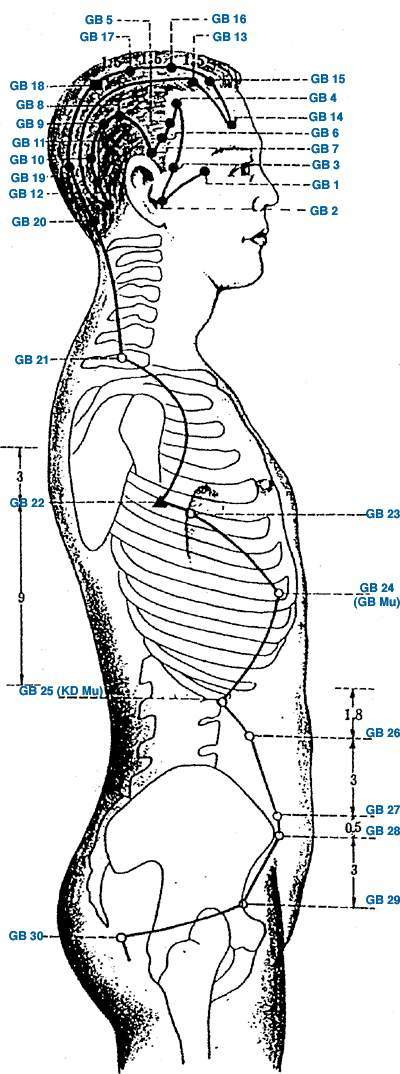
Location: 0.5
cun lateral to the outer canthus.
Indications: Eye diseases, headache, facial
paralysis, etc.
GB2: TING
HUI
Location: Posterior & anterior to the tragus, anterior to the tragic
notch. Within the depression when the mouth is opened.
Indications: Deafness,
tinnitus, otitis media, facial paralysis, arthritis of the mandible joint, etc.
GB3: SHANG GUAN
Location: In front
of the ear, on the upper border of the zygomatic arch, directly above Xiaguan
(S7).
Indications: Deafness, tinnitus, facial paralysis toothache, etc.
GB4: HAN YAN
Location: 1 cun below
Touwei (S8) on the hairline of the temporal region. There is a slight movement
during chewing.
Indications: Migraine, dizziness, tinnitus, rhinitis, facial
paralysis, etc.
GB5: XUAN
LU
Location: In the line connecting Hanyan (GB4) & Qubin (GB7) at the
junction of anterior & middle third of the line.
Indications: Migraine
headaches, neurasthenia, toothache, etc.
GB6:
XUAN LI
Location: In the line connecting Hanyan (GB4) & Qubin (GB7) at
the junction of inferior & middle third of the line.
Indications:
Migraine headaches, neurasthenia, facial swelling, toothache, etc.
GB7: QU BIN
Location: At the
crossing point of the horizontal line of the auricle & the line that
projects from the anterior auricle.
Indications: Pain & swelling of cheek
& submaxillary region, difficulty in opening mouth, headaches, stiff neck,
etc.
GB8: SHUAI GU
Location: If you
fold the ear over; the point is directly above the auricular apex, 1.5 cun
within the hairline.
Indications: Migraine headaches, dizziness &
vertigo, etc.
GB9: TIAN CHONG
Location: 0.5
cun posterior to Shuaigu (GB8), superior & posterior to the auricle, 2 cun
inside the hairline.
Indications: Headache, swelling & pain of the gum,
epilepsy, etc.
GB10: FU BAI
Location: About 1
cun inferior to Tianchong (GB9), at the upper border of the root of the auricle,
1 cun beyond the hairline.
Indications: Tinnitus, deafness, toothache,
tonsillitis, etc.
GB11: QIAO
YIN
Location: Midpoint of the line connecting Fubai (GB10) & Wangu
(GB12).
Indications: Ophthalmalgia, vertical headache, etc.
GB12: WAN GU
Location: In the
depression posterior & inferior to the mastoid process. Bend the neck to
locate this point easily.
Indications: Tinnitus, toothache, swelling of
cheek, facial paralysis, etc.
GB13: BEN
SHEN
Location: 0.5 cun inside the hairline, directly above the outer
canthus.
Indications: Epilepsy, stiff neck, etc.
GB14: YANG BAI
Location: 1 cun
above the midpoint of the eyebrow.
Indications: Facial paralysis, frontal
headache, night blindness, glaucoma, etc.
GB15:
LIN QI
Location: When looking straight ahead, it is 0.5 cun inside the
hairline, directly above the pupil of the eye.
Indications: Nasal
obstruction, eye diseases, apoplexy, epilepsy, etc.
GB16: MU CHUANG
Location: 1 cun
above head Linqi (GB15).
Indications: Eye diseases, facial swelling, etc.
GB17: ZHENG YING
Location: 1 cun
posterior to Muchuang (GB16).
Indications: Headache, toothache, etc.
GB18: CHENG LING
Location: 1.5 cun
posterior to Zhengying (GB17).
Indications: Headache, nasal obstruction,
epistaxis, etc.
GB19: NAO
KONG
Location: 1.5 cun above Fengchi (GB20), on the lateral side of the
occipital protuberance.
Indications: Headache, stiff neck, epistaxis, asthma,
etc.
GB20: FENG CHI
Location: In a
depression between the sterno-cleido-mastoideus & the upper portion of the
trapezius muscle. Specifically, between the depression directly inferior to the
occipital protuberance & the mastoideus.
Indications: Common cold,
headache, dizziness & vertigo, stiffness of neck, hypertension, tinnitus,
etc.
GB21: JIAN JING
Location: Midway
between Dazhui (D14) & the acromion, at the highest point of the
shoulder.
Indications: Pain in shoulder & back, rigidity & stiffness
of neck, motor impairment of upper extremities, mastitis, hyperthyroidism,
functional uterine bleeding, etc.
GB22: YUAN
YE
Location: 3 cun below the anterior axillary fold, on the axillary line, in
the 4th intercostal space when the arm is raised.
Indications: Pleuritis,
intercostal neuralgia, inflammation of the axillary lymph nodes, etc.
GB23: ZHE JIN
Location: 1 cun
anterior to Yuanye (GB22), in the 4th intercostal space.
Indications:
Vomiting, gastric acidity, salivation, asthma, etc.
GB24: RI YUE
Location: One rib
directly below Qimen (V14), in 7th intercostal space.
Indications:
Gastralgia, hepatitis, cholecystitis, hiccups, etc.
GB25: JING MEN
Location: On the
lateral side of the abdomen, at the lower border of the free end of the 12th
rib.
Indications: Borborygmus, costal pain, abdominal distention, etc.
GB26: DAI MAI
Location: Midway
between the free ends of the 11th & 12th ribs, level with the
umbilicus.
Indications: Endometritis, cystitis, lumbago, costal & back
pain, irregular female menstruation, etc.
GB27:
WU SHU
Location: 3 cun anterior & inferior to Daimai (GB26), level with
Guanyuan (R4), in front of the anterior superior iliac spine.
Indications:
Pain in the lower abdomen, lumbago, endometritis, orchitis, etc.
GB28: WEI DAO
Location: Anterior
& inferior to the anterior superior iliac spine, 0.5 cun anterior &
inferior to Wushu (GB27).
Indications: Endometritis, pain in lower abdomen,
chronic constipation, etc.
GB29: JU
LIAO
Location: Midway between the anterior superior iliac spine & the
highest point of the greater trochanter of the femur. Locate the point when in
recumbent position.
Indications: Disorders of the hip joint & its
surrounding soft tissue, pain in the lower extremities, etc.
GB30: HUAN TIAO
Location: At the
junction of the middle & lateral third of the distance between the highest
point of the great trochanter of the femur & the hiatus of the
sacrum.
Indications: Sciatica, paralysis of lower extremities, disorders of
the hip joint & its surrounding soft tissue, etc.
GB31: FENG SHI
Location: At the
lateral side of the thigh, 7 cun above the transverse popliteal crease, between
the vastus lateralis & the biceps femoris. When standing erect & hands
close to your thighs, the point is at the tip of your middle
finger.
Indications: Paralysis of lower extremities, pain in lumbar region
& legs, neurodermatitis of lateral aspect of thigh, etc.
GB32: ZHONG DU
Location: On the
lateral aspect of the thigh, 2 cun below the Fengshi (GB31)
point.
Indications: Hemiplegia, sciatica, etc.
GB33: XI YANG GUAN
Location: In
the depression superior to the lateral epicondyle of the femur, 3 cun above the
Yanglingquan (GB34) point.
Indications: Pain in the knee joint, etc.
GB34: YANG LING QUAN
Location: In
the depression anterior & inferior to the small head of the
fibula.
Indications: Hemiplegia, diseases of the gall bladder, lumbago &
leg pain, dizziness & vertigo, acid regurgitation, etc.
GB35: YANG JIAO
Location: 7 cun
above the tip of the external malleolus, in the anterior border of the fibula,
on the line connecting the tip of the external malleolus with Yanglingquan
(GB34).
Indications: Pain in lateral aspect of leg, sciatica, asthma, etc.
GB36: WAI QIU
Location: Level
& 1 cun posterior to the Yangjiao (GB35) point & posterior to the border
of the fibula.
Indications: Pain in lateral part of leg, spasm of the
gastrocnemius, etc.
GB37: GUANG
MING
Location: 5 cun above the tip of external malleolus, close to the
anterior border of the fibula.
Indications: Eye diseases, pain in lower
extremities, etc.
GB38: YANG
FU
Location: 4 cun above the tip of external malleolus, on the anterior
border of the fibula.
Indications: Lumbago, arthritis of the knee joint,
general malaise, etc.
GB39: XUAN
ZHONG
Location: 3 cun above the external malleolus, between the posterior
border of the fibula & the tendons of the peronaeus longus &
brevis.
Indications: Paralysis of lower extremities, stiffness & rigidity
of neck, disorders of the ankle joint & the surrounding tissue, etc.
GB40: QIU XU
Location: Anterior
& inferior to the external malleolus, in the depression on the lateral side
of the tendon of the extensor digitorum longus.
Indications: Pain in the
lower extremities, pain in the ankle joint, thoracalgia, etc.
GB41: LIN QI
Location: In the
depression anterior to the junction of the 4th & 5th metatarsal
bones.
Indications: To stop secretion of breast milk, mastitis, irregular
menstruation, pain in foot, deafness, tinnitus, etc.
GB42: DI WU HUI
Location: On the
cleft between the 4th & 5th metatarsal bones, 0.5 cun anterior to the Linqi
(GB41) point.
Indications: Tinnitus, pain in the axilla, mastitis, etc.
GB43: XIA XI
Location: On the
cleft between the 4th & 5th metatarsal bones, 0.5 cun proximal to the margin
of the web.
Indications: Deafness, headache, dizziness, chest pain,
intercostal neuralgia, etc.
GB44: QIAO
YIN
Location: On the lateral side of the tip of the 4th toe, 0.1 cun
posterior to the corner of toe nail.
Indications: Pleuritis, asthma,
headache, pharyngitis, etc.
The Liver Meridian (Yin/Lower
Limb)
Synopsis: The
Liver is the important Organ which stores & transforms the blood.
Course: This Channel originates at the big toe & runs
over the dorsum of the foot, along the medial aspect of the leg & the medial
side of the knee; then ascending further along the medial aspect of the thigh it
reaches the inguinal region; from here it courses to the tip of the 11th rib
& runs anteriorly along the costal border to its last point between the 6th
& 7th ribs on the nipple line.
V1:
DA DUN
Location: On the lateral aspect of the dorsum of the terminal phalanx
of the big toe, midway between the lateral corner of toenail &
interphalangeal joint.
Indications: Enuresis, menorrhagia, hernia, etc.
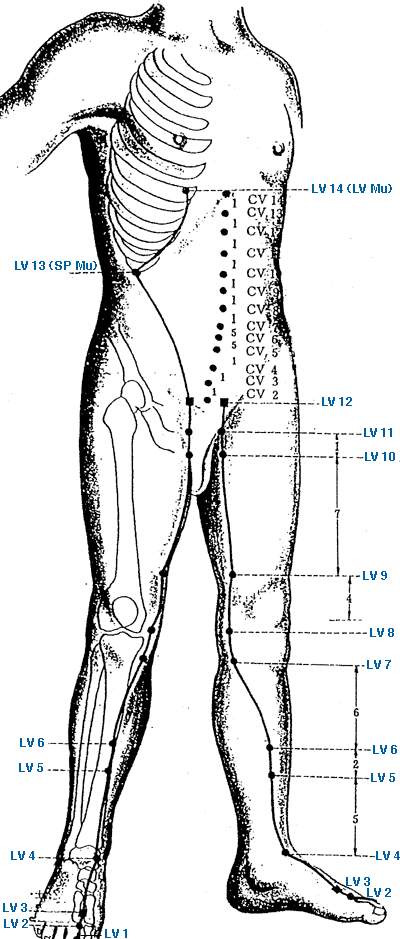
V2: XING JIAN
Location: 0.5 cun
proximal to the margin of the web between the 1st & 2nd
toes.
Indications: Irregular menstruation, urethritis, enuresis, pain in the
costal region, hypertension, epilepsy, insomnia, redness & swelling of eye,
etc.
V3: TAI CHONG
Location: Between
the 1st & 2nd toe, 2 cun proximal to the margin of the web.
Indications:
Headache, dizziness, epilepsy, convulsions in children & infants, eye
diseases, hernia, uterine bleeding, mastitis, etc.
V4: ZHONG FENG
Location: 1 cun
anterior to the medial malleolus, in the depression medial to the tendon of the
tibialis anticus.
Indications: Pain in the lower abdomen, retention of urine,
hernia, spermatorrhea, pain in the penis, etc.
V5: LI GOU
Location: 5 cun
superior to the medial malleolus, on the posterior border of the
tibia.
Indications: Inflammation of the pelvic organs, retention of urine,
spermatorrhea, impotence, etc.
V6: ZHONG
DU
Location: 7 cun superior to the tip of the medial malleolus, on the
posterior border of the tibia.
Indications: Irregular menstruation, hernia,
pain in the joints of lower extremities, etc.
V7:
XI GUAN
Location: In the posterior & inferior aspect of the medial
condyle of the tibia, 1 cun posterior to the Yinlingquan (N9)
point.
Indications: Pain in the knee joint, etc.
V8: QU QUAN
Location: At the
medial end of the transverse crease of the knee joint, in a depression at the
anterior border of the semimembranosus & the semitendinosus.
Indications:
Infection of urogenital system, spermatorrhea, impotence, hernia, disorders of
the knee joint & its surrounding soft tissue, etc.
V9: YIN BAO
Location: 4 cun
superior to the medial epicondyle of the femur, between the vastus medialis
& the sartorius.
Indications: Lumbago, pain in the lower abdomen,
enuresis, irregular menstruation, etc.
V10:
WU LI
Location: 1 cun below the Yinlian (V11) point in the medial aspect of
thigh.
Indications: Distention in the lower abdomen, retention of urine,
enuresis, eczema of the scrotum, etc.
V11: YIN
LIAN
Location: 1 cun inferior to the lateral aspect of the femoral artery in
the inguinal groove.
Indications: Femoral neuralgia, lumbago, pain in leg,
paralysis of lower extremities, irregular menstruation, etc.
V12: JI MAI
Location: 2.5 cun
lateral to and 1 cun inferior to the superior border of the pubic symphysis, at
the lower portion of the inguinal groove.
Indications: Pain in the penis,
prolapse of the uterus, pain in the lower abdomen, pain in the medial aspect of
thigh, etc.
V13: ZHANG MEN
Location: On the
free end of the 11th rib.
Indications: Splenomegalia, diarrhea, abdominal
distention, pain in the costal region, etc.
V14:
QI MEN
Location: On the mammillary line, directly below the nipple, in the
intercostal space of the 6th & 7th ribs.
Indications: Pleuritis,
hepatitis, chest pain, pain in the hypochondriac region, etc.
.: chal
The Du (Back Midline) Meridian (Yang)
Synopsis: The governing vessel unites the Yang Qi of the whole
body.
Course: In the back midline, from the anus
to the mouth. The Du Channel is one of the 2 unpaired channels, the other being
the Ren Channel which runs in the front midline. These 2 midline channels are
also classified with the 8 Extra Channels, as distinct from the 12 paired
regular "organ" Channels. However, the modern practice is to classify them with
the paired Channels to make up the 14 Channels. The Du Channel is not linked to
any definite "organ," yet it has a controlling or "governing" influence on all
the other Yang channels, and hence it occupies a very important place in
acupuncture/acupressure; "Du" in Chinese means "the Governor."
D1: CHANG QIANG
Location: Midway
between the tip of the coccyx & the anus, located in prone or knee-chest
position.
Indications: Hemorrhoids, prolapse of rectum, diarrhea, etc.
D2: YAO SHU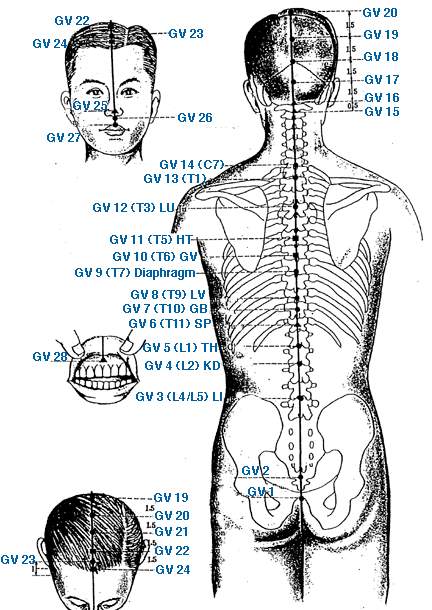
Location: At the
junction between the sacrum & the coccyx, at the hiatus of the
sacrum.
Indications: Pain in the sacrolumbar region, irregular menstruation,
spermatorrhea, impotence, enteritis, diarrhea, etc.
D3: YAO YANG QUAN
Location: In the
interspace of the spinous process between the 4th & 5th lumbar
vertebrae.
Indications: Lumbago, spermatorrhea, male impotence, etc.
D4: MING MEN
Location: When in
prone position, it is between the spinous process of the 2nd & 3rd lumbar
vertebrae, at the midline.
Indications: Lumbago, spermatorrhea, male
impotence, etc. Often used in Qigong & Taijiquan texts.
D5: XUAN SHU
Location: Below the
spinous process of the 1st lumbar vertebra. Locate the point with the patient in
prone position.
Indications: Lumbago, back pain, dyspepsia, enteritis,
diarrhea, etc.
D6: JI ZHONG
Location: Below
the spinous process of the 11th thoracic vertebra. Locate the point when in
prone position.
Indications: Epilepsy, hemorrhoids with bleeding, etc.
D7: ZHONG SHU
Location: Below the
spinous process of the 10th thoracic vertebra.
Indications: Back pain,
gastralgia, anorexia, poor eyesight, etc.
D8:
JIN SUO
Location: Below the spinous process of the 9th thoracic
vertebra.
Indications: Back pain, gastralgia, neurasthenia, epilepsy,
hysteria, etc.
D9: ZHI YANG
Location: Below
the spinous process of the 7th thoracic vertebra, level to the inferior angle of
the scapula.
Indications: Cough, dyspnea, jaundice, gastralgia, chest &
back pain, stiffness of the spinal column, etc.
D10: LING TAI
Location: Below the
spinous process of the 6th thoracic vertebra.
Indications: Asthma,
bronchitis, lumbago & back pain, gastralgia, etc.
D11: SHEN DAO
Location: Below the
spinous process of the 5th thoracic vertebra.
Indications: Poor memory,
anxiety, stiffness of back, persistent cough, etc.
D12: SHEN ZHU
Location: Below the
spinous process of the 3th thoracic vertebra.
Indications: Cough, dyspnea,
epilepsy, stiffness & pain in back, etc.
D13: TAO DAO
Location: Below the
spinous process of the 1th thoracic vertebra. Locate the point when in prone
position.
Indications: Stiffness of back, headache, malaria, febrile
diseases, epilepsy, etc.
D14: DA
ZHUI
Location: Between the 7th cervical vertebra & the spinous process of
the 1st thoracic vertebra.
Indications: Fever, heat stroke, malaria,
schizophrenia, epilepsy, asthma, eczema, etc.
D15: YA MEN
Location: At the nape,
0.5 cun above the hairline, between the spinous process of the 1st & 2nd
cervical vertebrae.
Indications: Deafness & muteness, posterior headache,
stiffness of neck, schizophrenia, neurosis, etc.
D16: FENG FU
Location: Directly
below the occipital protuberance, in the midline, in a depression 1 cun above
the hairline.
Indications: Cold, headache, mental disorders, apoplexy, etc.
D17: NAO HU
Location: 1.5 cun
above the Fengfu (D16) point, superior to the occipital
protuberance.
Indications: Stiffness & pain in the neck, headache,
dizziness, epilepsy, etc.
D18: QIANG
JIAN
Location: 1.5 cun above Naohu (D17) point, midway between Fengfu (D16)
& Baihui (D20) points.
Indications: Headache, vomiting, dizziness, etc.
D19: HOU DING
Location: 1.5 cun
anterior to the Qiangjian (D18) point.
Indications: Headache, dizziness &
vertigo, etc.
D20: BAI HUI
Location: 7 cun
above the posterior hairline, midway on a line connecting the apex of both ears,
often described as in the "twirl" of the hair.
Indications: Epilepsy,
schizophrenia, apoplexy, headache, etc. This is an alignment point that aids in
positioning Taijiquan & Qigong practitioners.
D21: QIAN DING
Location: 1.5 cun
anterior to the Baihui (D20) point.
Indications: Vertical headache, dizziness
a& vertigo, facial swelling, convulsions in young children, etc.
D22: XIN HUI
Location: 3 cun
anterior to Baihui (D20).
Indications: Headache, dizziness & vertigo,
nasal obstruction, epistaxis, convulsions in young children, etc.
D23: SHANG XING
Location: 1 cun
above the middle of the anterior hairline, 4 cun anterior to the Baihui (D20)
point.
Indications: Headache, eye diseases, rhinitis, nasal obstruction,
epistaxis, etc.
D24: SHEN
TING
Location: 0.5 cun above the midpoint of the anterior
hairline.
Indications: Frontal headache, dizziness and vertigo, rhinitis,
epilepsy, anxiety, insomnia, etc.
D25: SU
LIAO
Location: At the tip of the nose.
Indications: Nasal obstruction,
epistaxis, abscess in nose, rosacea, rhinitis, shock, etc.
D26: REN ZHONG
Location: In the
midline at the junction of the upper & lower 2/3rds of the upper
lip.
Indications: Shock, heat stroke, lumbago, epilepsy, facial paralysis,
etc.
D27: DUI DUAN
Location: On the
median tubercle of the upper lip, at the junction of the philtrum & the
upper lip.
Indications: Toothache, thrush, halotosis, etc.
D28: YIN JIAO
Location: Between
the upper lip & the upper gum in the labial frenum.
Indications: Pain
& swelling of the gum, hemorrhoids, etc.
.: chalk o
| ch
The Ren (Front Midline) Meridian (Yin)
R1: HUI
YIN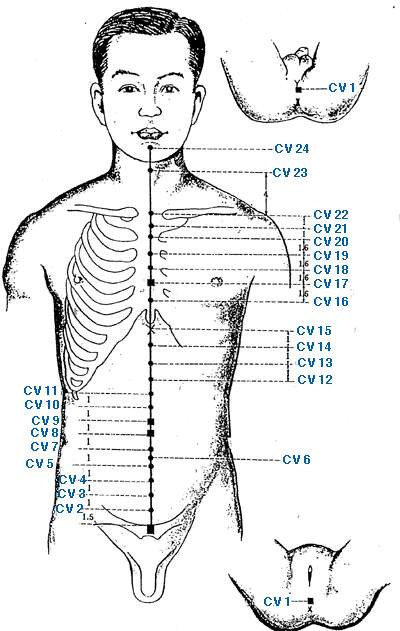
Location: In the centre of the perineum, between the anus & the
scrotum in the male or the anus & the posterior labial commissure in the
female.
Indications: Hemorrhoids, urethritis, pain in the penis, irregular
menstruation, prolapse of the uterus, etc. This is a major posture-alignment
point for Taijiquan & Qigong practitioners
R2: QU GU
Location: In the
superior border of the pubic symphysis, on the midline of the
abdomen.
Indications: Spermatorrhea, impotence, irregular menstruation,
leukorrhea, menorrhalgia, pelvic inflammation, incontinence or retention of
urine, etc.
R3: ZHONG JI
Location: 4 cun below
the umbilicus, on the midline of the abdomen. Locate this point in
supination.
Indications: Spermatorrhea, impotence, irregular menstruation,
leukorrhea, menorrhalgia, pelvic inflammation, incontinence or retention of
urine, etc.
R4: GUAN YUAN
Location: 3 cun
below the umbilicus, on the midline of the abdomen.
Indications:
Spermatorrhea, impotence, menorrhalgia, irregular menstruation, diarrhea,
enuresis, etc. This point is often used for tonic purposes & for general
health maintenance.
R5: SHI
MEN
Location: 2 cun below the umbilicus, on the midline of the
abdomen.
Indications: Abdominal distention, edema, dysuresis, irregular
menstruation, amenorrhea, leukorrhea, etc.
R6:
QI HAI
Location: 1.5 cun below the umbilicus, on the midline of the
abdomen.
Indications: Abdominal distention, abdominal pain, irregular
menstruation, uterine bleeding, enuresis, spermatorrhea, neurasthenia, etc.
R7: YIN JIAO
Location: 1 cun below
the umbilicus, on the midline of the abdomen.
Indications: Urethritis,
endometritis, irregular menstruation, postpartum pain, hernia, etc.
Location: In the
centre of the umbilicus.
Indications: Apoplexy of the flaccid type, abdominal
pain, diarrhea, etc.
R9: SHUI
FEN
Location: 1 cun above the umbilicus, on the midline of the
abdomen.
Indications: Dysuresis, edema, borborygmus, diarrhea, etc.
R10: XIA WAN
Location: 2 cun above
the umbilicus, on the midline of the abdomen.
Indications: Gastralgia,
dyspepsia, gastroptosis, enteritis, etc.
R11:
JIAN LI
Location: 3 cun above the umbilicus, on the midline of the
abdomen.
Indications: Gastralgia, vomiting, dyspepsia, edema, peritonitis,
etc.
R12: ZHONG WAN
Location: Midpoint
on a line connecting the xyphoid process with the umbilicus. Locate this point
with patient in supine position.
Indications: Gastralgia, gastroptosis,
vomiting, dyspepsia, abdominal distention, etc.
R13: SHANG WAN
Location: 5 cun
above umbilicus, on the midline of the abdomen.
Indications: Gastritis,
gastric ulcer, vomiting, abdominal distention, etc.
R14: JU JUE
Location: 6 cun above
umbilicus, on the midline of the abdomen.
Indications: Anxiety, palpitation,
gastralgia, vomiting, etc.
R15: JIU
WEI
Location: 7 cun above umbilicus.
Indications: Pain in cardiac region,
gastralgia, vomiting, hiccough, epilepsy, mental disorders, etc.
R16: ZHONG TING
Location: In the
midline of the sternum, at the level of the 5th intercostal space, 1.6 cun below
the Shan Zhong (RN17) point.
Indications: Asthma, cough, infantile
regurgitation, vomiting, etc.
R17: SHAN
ZHONG
Location: Midway between the two nipples.
Indications: Bronchitis,
bronchial asthma, thoracalgia, fullness of chest, hiccups, etc.
R18: YU TANG
Location: On the
midline of abdomen, 1.6 cun above Shanzhong (R17), at the level of the 3rd
intercostal space.
Indications: Bronchitis, asthma, pleuritis, vomiting, etc.
R19: ZI GONG
Location: On the
midline of the sternum, 3.2 cun above the Shanzhong (R17) point, at the level of
the 2nd intercostal space.
Indications: Bronchitis, pulmonary tuberculosis,
pleuritis, etc.
R20: HUA
GAI
Location: Midway between Xuanji (R21) & Zigong (R19).
Indications:
Bronchial asthma, etc.
R21: XUAN
JI
Location: On the midline of the sternum, 1 cun below the Tiantu (R22)
point.
Indications: Thoracalgia, cough & asthma, pain & swelling of
the throat, etc.
R22: TIAN
TU
Location: At the center of the suprasternal fossa 0.5 cun above the
sternal notch.
Indications: Bronchial asthma, bronchitis, pharyngitis,
hiccups, etc.
R23: LIAN QUAN
Location: In the
midline of the neck, midway between the tip of the cricoid cartilage & the
border of the mandible.
Indications: Aphasia, pharyngitis, laryngitis, etc.
R24: CHENG JIANG
Location: At the
depression in the middle of the mental labial groove.
Indications: Facial
paralysis, swelling of the gum, toothache, excess salivation, etc.
Extraordinary Points
Synopsis: After the points had been numbered in ancient
times & placed in their appropriate Channels, many new points were discovered
during the course of the succeeding centuries. These new points are termed
"Extraordinary Points." While the majority fall outside the 14 Channels, some
are located on the course of a Channel, and a few even coincide with regular
points of the Channels. The following are commonly used
Extraordinary Points:
EX1: YIN
TANG
Location: Midway between the medial end of the two eyebrows (the
glabella).
Indications: Diseases of the nose, headache, dizziness &
vertigo, etc.
EX2: TAI YANG
Location: On the
temple, in the depression 1 cun posterior to the midpoint of a line connecting
the outer end of the eyebrow with the outer canthus of the eye.
Indications:
Headache, migraine, eye diseases, facial paralysis, trigeminal neuralgia,
toothache, sinusitis, etc.
EX3: YU
YAO
Location: At the midpoint of the eyebrow, vertically above the midpoint
of the pupil.
Indications: Frontal sinusitis, eye disorders, facial
paralysis, etc.
EX4: QIU
HOU
Location: At the junction of the lateral 4th & the medial 3/4ths of
the infra-orbital border.
Indications: Myopia, optic nerve disorders,
glaucoma, eye disorders, etc.
EX5: JIA CHENG
JIANG
Location: In the depression on the mental foramen, 1 cun lateral to
Chengjiang (R24).
Indications: Facial paralysis, trigeminal neuralgia, lower
toothache, etc.
EX6: SI SHEN
CONG
Location: At the vertex, 1 cun posterior, anterior & lateral to the
Baihui (D20).
Indications: Headache, dizziness, apoplexy, epilepsy, etc.
EX7: YI MING
Location: 1 cun
posterior to Yifeng (TH17); lies on a straight line connecting Yifeng (TH17)
& Fengchi (GB20).
Indications: Ear & eye disorders, etc.
EX8: AN MIAN 1
Location: Between
Yifeng (TH17) & Yiming (EX7); 0.5 cun posterior to Yifeng
(TH17).
Indications: Insomnia, etc.
EX9:
AN MIAN 2
Location: Between Yiming (EX7) & Fengchi
(GB20).
Indications: Insomnia, etc.
EX10:
JIN JIN (left) & YU YE (right)
Location: On the sublingual veins on
either side of the root of the tongue.
Indications: Swelling of the tongue,
ulceration of the oral mucous membrane, thrush, aphasia, nausea, vomiting,
aphthous stomatitis, etc.
EX17: DING
CHUAN
Location: 0.5 cun lateral to Dazhui (D14); one of the Huatuojiaji
(EX21) points.
Indications: Bronchial asthma, etc.
EX20: YAO QI
Location: 2 cun
directly above the coccyx.
Indications: Epilepsy, muscular relaxation, etc.
EX21: HUA TUO JIA JI
Location: A
series of 28 pairs of points situated 0.5 cun lateral to the lower ends of the
dorsal spines of the 1st cervical to the 4th secret vertebrae.
Indications:
Pain along the spine, pain along the segmental nerve, disorders of the "Internal
Organ" at the corresponding level, etc.
EX28:
BA XIE
Location: On the dorsum of the hand, on the webs between the 5
fingers; 4 points in each hand, totalling 8 points.
Indications: Disorders of
the fingers, rheumatoid arthritis, numbness of the fingers, polyneuropathy, etc.
EX30: SHI XUAN
Location: On the
tips of the ten fingers, about 0.1 cun posterior to the apex of the
nail.
Indications: Shock, coma, heat strokes, apoplexy, fever, etc.
EX31: HE DING
Location: On the
midpoint of the upper border of the patella.
Indications: Disorders of the
knee joint, etc.
EX32: XI
YAN
Location: In the depression on the medial side of the ligamentum
patellae.
Indications: Disorders of the knee joint, etc.
EX33: LAN WEI
Location: 2 cun
below Zusanli (S36).
Indications: Appendicitis, post-operative pain after
appendicectomy, etc.
EX35: DAN
NANG
Location: 1 cun distal to Yanglingquan (GB34).
Indications: Diseases
of the gall bladder and the liver, etc.
EX36:
BE FENG
Location: On the dorsum of the foot, 0.5 cun proximal to the borders
of the webs between the 5 toes; 4 points on each foot, totalling 8
points.
Indications: Arthritis of the toes, numbness of the foot & the
toes, polyneuropathy, etc.
The Un-Numbered Extraordinary Points
Synopsis: These are points which have
been discovered in recent times, most of them were identified by medical workers
in the People's Republic of China, especially the points used in acupuncture
anaesthesia. There is still no universal agreement among
acupuncturists/acupressure therapists regarding the uses of these points; time
must elapse and more experience gained before they could be more precisely
categorised. Although there is a large collection of these points, only those in
common usage have been described. The total number described in international
literature exceeds a staggering 1500. Small wonder these are also known as
strange points. The following are commonly used Un-Numbered Extraordinary
Points:
UEX: BIEN TAO
Location: At the
level of the lower margin of the angle of the jaw, anterior to the carotid
artery; 1 cun inferior to Jiache (S6).
Indications: Acute tonsillitis,
trismus, etc.
UEX: HOU TING GONG
Location: On
the root of the ear, level with Tinggong (SI19).
Indications: Deafness,
deaf-mutism, dizziness, vertigo, chronic ear infections, pain of middle ear
disease, etc.
UEX: XIA YI FENG
Location: 1
cun below Yifeng (TH17).
Indications: Tonsillitis, sore throat, aphasia, etc.
UEX: BI PAY
Location: At the upper
end of the anterior crease of the axilla.
Indications: Heart disease, rhythm
disorders, angina pectoris, etc.
UEX: JIAN
NEI LING
Location: Midway between Bipay (UEX) & Jianyu
(LI15).
Indications: Tendinitis of the long head of biceps, frozen shoulder,
etc.
UEX: JIAN QUAN
Location: Midway
between Jianyu (LI15) & Jianliao (TH14).
Indications: Supra-spinatus
tendinitis, etc.
UEX: TA
NER
Location: Midpoint of the deltoid muscle.
Indications: Paralysis of
the deltoid muscle, stroke, etc.
UEX: TUN
ZHONG
Location: Midpoint between Huantiao (GB30) & the anterior superior
iliac spine.
Indications: Low backache, sciatica, Paraplegia, urticaria,
sacroiliac disease, etc.
UEX: YAO
YANG
Location: In the depression over the sacroiliac joint.
Indications:
Low backache, sacroiliac disease, pain of secondary carcinoma of the spine, etc.
UEX: DING CHAN
Location: 3 cun
proximal to Heding (EX31).
Indications: Arthritis of the knee, paralysis of
the lower limb, knee disorders, wasting of the quadriceps, etc.
UEX: NEI MA
Location: On the
medial border of the tibia, midway between the ankle joint & the knee joint.
This point coincides with Zhongdu (V6).
Indications: An anaesthetic point
used in childbirth, lower abodominal, pelvic & perineal surgery.
UEX: WAI MA
Location: On the same
level as Neima (UEX) on the lateral side of the leg, 9 cun above the tip of the
lateral malleolus on the Stomach Channel.
Indications: All abdominal &
pelvic surgery.