Acupoints
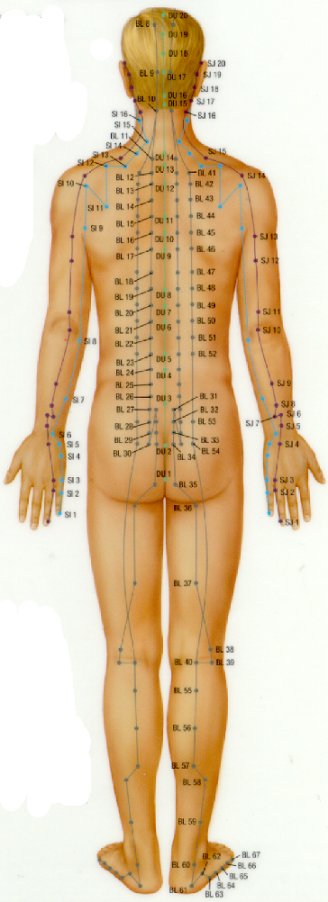
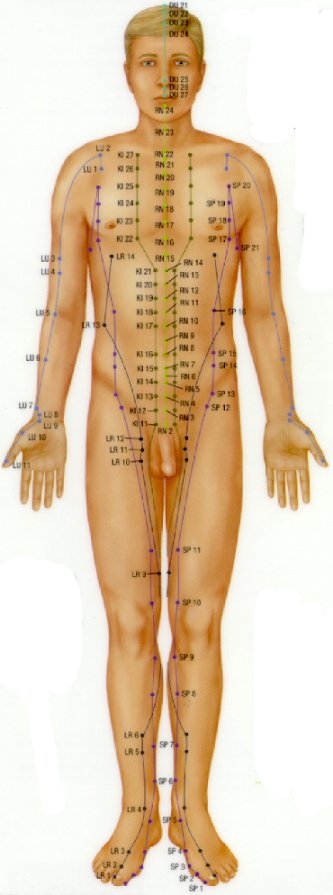
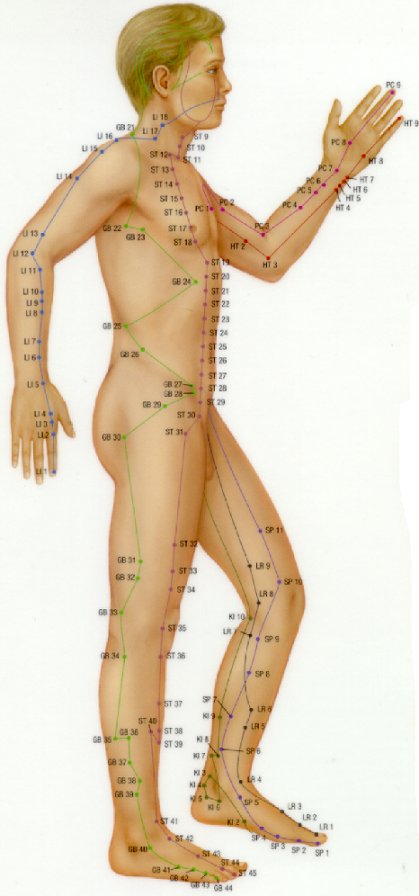
They are located on the organ meridians and on two of the extraordinary vessels. They are areas of potential imbalance, where Qi, which circulates in the meridians, is most likely to become obstructed. Western research has shown that approximately 85% of the classical acupoints have a higher electro-magnetic resistance than the immediate surrounding area. This implies that they are areas where electro-magnetic current, our "information highway", is most likely to be disrupted.
There are 364 classical acupoints points on the organ meridians and on two of the extraordinary vessels, the Governing and the Conception vessels. Besides being areas of potential obstruction in the flow of Qi, many of the acupoints have specific energetics, are used as diagnostic points, and impart information to the body. As an example, the acupoint, Lieque "Relieves the Exterior and Dispels Wind, Promotes the Descending Function of the Lungs, Benefits the Head and Neck, and Opens and Regulates the Conception Vessel." When combined with Hegu it is used for the common cold, when combined with Zhaohai it is used for chronic sore throat. It may also be used to treat headache and stiffness of the neck and nape.
The UN (United Nations) has standardized the names of the classical acupoints. They are named for the organ meridian they are on, and the order in which they fall. Besides the classical acupoints, there are hundreds of "extra points", of which approximately 20 are used with frequency
Modern classification of acupoints
includes:
- 361 Classical Chinese Points
- 171 Extra-Meridian Points
- 110 "New" Points
- 142 Auricular Points
Specific properties
of Acupoints:
- Electrical
- Biochemical
- Histological
- Anatomical
|
|
|
|