
| Fuzzy logic has rapidly become one of the most successful of today's technologies for developing sophisticated control systems. The reason for which is very simple. Fuzzy logic addresses such applications perfectly as it resembles human decision making with an ability to generate precise solutions from certain or approximate information. It fills an important gap in engineering design methods left vacant by purely mathematical approaches (e.g. linear control design), and purely logic-based approaches (e.g. expert systems) in system design. | |
What does it offer?
Ancient Greece
The world's getting fuzzier
It's heeere
Before illustrating the mechanisms which make fuzzy logic
machines work, it is important to realize what fuzzy logic actually is. Fuzzy
logic is a superset of conventional(Boolean) logic that has been extended to
handle the concept of partial truth- truth values between "completely true" and
"completely false". As its name suggests, it is the logic underlying modes of
reasoning which are approximate rather than exact. The importance of fuzzy logic
derives from the fact that most modes of human reasoning and especially common
sense reasoning are approximate in nature.
Fuzzy Sets
Fuzzy Set Theory was formalised by Professor Lofti Zadeh at the University of
California in 1965. What Zadeh proposed is very much a paradigm shift that first
gained acceptance in the Far East and its successful application has ensured its
adoption around the world.
A paradigm is a set of rules and regulations which defines boundaries and
tells us what to do to be successful in solving problems within these
boundaries. For example the use of transistors instead of vacuum tubes is a
paradigm shift - likewise the development of Fuzzy Set Theory from conventional
bivalent set theory is a paradigm shift.
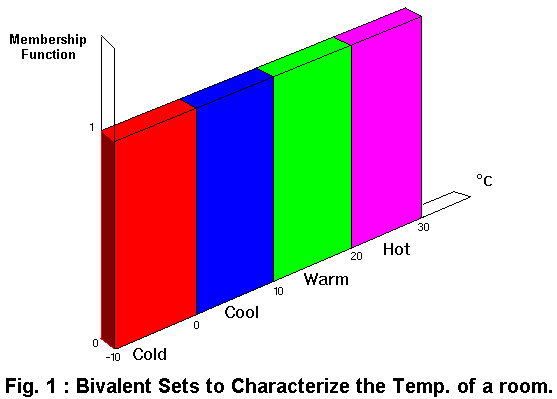
Bivalent Set Theory can be somewhat limiting if we wish to describe a
'humanistic' problem mathematically. For example, Fig 1 below illustrates
bivalent sets to characterise the temperature of a room.
The first applications of fuzzy
theory were primaly industrial, such as process control for cement kilns.
However, as the technology was further embraced, fuzzy logic was used in more
useful applications. In 1987, the first fuzzy logic-controlled subway was opened
in Sendai in northern Japan. Here, fuzzy-logic controllers make subway journeys
more comfortable with smooth braking and acceleration. Best of all, all the
driver has to do is push the start button! Fuzzy logic was also put to work in
elevators to reduce waiting time. Since then, the applications of Fuzzy Logic
technology have virtually exploded, affecting things we use everyday.
Take
for example, the fuzzy washing machine . A load of clothes in it and
press start, and the machine begins to churn, automatically choosing the best
cycle. The fuzzy microwave, Place chili, potatoes, or etc in a fuzzy
microwave and push single button, and it cooks for the right time at the
proper temperature. The fuzzy car, manuvers itself by following simple
verbal instructions from its driver. It can even stop itself when there is an
obstacle immedeately ahead using sensors. But, practically the most exciting
thing about it, is the simplicity involved in operating it.
Background
In fact, almost two centuries earlier,
Buddha saw the world filled with contradictions, that things could be a certain
degree true and a certain degree false at the same time. However, it was Plato
who laid the foundation for what would become fuzzy logic, indicating that there
was a third region (beyond True and False) where these opposites "tumbled about.
The success of modern mathematics is largely due to the efforts of
Aristotle and the philosophers who preceded him. In their efforts to
devise a concise theory of logic, and later mathematics, the so-called
"Laws of Thought" were invented. One of these, the "Law of the Excluded
Middle," stated that every proposition must either be True or False, A or
not-A, either this or not this. For example, a typical rose is either red
or not red. It cannot be red and not red. Every statement or
sentence is true or false or has the truth value 1 or 0. Even then, there
already were strong and immediate objections to this
proposal.
In the early 1900s, Lukasiewicz came and proposed a systematic
alternative to the bi-valued logic(bivalence) of Aristotle. He
described a three-valued logic, which can best be translated as the term
`possible', and assigned it a numeric value between True and False. Knuth,
a former student of Lukasiewicz proposed a three-valued logic apparently
missed by Lukasiewicz, whiched used an integral range [-1, 0 +1] rather
than [0, 1, 2]. Nonetheless, this alternative failed to gain acceptance,
and has passed into relative obscurity.

It was not until relatively recently that the theory
of fuzzy logic was discovered. Lotfi A. Zadeh, a professor of UC Berkeley in
California, soon to be known as the founder of fuzzy logic observed that
conventional computer logic was incapable of manipulating data representing
subjective or vague human ideas such as "an atractive person" or "pretty hot".
Fuzzy logic, hence was designed to allow computers to determine the distinctions
among data with shades of gray, similar to the process of human reasoning. In
1965, Zadeh published his seminal work "Fuzzy Sets" which described the
mathematics of fuzzy set theory, and by extension fuzzy logic. This theory
proposed making the membership function (or the values False and True) operate
over the range of real numbers [0.0, 1.0]. Fuzzy logic was now introduced to the
world.
Although, the technology was introduced in the United States, the
scientist and researchers there, ignored it mainly because of its unconventional
name. They refused to take something which sounded so child-like seriously. Some
mathematicians argued that fuzzy logic was merely probability in disguise. Only
stubborn scientists or ones who worked in discrete continued researching it.
be said that the popularity of fuzzy logic in the
Orient reflects the fact that Oriental thinking more easily accepts the concept
of "fuzziness". And because of this, the US, by some estimates, trail Japan by
at least ten years in this forefront of modern technology.
While the US and certain parts of Europe ignored it, fuzzy logic was
excepted with open arms in Japan, China and most Oriental countries. It
may be suprising to some that the world's largest number of fuzzy
researchers are in China with over 10,000 scientists. Japan, though
currently positioned at the leading edge of fuzzy studies falls second in
manpower, followed by Europe and the USA. Hence, it can
Fuzzy Sets and Operations
What do ya mean fuzzy ??!!
The essential characteristics of
fuzzy logic as founded by Zader Lotfi are as follows.
The third statement hence, define Boolean logic as a
subset of Fuzzy logic.
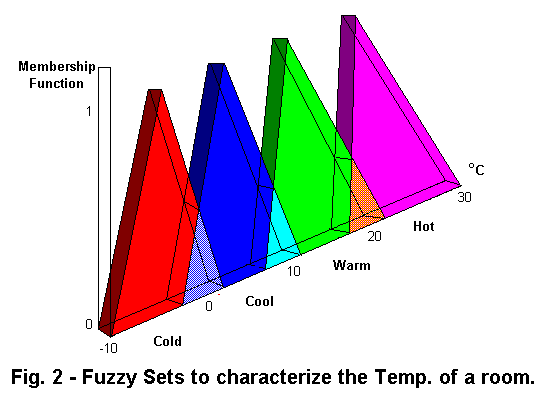
This natural phenomenon can be described more accurately by Fuzzy Set Theory. Fig.2 below shows how fuzzy sets quantifying the same information can describe this natural drift.
young(x) = { 1, if age(x) <= 20,
(30-age(x))/10, if 20 < age(x)
<= 30,
0, if age(x) > 30 }
A graph of this looks like:
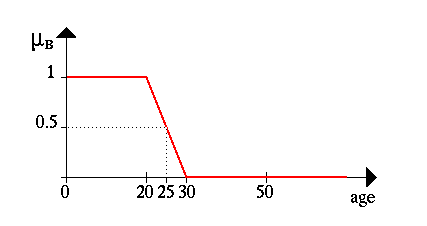
Given this
definition, here are some example values:
Person    Age    degree of youth
---------------------------------------
Johan     10        1.00
Edwin     21        0.90
Parthiban 25        0.50
Arosha    26        0.40
Chin Wei  28        0.20
Rajkumar  83        0.00
So given this definition, we'd say that the degree of truth of the statement "Parthiban is YOUNG" is 0.50.
Note: Membership functions almost never have as simple a shape as age(x). They will at least tend to be triangles pointing up, and they can be much more complex than that. Furthermore, membership functions so far is discussed as if they always are based on a single criterion, but this isn't always the case, although it is the most common case. One could, for example, want to have the membership function for YOUNG depend on both a person's age and their height (Arosha's short for his age). This is perfectly legitimate, and occasionally used in practice. It's referred to as a two-dimensional membership function. It's also possible to have even more criteria, or to have the membership function depend on elements from two completely different universes of discourse.
Fuzzy Set Operations.
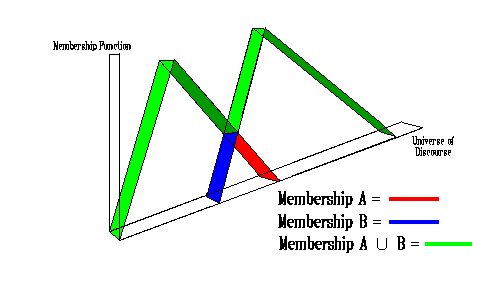
The Union operation in Fuzzy set theory is the equivalent of the OR
operation in Boolean algebra.
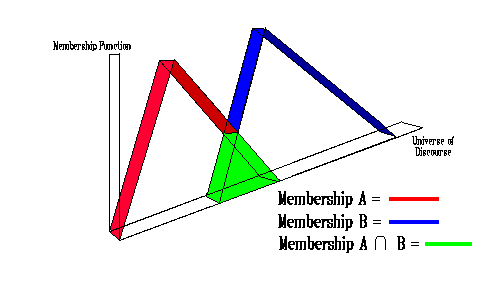
The Intersection operation in Fuzzy set theory is the equivalent of the
AND operation in Boolean algebra.
 Union
Union  and
and  respectively is defined as
the maximum of the two individual membership functions. This is called the
maximum criterion.
respectively is defined as
the maximum of the two individual membership functions. This is called the
maximum criterion.

 Intersection
and respectively is
defined as the minimum of the two individual membership functions. This is
called the minimum criterion.
Intersection
and respectively is
defined as the minimum of the two individual membership functions. This is
called the minimum criterion.

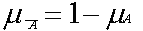
 Complementis defined as
the negation of the specified membership function. This is caleed the
negation criterion.
Complementis defined as
the negation of the specified membership function. This is caleed the
negation criterion.
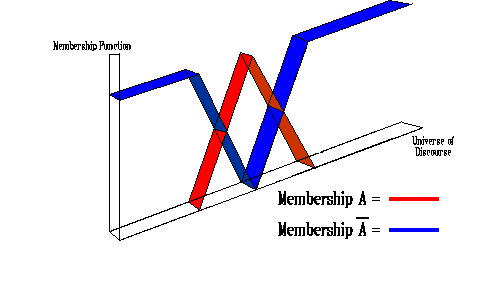
The Complement operation in Fuzzy set theory is the equivalent of the NOT operation in Boolean algebra.
The following rules which are common in classical set theory also apply to Fuzzy set theory.
De Morgans
law ,
, 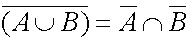 Associativity

Commutativity Distributivity

 Universe of
Discourse
Fuzzy Set
Support
Crossover point
Fuzzy Singleton
Universe of
Discourse
Fuzzy Set
Support
Crossover point
Fuzzy Singleton
Human beings make descisions based on rules. Although, we may not be aware of
it, all the descisions we make are all based on computer like if-then
statements. If the weather is fine, then we may decide to go out. If the
forecast says the weather will be bad today, but fine tommorow, then we make a
descision not to go today, and postpone it till tommorow. Rules associate ideas
and relate one event to another.
Fuzzy machines, which always tend to mimic
the behaviour of man, work the same way. However, the descision and the means of
choosing that descision are replaced by fuzzy sets and the rules are replaced by
fuzzy rules. Fuzzy rules also operate using a series of if-then statements. For
instance, if X then A, if y then b, where A and B are all sets of X and Y. Fuzzy
rules define fuzzy patches, which is the key idea in fuzzy logic.
A
machine is made smarter using a concept designed by Bart Kosko called the Fuzzy
Approximation Theorem(FAT). The FAT theorem generally states a finite number of
patches can cover a curve as seen in the figure below. If the patches are large,
then the rules are sloppy. If the patches are small then the rules are fine.

Fuzzy Control
Fuzzy control, which directly uses fuzzy rules is the
most important application in fuzzy theory. Using a procedure originated by
Ebrahim Mamdani in the late 70s, three steps are taken to create a fuzzy
controlled machine:
1)Fuzzification(Using membership functions to graphically describe a
situation)
2)Rule evaluation(Application of fuzzy rules)
3)Defuzzification(Obtaining the crisp or actual results)
As a simple
example on how fuzzy controls are constructed, consider the following classic
situation: the inverted pendulum. Here, the problem is to balance a pole on a
mobile platform that can move in only two directions, to the left or to the
right. The angle between the platform and the pendulum and the angular velocity
of this angle are chosen as the inputs of the system. The speed of the platform
hence, is chosen as the corresponding output.
Step 1
First of all, the different levels of output (high speed, low speed
etc.) of the platform is defined by specifying the membership functions for the
fuzzy_sets. The graph of the function is shown below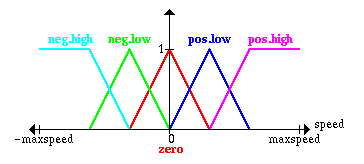
Similary, the
different angles between the platform and the pendulum and...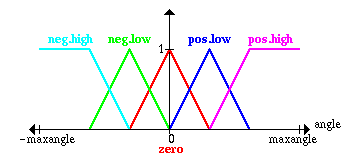
the angular velocities
of specific angles are also defined 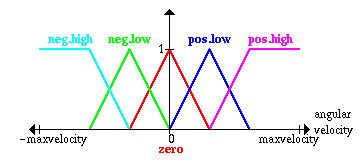
Note: For simplicity,
it is assumed that all membership functions are spreaded equally. Hence, this
explains why no actual scale is included in the graphs.
Step 2
The next step is to define the fuzzy rules. The fuzzy rules are
mearly a series of if-then statements as mentioned above. These statements are
usually derived by an expert to achieve optimum results. Some examples of these
rules are:
i) If angle is zero and angular velocity is zero then speed is
also zero. ii) If angle is zero and angular velocity is low then the speed shall
be low.
The full set of rules is summarised in the table below. The dashes
are for conditions, which have no rules ascociated with them. This is don eto
simplify the situation.
| Speed | Angle | ||||
|---|---|---|---|---|---|
| ------------ | negative high | negative low | zero | positive low | positive high |
| v negative high | ------------ | ----------- | negative high | --------- | --------- |
| e negative low | --------- | --------- | negative low | zero | -------- |
| l zero | negative high | negative low | zero | positive low | positive high |
| o positive low | --------- | zero | low | ----------- | --------- |
c| ---------
| high
| ----------
| ---------
| ----------
| |
An application of these rules is shown using specific values for angle and
angular velocities. The values used for this example are 0.75 and 0.25 for zero
and positive-low angles, and 0.4 and 0.6 for zero and negative-low angular
velocities. These points sre on the graphs below.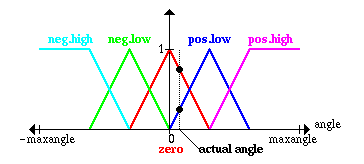
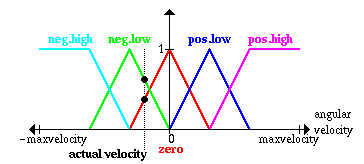
Consider the rule "if
angle is zero and angular velocity is zero, the speed is zero". The actual value
belongs to the fuzzy set zero to a degree of 0.75 for "angle" and 0.4 for
"angular velocity". Since this is an AND operation, the minimum criterion is
used , and the fuzzy set zero of the variable "speed" is cut at 0.4 and the
patches are shaded up to that area. This is illustrated in the figure
below.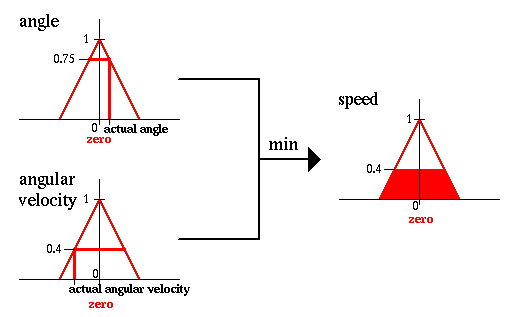
Similarly, the minimum
criterion is used for the other three rule. The following figures show the
result patches yielded by the rule "if angle is zero and angular velocity
is negative low, the speed is negative low", "if angle is positive low and
angular velocity is zero, then speed is positive low" and "if angle is positive
low and angular velocity is negative low, the speed is zero".
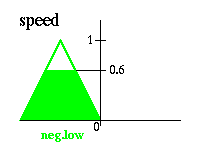
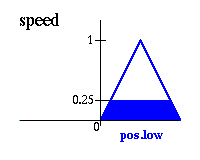
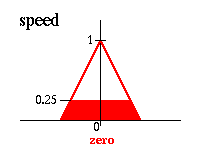
The four results
overlaps and is reduced to the following figure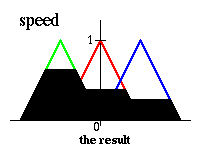
Step 3: The result of
the fuzzy controller as of know is a fuzzy set (of speed). In order to choose an
appropriate representative value as the final output(crisp values),
defuzzification must be done. There are numerous defuzzification methods, but
the most common one used is the center of gravity of the set as shown
below.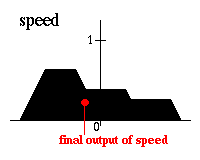
This part of the report describes the design procedures of a real life application of fuzzy logic: A Smart Traffic Light Controller. The controller is suppose to change the cycle time depending upon the densities of cars behind green and red lights and the current cycle time.
Background
In a conventional traffic light controller, the
lights change at constant cycle time, which is clearly not the optimal solution.
It would be more feasible to pass more cars at the green interval if there are
fewer cars waiting behind the red lights. Obviously, a mathematical model for
this decision is enormously difficult to find. However, with fuzzy logic, it is
relatively much easier.
Fuzzy Design
First, eight
incremental sensors are put in specific positions as seen in the diagram below.
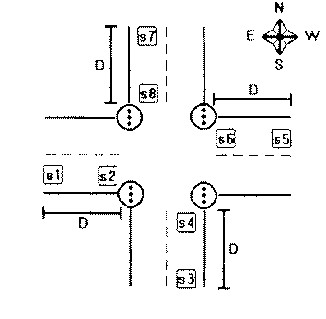
The first sensor behind each traffic light counts the number cars coming to
the intersection and the second counts the cars passing the traffic lights. The
amount of cars between the traffic lights is determined by the difference of the
reading of the two sensors. For example, the number of cars behind traffic light
North is s7-s8.
The distance D, chosen to be 200ft., is used to determine
the maximum density of cars allowed to wait in a very crowded situation. This is
done by adding the number of cars between to paths and dividing it by the total
distance. For instance, the number of cars between the East and West street is
(s1-s2)+(s5-s6)/400.
Next comes the fuzzy descision process which uses the
three step mentioned above(fuzzyification, rule evaluation and defuzzification).
Step 1
As before, firstly the inputs and outputs of the design has
to be determined. Assuming red light is shown to both North and South streets
and distance D is constant, the inputs of the model consist of :
1) Cycle
Time
2)Cars behind red light
3) Cars behind green light
The cars behind
the light is the maximum number of cars in the two directions. The corresponding
ouput parameter is the probabilty of change of the current cycle time. Once this
is done, the input and output parameters are divided into overlapping member
fuctions, each function corresponding to different levels. For inputs one and
two the levels and their corresponding ranges are zero(0,1), low(0,7),
medium(4,11), high(7,18), and chaos(14,20). For input 3 , the levels are ver
short(0,14), short(0,34), medium(14,60), long(33,88), very long(65,100),
limit(85,100). The levels of output are no(0), probably no(0.25), maybe(0.5),
probably yes (o.75), and yes(1.0). Note: For the output, one value(singleton
position) is asosciated to each level instead of a range of values. The
corresponding graphs for each of these membersip function is drawn in the
similar way above.
Step 2
The rules, as before are formulated
using a series of if-then statements, combined with AND/OR opearotors. Ex: if
cycle time is medium AND Cars Behind Red is low AND Cars Behind Green is medium,
then change is Probably Not. With three inputs, each having 5,5,and 6 membership
functions, there are a combination of 150 rules. However using the minimum or
maximum criterion some rules are combined to a total of 86.
Step
3
This process, also mentioned above converts the fuzzy set output to
real crisp value. The method used for this system is center of gravity:
Crisp Output={Sum(Membership Degree*Singleton Position)}/(Membership degree)
For example, if the output membership degree, after rule evaluation
are:
Change Probability Yes=0, Change Probability Probably Yes=0.6, Change
Probability Maybe=0.9, Change Probability Probably No= 0.3, Change Probability
No=0.1
then the crisp value will be: Crisp Output=(0.1*0.00)
+(0.3*0.25)+(0.9*0.50)+(0.6*0.75)+(0*1.00)/0.1+0.3+0.9+0.6+0 =0.51
Is Fuzzy Controller better ?
Testing of the
controller
The fuzzy controller has been tested under seven different
kinds of traffic conditions from very heavy traffic to very lean traffic. 35
random chosen car densities were grouped according to different periods of the
day representing those traffic conditions.
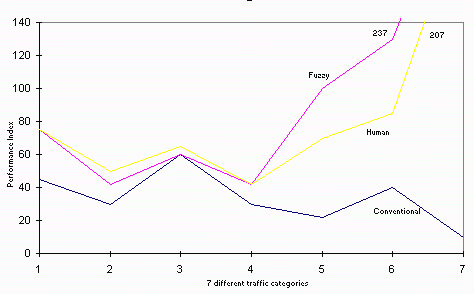
Performance
evaluation
The performace of the controller was compared with that of a
conventional controller and a human expert. The criteria used for comparison
were number of cars allowed to pass at one time and average waiting time. A
performance index which maximises the traffic flow and reduces the average
waiting time was developed. A means of calculating the average waiting time was
also developed, however, a detailed calculation of this evaluation is beyond the
scope of this article. All three traffic controller types were compared and can
be summarized with the following graph of performance index in all seven traffic
categories.
 Performance Index for 7 different traffic
catagories
Performance Index for 7 different traffic
catagoriesIn conclusion, as Man gets hungry in finding new ways of improving our way of life, new, smarter machines must be created. Fuzzy logic provides a simple and efficient way to meet these demands and the future of it is limitless.
Background
As of now the "smartness" of our
fuzzy machines are dependent on the rules given. The greater the number of
rules, the "smarter" the machine gets. However, this means that the performance
of the fuzzy machines is restricted by the capabilities of the human brain.
Therefore, how do we make the machines think for themselves and come up with
rules of its own?
Consider the way the human beings learn. We all learn through experience and through experience we become smarter. Whether, it is the smell of lime, or the picture of our mother, we remember things as it is given to us. With memory, we improve on our actions or thoughts and by defintion become smarter. Fuzzy logic can be applied the same way. Instead, of depending on humans to put specifc fuzzy rules to deal with every situation, the machine should be able to produce its own rules through experience. This can be done with the Data In Rules Out(DIRO) method.
Data In Rule Out
The DIRO method is simple, put data in through a
black box and rules come out as shown in the figure below.

Nueral networks, which fill the black box is beyond the scope of
this article. However, it is important to note that it is neural networks, which
acts like the eyes and ears of an adaptive fuzzy system whose rule changes with
experience. The adaptive fuzzy system tunes its rules as it samples new data. At
first the rules change fast. This lets the fuzzy system find a working set of
fuzzy rules. Then with more samples, the rules change and fine tunes itself and
as the saying goes practice makes perfect.
Simple Case Study: An Adaptive Fuzzy Air Conditioner The nueral nets used in this example are called the adaptive vector
quantizers (AVQ) which are suppose to come up with rules by itself. Each web
of nueron in the system is defined as AVQ points. As data comes in, the AVQ
point tries to move closer to it. The nuerons then "compete" with each other and
"wins" if its AVQ point is closest to the data. How the AVQ points move about is
again beyond the scope of this report.
As an example,
consider an air-conditioner controller, which controls the speed of its motor
according the the temperature of the surrounding. Fuzzy subsets and member
functions are written for this application in the similar way as before. The two
subsets used are the temperature of the surrounding as inputs and speed of the
motor as outputs. As usual the two sets overlap to produce fuzzy patches.
Because at first, five rules are defined, there are five patches. Each patch
will cover data which are represented here as points. Using an expert, we can
place logical data points on each patch of the system. The expert adjusts the
speed of the motor according to what temperature of the room she or he feels
appropriate.
The whole system can be seen in the
figure below. The big black dots represent the AVQ point and the small dots
represent the data points.
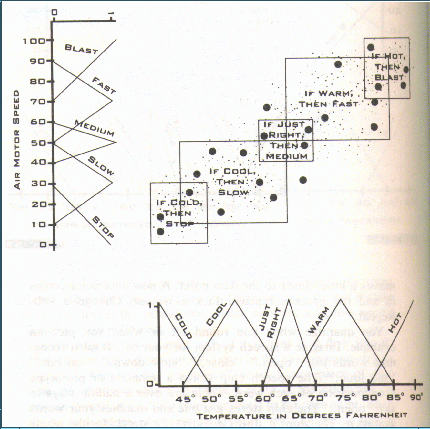
The number of rules taken now, simply depends on the number of
AVQ points in the rule cells. If a cell has an AVQ point, the that rule
is added add to our list of rules. Some cells which have more than one rule in
it, are used more often making them more inportant. Note: It is more feasible
usually to have not more than two rules per cell as this cuts down on bad rules.
With more data the expert is no longer needed as the system starts generating
its own rules. With practise the system may enventually win over the expert.
Conclusions
It may seem obvious that babies nowadays don't drink the way it is described
in child care books. They may drink a little or a lot depending on their
physical condition, mood, and other factors. But if a fuzzy-logic program can be
created that would recommend how much to feed the baby, mothers would have an
easier time raising the child. The basis of the research is to develop a program
to determine the appropriate amount of milk to feed the child according to a
knowledge base that includes the child's personality, physical condition, and
some environmental factors. This can prevent the child from being fed
unnecessarily. Now although adapting fuzzy logic to babies may seem silly, one
can easily imagine using it to control the feeding of animals in captivity, for
instance.
Wanna see more. Well, here are some of the future fuzzy uses as predicted by
Professor Bart Kosko from UC Southern California:
Hence, it can be seen that with the enormous reseach currently being done in
Japan and many other countries whose eyes have opened, the future of fuzzy logic
is undetermined. There is no limit to where it can go.
This method is just one of the many methods used to
generate rules in an adaptive sytem. Thougha simple example was used to
illustrate the system, it is important to realize how powerful this system is.
In Japan, research is currently being made to use adaptive systems to model
events in politics, history, medicine and even military planning. Imagine in the
future, we may even have a Fuzzy British Prime Minister !!
How far can fuzzy logic go???
Just from the examples given previously, it is clear that fuzzy logic
can be used in numerous applications. It can appear almost anyplace where
computers and modern control theory are overly precise as well as in tasks
requiring delicate human intuition and experience-based knowledge. What
does the future hold? Consider, the example below which is currently
undergoing intensive research in OMRON Research Center, Japan.

 Vast expert decision makers ,
theoretically able to distill the wisdom of every document ever witten. Sex robots with a humanlike repertoire of
behaviour, Computers that
understand and respond to normal human language.Machines that write interesting norvels and
screenplays in a selected style , such as Hemingway's. Molecule-sized soldiers of health that will
roam the blood-stream, killing cancer cells and slowing the aging process.
Vast expert decision makers ,
theoretically able to distill the wisdom of every document ever witten. Sex robots with a humanlike repertoire of
behaviour, Computers that
understand and respond to normal human language.Machines that write interesting norvels and
screenplays in a selected style , such as Hemingway's. Molecule-sized soldiers of health that will
roam the blood-stream, killing cancer cells and slowing the aging process.
The future is bright.
The future is fuzzy.