|
||||||||||||||||||||||||||||||||||
|
||||||||||||||||||||||||||||||||||
THE INCA TRAIL TO MACHU PICCHU |
||||||||||||||||||||||||||||||||||
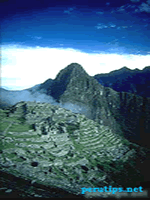
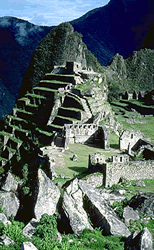
Located in the department of Cuzco, the Inca Trail to Machu Picchu is Peru's most popular trekking route and possibly one of the most spectacular walks in the Americas. It forms part of the more than 23,000 km of roads built by the Incas across South America. Each year, some 25,000 hikers from all over the world walk the 43 km stone-paved trail, built by the Incas to get to the impregnable citadel of Machu Picchu, deep in the Cuzco cloud forest. The trail sets out from Qorihuayrachina, at Kilometer 88 of the Cuzco- Machupicchu railway, and takes three to four days of tough hiking. The route runs through an impressive range of altitudes, where climates and eco-systems range from the high Andean plain down to the cloud forests. The trail climbs up through two highland passes (the higher of the two, Warmiwañuska, lies at 4,200 masl) before reaching Machu Picchu through the Inti Punku or Gateway of the Sun. One of the attractions of the trail is that it winds past carved granite Inca settlements (Wiñay Wayna, Phuyupatamarca), and is surrounded by breath-taking natural scenery. The forests abound in hundreds of species of orchids, brightly-colored birds and dream-like landscapes, the ideal complement to this indispensable hikers' route. |
|
|||||||||||||||||||||||||||||||||
Adventure trips around this place |
||||||||||||||||||||||||||||||||||
Archaeological Sites on the Inca Trail |
||||||||||||||||||||||||||||||||||
The network of Inca roads traces the route from Cusichaca to Machu Picchu, and to describe it adequately we must identify and describe the pre-Hispanic remains found along its length, from Qoriwayrachina, at Km.88, along what is known to millions of people around the world as the Inca Trail to Machu Picchu. Patallaqta: This is a large archaeological complex consisting of approximately 112 rooms, each constructed using roughly finished stone and mud-based mortar. Nearby there is another important site known as Pulpituyoq. Continuing along the trail we come across the sites of Tarayoq, Huayllabamba, the high pass of Warmiwañuska (Dead Woman's Pass), Rukuraqay and Sayaqmarka Sayaqmarka: This important archaeological site boasts a number of chambers, shrines, canals, water fountains and a curved section of stonework from where the beautiful Aobamba valley can be seen stretched out below. Q'onchamarka and Phuyupatamarka: Located just beyond Sayaqmarka, these two sites comprise a dozen rooms of varying sizes built to harmonise with the sinous form the bedrock takes at the site, and constructed from finely-wrought and well-fitted stones. The site is also noteworthy for the channelling of the stream that runs through the area, via a large carved rock outcrop lying in an open space, suggesting that the site was originally a shrine associated with the worship of water. A little further up the trail one reaches Q'antupata. Wiñaywayna: This site consists of two sectors, a higher and a lower one. The upper sector comprises granite constructions built from very finely finished and polished stones, fitted together with great precision, forming what might once have been a ceremonial site. The lower section features a series of terraces alternating with a row of water fountains, and a number of chambers with rectangular bases of different sizes. These buildings still retain the cylindrical stone roof supports emerging from their walls that are known locally as "stone keys", which would have once held up the wooden gables Intipata: At the end of the trail one reaches this site, located at 2,850 metres above sea level on the slopes of Qoriwayrachina hill. Intipata is a series of agricultural terraces with stone retaining walls held together with mud-based mortar. Of particular interest are the stone steps that project from the terrace walls. Called sarunas, they provided easy access to the terraces. In the higher part of the complex stand the remains of a number of buildings of different sizes that were probably once guard posts. In the lower section there are three more rooms that may once have been used as storehouses for the harvest produced at the site. Quillapata: Two groups of agricultural terraces and two large rectangular rooms known as "kallancas". Chaskapata: A small archaeological complex consisting of a small three-walled structure approximately 5.4 metres long and 2 metres wide, located about 100 mteres from Intipunku (the Sun Gate) along a well-made path. Intipunku: The "Sun Gate". This is the main entrance to Machu Picchu. Intipunku is a series of stepped, stone platforms made from carved blocks which form an entrance way. On the facade exist three trapezoidal niches, and there are four niches on the north wall and two more on the southern wall. |
||||||||||||||||||||||||||||||||||