 |
|
|
|
|
|
|
|
|
|
|
|
|
|
|
|
|
|
|
|
|
|
|
|
|
|
|
|
|
|
|
|
|
 |
|
|
|
 |
|
|
|
Here are the main tools that a "entry level" ghoul should acquire for this kind of job
1. Crowbar 6. Meat cleaver/ scapel
2.Screwdriver (serveral sizes) 7. Surgical gloves 3. A pair of plyers 8. Flashlight
4. allen wrench (hexagonal keys) 9. ultrasonic whistle (for dogs)
5. set of skeleton keys/ L shape keys
Wrap the tools in plastic bags, and put the plastic bags in a backpack. The bag will prevent the tools from banging against each other, and you will use them to store the remains. I recommend wearing black clothes, tennis shoes, and a hood.
|
|
|
|
 |
|
|
|
Always visit the cemetery under daylight before you decide to visit it during the night. Check out if the cemetery keeper lives in a house inside the graveyard walls. Check out if there were dogs. Then proceed to examine the surrounding walls. It is important to determine the size of the wall on each side. Sometimes the wall is higher on the street level, but sometimes it is higher on the cemeteries level. See if some objects can help you climb the wall on the side of the street (Cars, trees, trash cans, etc.) and on the other side of the wall (statues, trees...). Decide where you will climb into the graveyard, and where you will climb out of it. Be sure you can locate your way out easily, in case you should need a quick escape. While you're in, choose your prey carefully. Examine if the locks are rusty, when you choose a mausoleum. Determine which tombs will be easier to rob, those who are sealed, those who are so old that the lid is getting loose. etc. See if there are signs of recent burial (temoporary lids, lots of flowers, etc.). |
|
|
|
 |
|
|
|
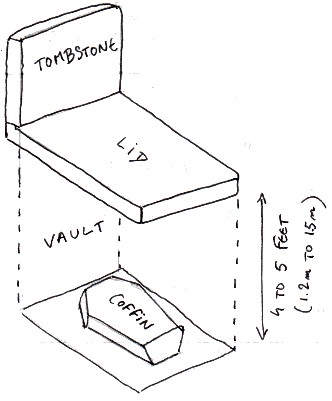
There are two kinds of grave: Vaults, and Crypts |
|
|
|
 |
|
|
|
A vault is a burial chamber, buried in a shaft, which looks like a concrete box, designed to hold a casket. The lid of concrete vaults is usually sealed in place with a rubber tarlike substance that stiffens over time. Sometimes, the seal can be broken and the lid removed by prying, but often the vault has to be broken to enter. Temporary lids are fibreglass lids that have not been sealed yet, so they are easy to open. Graves are shallower than one might think at first sight, so you do not need rope to climb inside. Some graves are as shallow as 3 feet below the surface. The expression "to dig up a coffin" is not appropriate, because the lid of the vault is seldom covered with dirt. So you will not need a shovel and spade for this. Yet it is the most popular musconception of grave robbery. Sometimes you will encounter metal vaults that have latch-type locks on the corners. Sometimes the casket is inderted through an end opening. |
|
|
|
|
|
 |
|
|
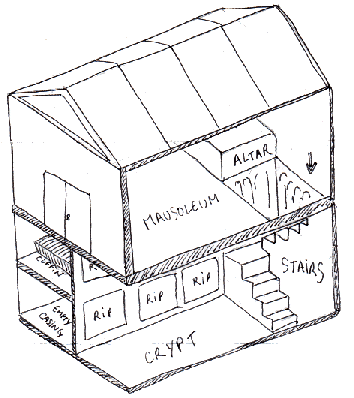
A crypt is an underground chamber, housed inside an above ground structure named mausoleum. A crypt can house several coffins, stored inside individual vaults, or stone casing
The locj of the door can be easily picked up with a L shaped key, or pryed open. The lids of stone casing are sometimes sealed in place with the same substance for vault lids, and can be pryed open with a big screwdriver. Then the coffin can be dragged out of its casing. |
|
|
|
|
|
|
 |
|
|
|
Caskets are made of metal, wood, plastic or wood- resin combinations.
WOOD - The lid of most hardwood caskets is help in place by thumblocks. You will need to unscrew the thumblocks with the plyers, and use the screwdrivers as well. Sometimes the lid is nailed to the casket, so a good crowbar will be useful as well.
METAL - The lid of metal caskets may have a watertight seal that can be open by using an allen wrench or similar device. The insertion point for the key is often at the front corner of the foot of the casket. A threaded metal cap is unscrewed and the wrench is inserted into the mechanism and turned. Sometimes, metal lids are welded closed, so you will need to cut through it wilth special scissors. |
|
|
|
 |
|
|
|
After burial, a number of factors can influence the rate of decomposition of the body. These unclude, among other factors, the degree of perfusion of tissues by preservatives introduced during embalming, the effectiveness of preservatives (formaldehyde, trioxane, methanol, phenol, germicides...), the acidity or alkalinity of the soil, the nature of microbes and insects in the soil, and the lenth of time since burial. But, I personally observed that it takes 2-3 years inside a wood coffin for a body to turn into a skeleton. Body stored inside sealed metal coffins take 4 years. After 15 or 20 years, the bones crumble. |
|
|
|
 |
|