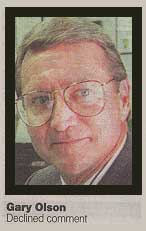
Animal Regulations documents obtained by the Daily News said then-department
General Manager Gary Olsen ordered his staff to "take no action" against
Romeo, even in the face of mounting complaints from the public and indications
of illegal conditions.
"The situation did not appear to pose a threat to public health or animal welfare,"
wrote Peter Persic, the department spokesman. Then in July, Los Angeles
police responded to a call from a disgruntled pet owner who broke into Romeo's
Pets for Life shelter -- a three-bedroom house in Van Nuys -- to retrieve
a cat he entrusted to the shelter's care.
At that point, Animal Regulation officers "determined that the situation now was
a threat ... and therefore, the animals had to be removed," Persic wrote.
At the time of the raid, the pet population at Romeo's kennel had soared to 589
cats and 28 dogs, making it the biggest illegal shelter in Los Angeles history.
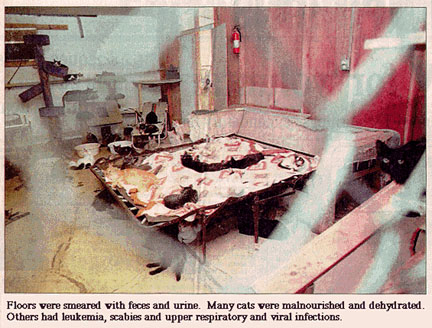
Floors were smeared with feces and urine. Many cats were malnourished and dehydrated.
Others had leukemia, scabies and upper respiratory and viral infections.
At least 275 of Romeo's animals ended up dead, either through euthanasia or because
they were already deceased when taken from her kennel, at 7029 Valjean Ave.
[Van Nuys, California]
The Romeo case casts a shadow over the already-embattled department.

The cost to taxpayers for medical care, overtime and other expenses could rise
to several hundred thousand dollars, pushing the cash-strapped department over
it $7.2 million budget.
The extra cost put such a strain on the department that Olsen's office issued
a public appeal for donations.
Romeo, who is in her 50s and lives in West Hollywood [California],
blamed the squalor and neglect on a live-in employee, who cared for the animals
while Romeo was busy with her catering business and maid service.
"I took in the sick, the abused, the crippled, the old and the homeless,"she said
recently. "I do this because I love them. It's strictly altruistic."
Prosecutors in the City Attorney's Office may announce as soon as this week whether
they will file animal cruelty charges against Romeo.
The documents obtained by the Daily News show that officers, acting on Olsen's
instructions, opted not to take action against Romeo.
In an April 1996 investigation report, Officer Michael Fowble discussed the Romeo
kennel, in light of the city's denial of her application for a cat-kennel permit.
At the bottom of the report, Officer Tim Goffa wrote: "Per GO (Gary Olsen) we are
to work with (Romeo) for as long as necessary. No action to be take re: this case."
In a December 10, 1996 memorandum to Olsen, West Valley Shelter Supervisor
Richard Felosky noted that his office was continuing to receive complaints
about Romeo's shelter, and asked how he should handle them, "in view of ... written
comments reporting that you want no further action on this case."
Bowing to the pressure to euthanize fewer strays, Animal Regulation commissioners
and City Hall Officials openly encourage officer to look the other way at unlicensed
rescuers, who take in neglected and feral animals that otherwise might be put
to sleep.
The attitude is reflected in a May 17, 1996 memo from Olsen.
The then-general manager of the department said that because of increasing demands
on staff and resources, employees should "place a low priority on investigating
complaints of too many cats in one residential location," unless there are allegations
of inhumane treatment, neglect or illegal activity."
Commission President Steve Afriat acknowledged the policy.
"Whenever rescuers can help us meet the need, we do look the other way as long
as there aren't other complaints," Afriat said.
Animal Regulation officers were aware that Romeo kept at least 225 animals as
early as August 1995, when she indicated so on an application for a cat-kennel
permit.
Romeo said she and Olsen enjoyed a professionally friendly relationship over the
years, and he told her not to worry about getting arrested, as long as she kept
up her kennel.
"He said, 'Everything's going to be OK.' He was real assuring," Romeo said.
According to sources, Romeo was known in the department as a "FOG" -- Friend of
Gary.
Olsen retired from his $100,182-a-year post last week, but remains with the department
for three months as a consultant.
Olsen was pressured to step down by Mayor Richard Riordan, according to
sources. But his departure had nothing to do with the Romeo case. Rather, it came
after years of angry opposition from animal rights advocates.
Members of those groups complain that the department is little more than a killing
factory because of its high euthanasia rate -- about 47,000 animals a year.
In addition to his $64,794-a-year retirement pay, Olsen will earn $24,750 over
three months as part of his consulting deal.
The deal calls for Olsen to perform a number of tasks. One of them, perhaps ironic
in light of the Romeo case, is to draw up a draft legislation making it easier
for animal rescuers to do their work without fear of getting arrested for violating
the city's three-animal-per-residence limit.
But Miguel Iniguez still has questions about the Romeo case.
In November 1996, about seven months before the raid, Iniguez a cable
television technician, called in a complaint to the department after visiting
Romeo's kennel to install a new cable television box.
"I see lots of cats, decaying cats, feces all over, dead cats, all that
stuff," Iniguez said.
When he got back to his service vehicle, Iniguez said, he "vomited
all over myself."
An investigation report obtained by the Daily News shows that the department dismissed
the complaint, citing an inability to reach Iniguez by telephone to elicit more
details about the complaint.
That's baffling to Iniguez, who said he already had detailed his complaints twice
to Animal Regulation officers.
Department critics are hoping for an overhaul at Animal Regulation, so that cases
such as Romeo's don't happen again.
Olsen's temporary replacement is Sharon Morris, Riordan's deputy mayor for
neighborhood and community affairs .
Morris has no experience in the field of animal regulation. In fact, she doesn't
even keep pets at home.
But Morris said she will bring valuable skills to her new role in the areas of
management and community relations. And some department critics feel that her
inexperience won't hurt her at all.
"The department needs a good manager and business leader,' said Madeline Bernstein,
executive director of the Los Angeles Society for the Prevention of Cruelty to
Animals.
But Bernstein said she is concerned that the department's animal experts condoned
Romeo's kennel.
"Somebody is responsible for the condition of those animals whether it's the (Animal
Regulation) commission, the general manager, or Miss Romeo. Something should be
done." Bernstein said.
NOTE: ITALICS & BOLDING IS BY "HELP SAVE THE ANIMALS"
 Animal Regulations documents obtained by the Daily News said then-department
General Manager Gary Olsen ordered his staff to "take no action" against
Romeo, even in the face of mounting complaints from the public and indications
of illegal conditions.
Animal Regulations documents obtained by the Daily News said then-department
General Manager Gary Olsen ordered his staff to "take no action" against
Romeo, even in the face of mounting complaints from the public and indications
of illegal conditions.