Below is the article
"Jim's den" from Sunday vision's supplement "discovery"
the 12th of December 2010, by Raphael Okello and Roderick Ahimbazwe.
JIM'S DEN
Our eyes dart this way and that way, from one corner to another and
from one wall to another as we stand in the living room, seemingly lost
or perhaps enchanted by the hundreds of pictures on the walls and tables.
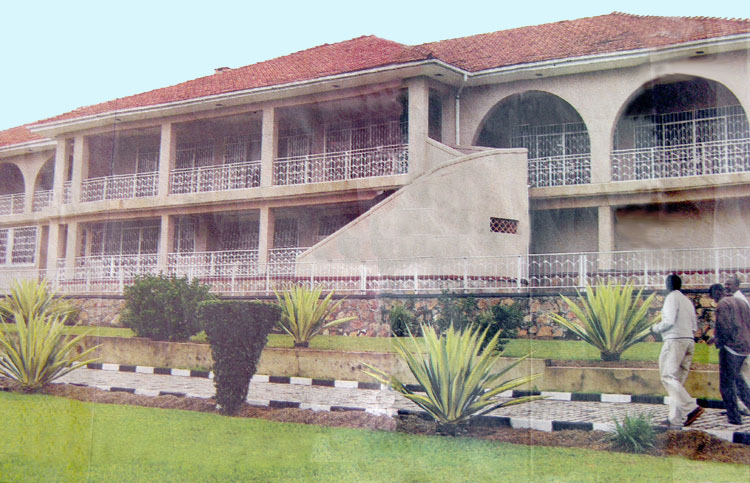
Maj. Gen. Jim Muhwezi's country house in Rujumbura, Rukungiri district
is a photo gallery with hundreds of pictures that have captured and
frozen Muhwezi's past and present life; the loving dad and husband,
friend to the country's high and mighty, avid politician, diplomat and
freedom fighter and an admirer of Nelson Mandela, South Africa's former
head of state and freedom fighter.
There are pictures of him and his children locked in passionate embrace,
his wife's friendly meetings with Janet Museveni, the first lady, and
Patience Museveni, the first daughter pictures of the president and
wife in a farm and a series of framed sentimental love poems.
WEDDING PHOTO
Some of the exciting pictures include a pale picture of his 1977 wedding
to his wife Susan, one with Libyan leader Col. Muammar Gadaffi and another
with Pope John Paul II during his 1993 visit to Uganda.
PALATIAL ENCLAVE
The house is tucked away in the sedate hilly countryside, more than
340 km south west of Kampala. From the balcony of the spacious living
and dining rooms, through the sliding glass doors, the enchanting spectacle
of swashbuckling waves of green hills interplays before you like an
artistic illusion. In many ways, the landscape lends its tranquillity
and meditative air to Muhwezi's palatial enclave.
Earlier when we had been ushered into the living room, neatly laid out
with exotic cream sofas and fine furniture, we were transfixed on the
different pictures unattended to for about five minutes until a voice
from the adjacent dining room tempered with the silence.
"You come this way," it commanded. It was Muhwezi, seated
at the dining table with his back facing us. It was almost comical,
even embarrassing, to realise that our host had probably been watching
us from a reflection in a giant mirror!
KATOGO
This little dramatic display of espionage with two harmless journalists
said so much of a man who was once the Internal Security Organisation
boss between 1991 and 1994; once a spy, always a spy. His creamy jumper
had deceptively blended in with the creamy walls and sofas, creating
a perfect camouflage for surveillance.
"Please have a seat", his voice was as calm as his demeanour
and his words seemed deliberately selected as if being too guarded about
what he has to say. "Do you want anything to eat, tea may be?"
Before him is a plate of katogo (green bananas cooked in groundnut stew),
which many people regard as a quick-fix low-budget delicacy.
"I always have this (katogo) or boiled cassava for breakfast. Yesterday
I had cassava," he says and explains that he doesn't eat fried
or fatty food because it's unhealthy. "At my age, I don't want
to grow as fat as a broiler. And since my body is not for sale like
a broiler, I will keep away from fatty foods," he quips as he starts
to lighten up.
The cassava and bananas are picked from his 100 acre cattle and banana
farm. The hills outside mark the beginning of the 100 acre farmland,
which he says he rarely visits.
"I have 100 cows, but I think they are now 50 because I sold off
some to reduce the numbers," he says "But it's not a commercial
farm. I have it for cultural reasons, in our place; a home is not a
home without a cow. "When the children come over during the Christmas
holidays, we get the milk from the farm and when we receive a visitor,
we slaughter a cow as a sign of honour and respect," he says.
Every Christmas, this quiet and secluded place erupts with life as the
entire family gathers for the festive season. Two of his children are
still in school, with one studying in Canada, the rest are working and
barely have time to come down here.
"This is our family home," he says. "The house in Kololo
(an affluent neighbourhood in Kampala) is the working home."
MONSTER HOME
The house has four living rooms. By Ugandan standards, this is a staggering
monster of a residence, which can make a mockery of many houses in Kampala's
leafy suburbs. Sometimes it serves as a hotel for visiting whites who
pay for the service.
"When the house hosts such guests, we invite the chef and catering
staff from my small motel in Rukungiri to cater to the guests,"
he says "The money they pay is what we use to maintain this house."
He sips black tea from a white customized clay cup that has a picture
of his face and the words: "Happy 60th birthday daddy, from mum,
Samantha, Sandra, Sonia and JJ." But Muhwezi barely cuts a 60-year-old
man's profile; his skin oozes youthful vigour. This could be attributed
to his healthy living practices. Besides steering clear of fried food,
he doesn't drink his tea with processed sugar.
None of his seven children is around nor is Susan, but their presence
and warmth fills the house, in every corner, on every wall and in every
corridor, they smile down at us in pictures. This house, these hills,
this countryside present a picture-perfect retirement enclave. But Muhwezi
isn't down here for such a retreat.
POLITICS
The political tension is palpable in the house. For over six months,
we have been tracking this man down but even now that we finally have
him, we don't seen to have him! His two Black Berry phones incessantly
ring off the hook and the endless stream of visitors has refused to
dry up; the mayor of Rukungiri, local council members, community elders
and youth and his campaign manager are engaged in secretive meetings
to discuss strategies to win over Rujumbura. His attention is divided
between us and his political strategists as political alliances are
being expanded and others mended.
The more time we spend with him, the more he seems as far removed from
his espionage tendencies. As he navigates us through his house, our
conversation oscillates from his school days at Makobore High school.
Old Kampala SSS to his pursuit of a bachelor's degree in Law at Makerere
University.
BUSH WAR
Having trained at Kibuli and Masindi police training schools in the
1970's, Muhwezi was posted as the officer-in-charge in Mbale Police
Station. In 1981, Muhwezi was arrested for his links with the then National
Resistance Army rebels led by Yoweri Kaguta Museveni.
He was detained at Jinja road police station but later carried out a
daring escape along with David Tinyefunza.
The two grabbed guns from their guards and shot them before escaping.
Muhwezi sought refuge in renowned Anglican bishop Festo Kivengere's
daughter Hope's home before sneaking out of Kampala, apparently dressed
like a woman!
That is when he joined the rebels where he played a leading role in
the intelligence circles.
|
Jim
Muhwezi
From Wikipedia,
the free encyclopaedia
He was
appointed Minister of Health in 2001, serving in that capacity until
2006.
Controversy
Muhwezi was censured by the Ugandan Parliament in 1998 for abuse of
office. He however kept his Cabinet post and his parliamentary seat.
In June 2006, a Commission of Inquiry, headed by Justice James Munage
Ogoola, set up by the Ugandan Government to inquire into the misuse
of funds of the Global Fund for AIDS, Malaria and Tuberculosis, found
in its report that Jim Muhwezi and his two Ministers of State, Captain
Mike Mukula and Dr. Alex Kamugisha, were responsible for misuse of public
funds. The Commission recommended prosecution, restitution and possible
imprisonment if found guilty. In a cabinet reshuffle one week before
the Commission Report was made public, President Museveni removed all
three ministers from his cabinet.
On Sunday 27 May 2007, Major General (Rtd)Jim Muhwezi Katugugu, the
former Minister of Health turned himself in to the police, was arrested,
booked and sent to Luzira prison, on charges of (a) abuse of office
(b) theft and (c) embezzlement of over Sh1b (approximately US$500,000)
in donor funds for immunisation. Three days later, he appeared before
a High Court Judge, made bail and was released. The case is still (2011)
pending in Ugandan courts.
|