GEB 206 Global Culture and Citizenship
Part I: What is “Globalization”? What is “Global Culture”?
1.
What is “Global Culture(s)”?
1.1. Anxiety
over cultural homogenization: US vs. Third World
1.2. Problematizing
binary opposition: Example: “Sept 11”
1.3. No
single global culture
1.4. “Global
culture”: a series of contested and cross-border terrains in which different
agents interact with one another.
1.5. Global
culture: a complex, overlapping and disjunctive order
Question: Can you illustrate some features of
contemporary global culture(s) from the recent event of the US threatening to
wage war against Iraq?
2. What is citizenship?
2.1. Citizen: a republican idea
2.2. Citizenship: the rise of welfare state and new
social movement
2.3. Two questions:
a. What should be included in citizenship?
a.
Who are eligible for enjoying welfare goods and
services?
2.4. Citizenship and “cross-bordering”
3.
What is “Globalization”?
3.1. Decline of the nation-state?
3.2. World without stranger? Global Market? Global
Economy? World-wide web?
3.3. Global trade?: G-7 and new developing region
3.4. Global investment?: “Triad” countries
3.5. Unequal global pollution: carbon dioxide
emission
3.6. Is world-wide web really “world-wide”?
3.7. Say NO to “global village”: a divided, unequal,
disrupted and fragmented world
4.
Globalization and me
References
大前研一著;李宛蓉譯1996《民族國家的終結
: 區域經濟的興起》台北 : 立緒文化。
Richard Rosecrance著
; 李振昌譯2000《虛擬國家
: 新世紀的財富權力》台北 : 聯經出版事業公司。
Hirst, Paul and Grahame Thompson
1999. Globalization in question : the international economy and the
possibilities of governance. Malden: Polity.
United Nations Development
Programme. 1999. Human Development Report. New York: Oxford UP.
Table 3:
Ratio of merchandise trade to GDP at current prices (exports and imports
combined), 1913, 1950, 1973 and 1995
|
|
1913 |
1950 |
1973 |
1995 |
France |
35.4 |
21.2 |
29.0 |
36.6 |
|
Germany |
35.1 |
20.1 |
35.2 |
38.7 |
|
Japan |
31.4 |
16.9 |
18.3 |
14.1 |
|
Netherlands |
103.6 |
70.2 |
80.1 |
83.4 |
|
UK |
44.7 |
36.0 |
39.3 |
42.6(1994) |
|
US |
11.2 |
7.0 |
10.5 |
19.0 |
Source: Hirst and Thompson 1999: 27 (Figures from
1913 to 1973 derived from Maddison 1987, table A-23, p. 695; figures for 1995
derived from OECD National accounts, 1997, country tables.)
Table 5: World merchandise imports by region and selected economy, 1989, 1999
|
|
1989 |
1999 |
||
|
|
m (US$) |
% of
total world imports |
m(US$) |
% of total world imports |
World |
3190000 |
100% |
5881000 |
100% |
|
United States |
492922 |
15.6 |
1059126 |
18 |
|
EU |
1280750 |
40.1 |
2232225 |
37.9 |
|
Africa |
85700 |
2 |
132500 |
2.2 |
|
Middle East |
93300 |
2.9 |
149700 |
2.5 |
|
Asia |
688600 |
21.6 |
1351600 |
23 |
|
Japan |
209715 |
6.6 |
311262 |
5.3 |
|
China |
59142 |
1.9 |
165788 |
2.8 |
|
Hong Kong |
77662 |
2.4 |
180716 |
3 |
|
Latin America |
118400 |
3.7 |
334700 |
5.7 |
Source: World Trade Organization. 2001. International
Trade Statistics 2001. WTO
(http://www.wto.org/english/res_e/statis_e/its2001_e/its01_toc_e.htm)
Table 6: World merchandise exports by region and selected economy, 1989, 1999
|
|
1989 |
1999 |
||
|
|
m (US$) |
% of
total world imports |
m(US$) |
% of total world imports |
World |
3089000 |
100% |
5625000 |
100% |
|
United States |
363812 |
11.8 |
695215 |
12.3 |
|
EU |
1243625 |
40.3 |
2180445 |
38.8 |
|
Africa |
86200 |
2.8 |
112100 |
2 |
|
Middle East |
107700 |
3.5 |
170100 |
3 |
|
Asia |
729400 |
23.6 |
1545700 |
27.5 |
|
Japan |
273932 |
8.9 |
419363 |
7.5 |
|
China |
52538 |
1.7 |
195150 |
3.5 |
|
Hong Kong |
73336 |
2.4 |
174408 |
3 |
|
Latin America |
134500 |
4.4 |
297000 |
5.3 |
Source: World Trade Organization. 2001. International
Trade Statistics 2001. WTO
(http://www.wto.org/english/res_e/statis_e/its2001_e/its01_toc_e.htm)
Table 8: Populations and inward FDI flows, 1991-1996
|
|
Population 1996 |
Investment flows 1991-6a |
||
|
|
(m) |
% |
(US$m) |
% |
World total |
5,753.726 |
100 |
1,455,280 |
100 |
|
A |
|
|
|
|
|
USA and Canada |
295.248 |
|
317,618 |
|
|
Western Europe (EU12+EFTA) |
413.534 |
|
526,299 |
|
|
Japan |
125.761 |
|
29,106 |
|
|
Total |
834.543 |
14.5 |
873,023 |
60 |
|
B |
|
|
|
|
|
Ten most important developing countries in terms of
FDI flowsb |
1,834.555 |
31.9 |
349,267 |
24 (73% of FDI flows o developing economies) |
|
A+B |
|
46.4 |
|
84 |
a1996 estimates
bArgentina, Brazil, China, Hungary,
Indonesia, Malaysia, Mexico, Poland, Singapore, Thailand,.
Source: Hirst and Thompson 1999: p. 72 (For
investment flows, United Nations 1997, calculated from Annex, table B1; for
population levels, World Bank Atlas 1998)
Figure 1: Carbon dioxide emissions per capita 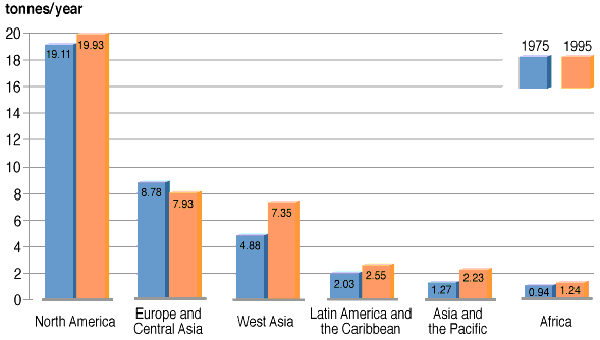
Source: UNEP 2000 Global Environment Outlook
(compiled by UNEP GRID Geneva from CDIAC 1998 and WRI, UNEP, UNDP and WB 1998)
Table 9: Internet user as a percentage of regional
population (Mid-1998)
|
|
Regional Population (as a percentage of world
population) |
Internet users (as a percentage of regional
population) |
United States |
4.7 |
26.3 |
|
OECD excluding US |
14.1 |
6.9 |
|
Latin America and the Caribbean |
6.8 |
0.8 |
|
South-East Asia and the Pacific |
8.6 |
0.5 |
|
East Asia |
22.2 |
0.4 |
|
Eastern Europe and the CIS |
5.8 |
0.4 |
|
Arab States |
4.5 |
0.2 |
|
Sub-Saharan Africa |
9.7 |
0.1 |
|
South Asia |
23.5 |
0.04 |
|
World |
100 |
2.4 |
Note: The Czech Republic, Hungary, Mexico, Poland,
the Republic of Korea and Turkey are included in the OECD and not in the
regional aggregates.