Part IX: Internet
and Software
1.
The birth of “software”
1.1. Until
the early 60s, software and hardware had been bundled in computer
manufacturing, including that of IBM and other manufacturers.
1.2. In
1964, IBM introduced IBM System/360 “family” that unified the operating system
software of its product line, allowing users to develop software applications.
1.3. More
independent software vendors came into the market.
1.4. The
development of minicomputer, pioneered by Digital Equipment Corporation, also
created more opportunities for software production.
1.5. Bell Laboratories and General Electric worked on a
project of Multics system in
1965. Ken Thompson developed it into Unix system that becomes a popular system
for server machines.
1.6. Bill
Gates and Paul Allen (Microsoft) bought Quick and Dirty Operating System
(Q-DOS) from Seattle Computer Products and expanded it to MS-DOS for IBM’s
first Personal Computer (PC) in 1981.
1.7. In
the 1980s, Microsoft products became popular mainly because of IBM’s decision
of adopting DOS as its PC system.
1.8. Since
then, Microsoft becomes the most dominant software vendor in the world. Through
network effects created by IBM compatible PCs and its application products
(including Microsoft Office and Internet Explorer), Microsoft monopolizes the
market of operating system software.
1.9. Microsoft
further monopolizes the market through Windows 95, 97, NT, 2000, XP and other
applications and combining Windows with the windows of Internet Explorer. The
products of Windows NT, 2000 and XP are intended to invade the market for
internet server.
1.10. Microsoft
and other big corporate groups promote the concept of intellectual property
right and the law system protecting this right for information product.
1.11. There
seems to be no alternative to this mainstream copyright system and copyright
becomes a “natural” right.
http://members.fortunecity.com/pcmuseum/windows.htm
2.
The birth of internet: a new form of knowledge
2.1. Internet
is the product of the Cold War. The Pentagon attempted to develop a network of
information to reduce the damage caused by possible attacks from the USSR.
2.2. History:
-In
1971, the ARPANET covering twenty three universities was established.
-In
1974, Vint Cerf, founder of internet, developed TCP/IP (Transmission Control
Protocol and Internet Protocol).
-In
1991, Tim Berners-Lee invented World Wide Web and abandoned the patent of WWW.
(http://www.w3.org/)
Weaving the Web: The Original Design and Ultimate Destiny of the
World Wide Web (一千零一網)
2.3. Memex
(Vannevar Bush)
2.3.1.
“As we may think” (1945)
http://www.theatlantic.com/unbound/flashbks/computer/bushf.htm
2.3.2.
Vannevar Bush proposed to develop a system called
Memex, a searchable and retrievable database connecting all kinds of human
knowledge.
2.4. Hypertext
(Ted Nelson)
2.4.1.
He invented two words: “hypertext” and “hypermedia”
2.4.2.
Project Xanadu ( http://xanadu.com/):
All texts are connected.
2.4.3.
Transcopyright for the web: reasonable micropayment
for obtaining information.
2.4.4.
It remains a utopia until now. A utopia for sharing
knowledge.
3.
Linux: a case of open source movement開放原始碼運動
3.1. History:
-In
1991, Linus Benedict Torvalds was a second year student of Computer Science at
the University of Helsinki and a self-taught hacker. He develops a small
operating system as a hobby. (http://www.cs.helsinki.fi/u/torvalds/)
-Torvalds
posted a message on internet to invite people to give comments on it and even
make use of it for developing new version because the source codes of Linux is
open. With the ideal of free software movement, many people on internet join to
develop it.
-Within
two weeks, a new version of Linux appeared. And Linux attracts a lot of people,
including some companies, to further develop it. Now there are a large number
of versions of Linux.
The
Linux logo: http://www.isc.tamu.edu/~lewing/linux/
3.2. Major
features:
-Linux
is an open-source operating system.
-It
is developed mainly by the virtual community of internet rather than a
corporate giant.
-No
one is allowed to restrict the freedom to disseminate Linux. (GNU, copyleft)
-Most
users of Linux (at the early stage of Linux development) are also would-be
producers.
-The
performance of Linux is very stable and does not have a high requirement of
hardware.
-Companies
make money through technical services.
-A
typical product of knowledge-sharing in the new era.
3.3. Microsoft’s
response
http://www.opensource.org/halloween/halloween7.php
4.
Free Software Movement
4.1
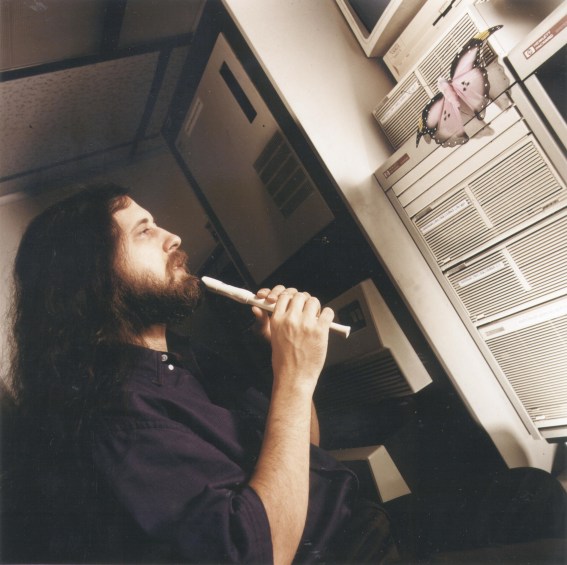
GNU’s Not Unix (Richard Stallman): http://www.gnu.org,
http://www.stallman.org/
(his
photo: http://www.stallman.org/rms.jpg,
http://www.auxicad.fr/agenda/2000/linuxexpo/photos/rms/index.php)
4.2.
The GNU Manifesto: http://www.gnu.org/gnu/manifesto.html
4.3. Software programming is a creative work like all kinds of arts. No one should impose an overwhelming system (such as patent and copyright) on these creative activities.
4.4.
“Free” software is distributed according to the General Public License, GPL. No one is allowed to restrict the distribution to others.
The source codes are open to public and all are welcome to rewrite the original
source codes.
5.
Internet: a barrier to knowledge and a new
possibility of knowledge
5.1. Knowledge
is not something ready-made but is created persistently in communities.
5.2. Some
big companies can manipulate Internet and its network or community effect to
achieve monopoly.
5.3. However,
Internet can enable people to network others and establish their virtual communities
for sharing knowledge, communicating with one another and producing knowledge.
References
彼得•威納著,開放原始碼
: Linux 與自由軟體運動對抗軟體巨人的故事,蔡憶懷譯,台北 : 商周出版,2000。
The Political Economy of Open Source Software. Steven Weber. June 2000.
http://e-conomy.berkeley.edu/publications/wp/wp140.pdf