The Iain Banks Forum
Review of Books by Iain Banks
On this page I've given a brief summary of the books published by Iain Banks. These are not definitive reviews, but just give a flavour of what the books are about. Any relevant articles or interviews on any of the books are highlighted with links to the appropriate page. You can also check out the publisher's copy on each book together with reviews included on the back cover of each title by clicking on the link next to the title. This will also take you to the bookshop where you can buy books through amazon.co.uk.
'Mainstream' Fiction (the ones with black and white covers):
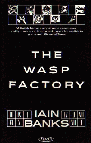
The Wasp Factory (1984)
|
|
First published in 1984, this book caused quite a stir amongst reviewers at the time and launched Iain Banks career as a writer. The book is one of the briefest of his novels, but also probably the best, although The Bridge comes a close second. The book is about Frank, a sixteen year old who lives with his father by the sea near a small Scottish town. Frank is no ordinary adolescent - he has constructed a world of his own with its own rules and mythologies. I won't say much more about the plot, except that the book verges on the horrific at times and was seen as shocking by reviewers because of the lack of morality displayed. If you have read the book why not check out my article on it which illustrates how Banks was influenced by writers outside staid world of the English novel - and inspired to create something new which shook up the literati of the day. |
The Influence of The Tin Drum on Iain Banks's The Wasp Factory
Order The Wasp Factory Today!
Publisher Copy and Reviews
Walking on Glass (1985)
|
|
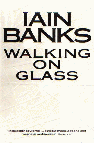
A number of themes run through Iain Banks's 'mainstream' fiction, and one of the main ones involves his character's believing that they live in alternative realities. Such is the case for Steven Grout, the protagonist of Walking on Glass. |
Order Walking on Glass Today!
Publisher Copy and Reviews
The Bridge (1986)
|
|
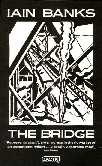
Again it is difficult to discuss much of the plot of this book, without giving the game away. This book isfantastic - it is less punchy and shocking than The Wasp Factory, but matches it in the imaginative depth of the author's creation. We become increasingly absorbed and intrigued by the world created by Banks for his pricipal character - a man who finds himself on an enormous bridge (one very similar to the Forth bridge), which is also a self-contained city. He has lost his memory and has no idea how he came to be there. The story involves his quest to discover more about himself and the enigmatic Bridge.
The book has been adapted into an Audio-Book, read by , which is well worth getting. Please let's have more Iain Banks audio.
|
Order The Bridge Today!
Publisher Copy and Reviews
Espedair Street

Order Espedair Street Today!
Canal Dreams
Order Canal Dreams Today!
The Crow Road
Order The Crow Road Today!
Complicity
Order Complicity Today!
Whit
Order Whit Today!
A Song of Stone
Order A Song of Stone Today!
Publisher Copy
The Business

Order The Business Today!
Publisher Copy
Science Fiction (the ones with colourful covers):
For some more articles on The Culture (the civilisation around which most of Iain's Sci-Fi is written) check out these articles and links to other sites with good info on things like Ship Names and the technology of The Culture:
Consider Phlebus
Order Consider Phlebus Today!
The Player of Games
|
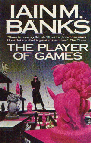 |
Apparently based on what Iain thought Civilisation (the computer game) was going to be like. He actually found that the game was better than the one he had written about and he's now a complete addict (reassuring that even great writers can be sad computer game nerds like the rest of us. For links on Civilisation II why not check out
The book as you may have guessed is focused around a game. The main character, , is one of the foremost gamesplayers in the universe - making a living and a famous reputation out of his skills.
|
Order Player of Games Today!
Use of Weapons
Order Use of Weapons Today!
The State Of The Art
Order The State of the Art Today!
Against A Dark Background
Order Against A Dark Background Today!
Feersum Endjinn
|

|
One of only two non-culture science fiction novels by Iain. This really is a bit of a weird one. You'll like this one if you enjoy translating lots of different accents - such as broad glaswegian nutter. |
Order Feersun Endjinn Today!
Excession
|
|
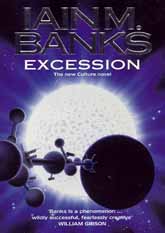
When an object reminiscent of the monolith from 2001 appears in the middle of space several interested parties become involved in a struggle to see who can make best use of this phenomenon. This book delves further into the Culture, exploring the real politicks of the Minds and their sometimes dubious actions. Banks uses one of his favourite narrative techniques of building the plot from a number of seemingly unconnected story threads until the plot is drawn together and previously unknown connections appear between the characters. The way he does this, particularly with the human characters makes us realise here more than ever how humans are but pawns in a vast galactic game played by the real masters, the minds, who actually control everything. Really quite scary in a way, but luckily most minds are very benign and careful not to harm their human charges. One of the interesting themes of this book, which I believe can be traced through other Culture books as well, is the way war is treated as a work of art. Very ironic or contradictory considering the Culture's love of pacificism, but maybe understandable: by making war an art form or a game then it is still allowed to be present in society reminding civilisation of its destructive power.
|
Order Excession Today!
Publisher Copy and Reviews
Inversions
Order Inversions Today!
Publisher Copy
Look to Windward

Order Look to Windward Today!
Publisher Copy

Home | Links
In Association with Amazon.co.uk