 |
|
|
|
|
|
|
|
|
|
|
|
|
|
|
|
|
|
|
|
|
|
|
|
|
|
|
|
|
|
|
|
|
|
|
|
|
|
|
|
|
|
Sumerian |
|
|
|
Heather Ceana |
|
|
|
|
|
Sumerian is the language which was spoken in Sumer (being called Sumeria now by some scholars), by the Sumerians. Sumer was a collection of City-States situated in Ancient Mesopotamia. Sumerian was written on tablets of clay, then left in the sun or baked to harden. The languages of the Ancient Near East, also called Ancient Mesopotamia, were Semitic languages. Sumerian was not a Semitic language, as the Sumerians were not originally from this region. We do not know from whence they migrated.
The writing system used to represent Sumerian, amongst other languages of Ancient Mesopotamia, was cuneiform. Cuneiform is not a language, but rather a set of symbols used to represent concepts or portions of concepts. Many languages could be written (thus communicated through time and space) using cuneiform.
I am stressing this point, because in our modern society, we do not, by and large, understand the difference between what is spoken (a language) and what is written (a writing system). I also feel that it is necessary to understand the import of the developement of writing. Writing allows one to communicate their experiences, thoughts, dreams, etc., to directly to people who are removed from them by time, space, or both.
ex: I might write a journal of my family's experience in adjusting to German life, culture, society, politics, economy, and education, that could be read by someone in California, Chili, South Africa, Australia, even Great Britian! That same journal could also be read by my daughter's son's son's daughter in Montana or Canada.
This is merely an example. One only need be familiar with the writing system and have some command of the language which is represented.
We all know that expressing thoughts from one language to another is translation. What is it called though, when we wish to express a language in a different writing system then what it was originally written in? This process is called 'transliteration.'
The Epic of Gilgemesh (written c. 2000 BCE) is one of the best know works of literature written in Sumerian. It is an epic about a Babylonian king. Babylon did not exist contemporarily with Sumer, but rather after the collection of 'city-states' that we call Sumer. Never the less, Sumerian continued to be the dominant language for political, religious, literary, and economic writings long after the fall of Sumer. |
|
|
|
Sample of a Cuneiform Tablet |
|
|
|
|
|
Click the image below to go to the enlarged version on my Cuneiform Samples page. |
|
|
|
|
|
 |
|
|
|
|
|
 |
|
|
|
|
Each symbol in this system, typically represented a syllable, not a single sound. (In the earliest forms, each symbol represented a word or concept.) The few symbols which still represented a word, are known as "determinatives." They tell the reader whether the following (or in some cases previous) word will be a city, diety, person, tree etc.,. The syllables are, of course, composed of vowels (v) and consonants (c). They were either v, v+c, c+v, v+c+v, c+v+c(+v), v+c+v+c, or v+c+c+v+c, etc.,.
The following are examples of transliterated sumerian words:
agam - swamp �ka - fleece
akar - leather armor b�zur - hand, palm
� - house, household, temple, plot of land gi - reed
g� (and) g� - reed mat g�b - to purify or cleanse
ig - door, entrance murgu - dung (sheep) |
|
|
|
|
|
|
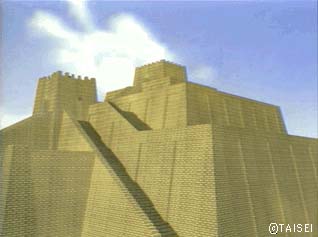
Computer Reconstruction of a Ziggurat at Ur |
|
|
|
|
|
Click the image below to go to the enlarged version on my Cuneiform Samples page. |
|
|
|
|
|
 |
|
|
|
|
 |
|
|
|
|
|
|
Babylonian Epic of Creation, Enuma elish, in Akkadian |
|
|
|
|
|
Misc. Links |
|
|
|
|
|
Scribal Education |
|
|
|
|
|
For an excellent overview of Mesopotamian Cultures, including Sumerian Culture - Mesopotamia: The Sumerians |
|
|
|
|
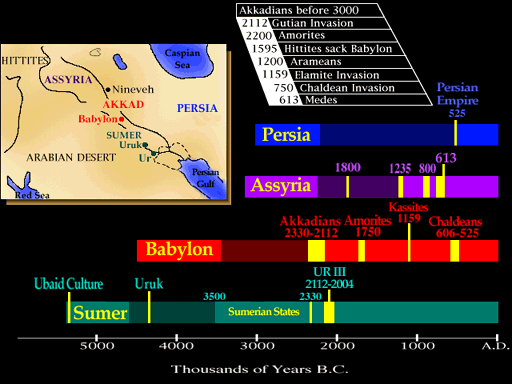
The Settled Agricultural Revolution ensued c. 7000 BCE. We see the developement of cities in Sumer c. 3500 BCE Sargon I established the Kongdom of Akkad c. 2340 BCE. The Third Dynasty of Ur (Ur III) is probably the most commonly known period of Sumerian Civilization. Sir Leonard Woolley and T.E. Lawrence (Lawrence of Arabia) excavated this level of Ur. Leonard Woolley published books geared toward sharing the experience and providing some level of enlightenment regarding the Middle East and Archaeology to the populace of Victorian England. |
|
|
|
|
|
|
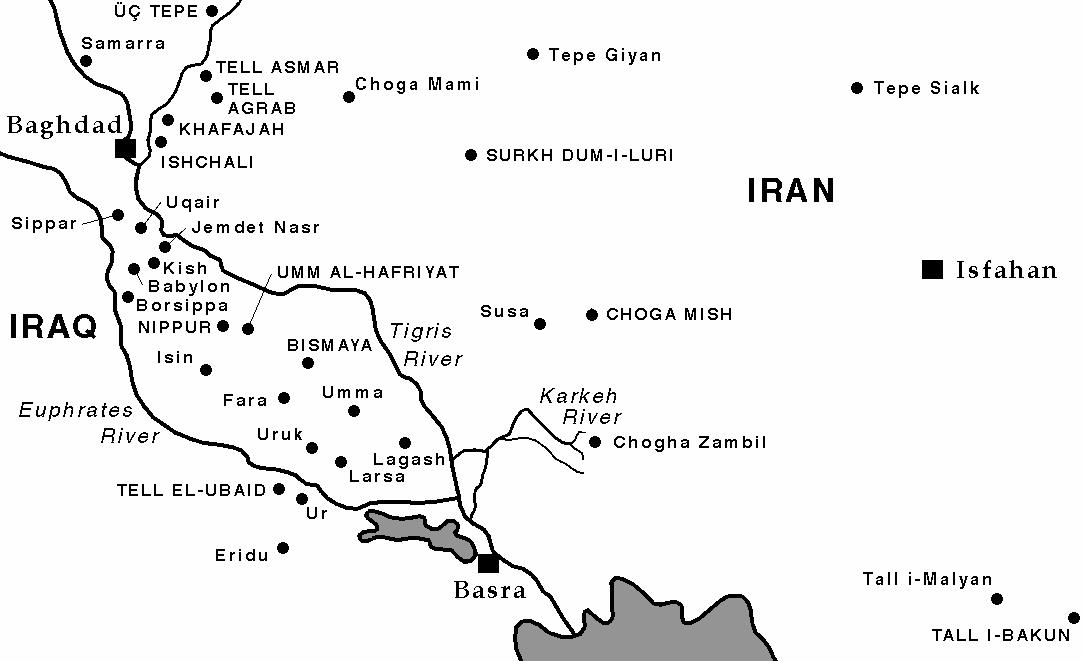
Cities of Sumer Links:
James Bell
Ancient Sumer History
Sumerians |
|
|
|
|
Timelines: Sumer: 5000-1595 BCE; Sumerian King List transliterated and translated; Assyrian Kings' List (including Akkad); Chronology of Ancient Near Eastern History; Chronology of Different Civilizations in Syria; |
|
|
|
|
|
|
The Electronic Text Corpus of Sumerian Literature
The Johns Hopkins/University of Amsterdam
Joint Expedition to Tell Umm el-Marra, Syria |
|
|
|
|
 |
|
|
|
|