"Rune-stone of the Torvaldsmark is taken by many,to mark the border between Torvaldsland and the south. Many of those of Torvaldsland, however, take its borders to be much further extended that the Torvaldsmark. Indeed, some men regard Torvaldsland to be wherever their ships beach, as they took their country, and their steel, with them."
Marauders of Gor, pg. 45
These stones, incidentally, are normally quite colorful, and can often be seen at great distances. Each year their paint is freshened, commonly on the vigil of the vernal equinox, which, in the north, as commonly in the south marks the new year. Religious rune stones are repainted by rune-priests on the vigil of the fest-season of Odin, which on Gor, takes place in the fall. If the stones were not tended either by farmers on whose lands they lie, or by villagers in whose locales they lie, or by rune-priests, in a few years, the paint would be gone, leaving only the plain stone. The most famous rune stone in the north is that on Einar�s Skerry, which marks the northland�s southern border.
Marauders of Gor pg 229
We saw thralls, too, in the crowd, and rune-priests, with long hair, in white robes, a spiral ring of gold on their left arms, about their waist a bag of omens chips, pieces of wood soaked in the blood of the sacrificial bosk, slain to open the thing; these chips are thrown like dice, sometimes several times, and are then read by the priests; the thing-temple, in which the ring of the temple is kept, is made of wood; nearby, in a grove, hung from poles, were bodies of six verr; in past days, it is my understanding, there might have been there, in place of the six verr, six thralls; it had been decided, however, a generation ago, by one of the rare meetings of the high council of rune-priests, attended by the high rune-priests of each district, that thralls should no longer be sacrificed; this was not defended, however, on grounds of the advance of civilization, or such, but rather on the grounds that thralls, like urts and tiny six-toed tharlarion, were not objects worthy of sacrifice; there had been a famine and many thralls had been sacrificed; in spite of this the famine had not abated for more than four growing seasons; this period, too, incidentally, was noted for the large number of raids to the south, often involving entire fleets from Torvaldsland; it had been further speculated that the gods had no need of thralls, or, if they did, they might supply this need themselves, or make this need known through suitable signs; no signs, however, luckily for thralls, were forthcoming; this was taken as a vindication of the judgement of the high council of rune-priests; after the council, the status of rune-priests had risen in Torvaldsland; this may also have had something to do with the fact that the famine, finally, after four seasons, abated; the status of the thrall, correspondingly, however, such as it was, declined; he was now regarded as much in the same category with the urts that one clubs in the Sa-Tarna sheds, or are pursued by small pet sleen, kept there for that purpose, or with the tiny, six-toed rock tharlarion of southern Torvaldsland, favored for their legs and tails, which are speared by children. If the thrall had been nothing in Torvaldsland before, he was now less than nothing; his status was now, in effect, that of the southern, male work slave, found often in the quarries and mines, and, chained, on the great farms. He, a despised animal, must obey instantly and perfectly, or be subject to immediate slaughter.
Marauders of Gor pg 152
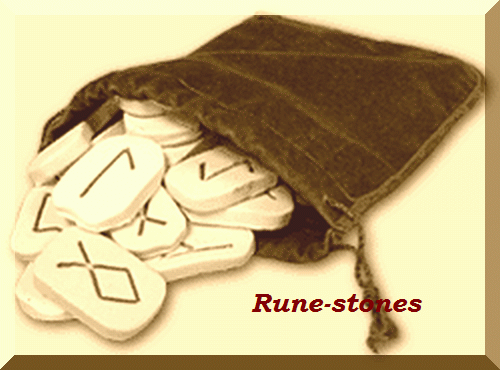
Characters called runes, meaning "secret," are said to have been created by the Norse god, Odin. According to legend, he hung upside down from the World Tree, Yggdrasil, for nine days in order to learn the wisdom of the runes. They are letters of the alphabet used by the earliest Gothic tribes of Northern Europe. heroic deeds were recorded in runic writing, and rune stones were used for charms and divination. Rune stones are still very popular for divination, partly because they are simple to use.
Casting the Runes
The inquirer holds a bag or box of of runes while asking a question. He or she casts, or throws, the stones on the ground, or picks one a t a time. The patterns of the letters, and the art of interpreting them, should result in an answer to the question.
 |
 |
 |
 |
 |
 |
 |
 |
 |
 |
 |
 |
 |
 |
 |
 |
 |
 |
 |
 |
 |
 |
 |
 |
 |
