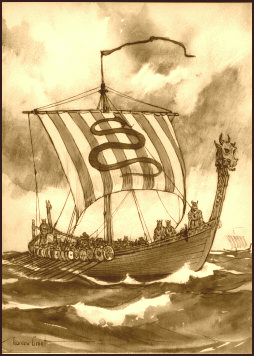
"There had been much fear in Kassau when the ship of Ivar Forkbeard had entered the inlet. But it had come at midday. And on its mast, wound and painted and of painted wood, had hung the white shield. His men had rowed slowly, singing a dirge at the oars. Even the tarnhead at the ship's prow had been swung back on the great wooden hinges. Sometimes, in light galleys, it is so attached, to remove its weight from the prow's height, to ensure greater stability in high seas; it is always, however, at the prow in harbor, or when the ship inters an inlet or river to make its strike; in calm seas of course, there is little or no danger in permitting it to surmount the prow generally, that the tarnhead was hinged back, as the ship entered the inlet, was suitable indication like the white shield, that it came in peace.
The ship was a beautiful ship, sleek and well-lined. It was a twenty bencher, but this nomenclature may be confusing. There were twenty benches to a side, with two men to each bench. It carried thus, forty oars, with two men to each oar. Tersites of Port Kar, the controversial inventor and shipwright, had advocated more than one man to an oar but, generally, the southern galleys utilized one man per oar, three oars and the three men on a diagonal bench, facing aft, the oars staggered, the diagonality of the bench permitting the multiplicity of oars. The oars were generally some nineteen feet in length, and narrower than the southern oars, that they might cut and sweep with great speed, more rapidly that the wider bladed oar, and the lightness of the ship, this would produce great speed. As in the southern galleys the keel to beam ratio was designed, too, for swiftness, being generally in the neighborhood of one to eight.
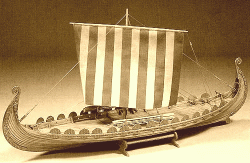
Forkbeard's ship, or serpent, as that are sometimes called, was approximately eight feet Gorean. His ship, like most of the northern ships, did not have a rowing frame, and the rowers sat within the hull proper, facing, of course aft. The thole ports, I noted, had covers on the inside, on swivels, which permitted them to be closed when the ship was under sail. The sail was quite different from the southern ships, being generally squarish, though somewhat wider at the bottom. The mast, like that of the southern ships, could be lowered. It fitted into two blocks of wood, and was wedged in the top black by means of a heavy diagonal wooden plug, driven tight by hammers. The northern ship carries one sail, not several sails, all lanteens, of the southern ships, which must be removed and replaced. It was an all-purpose sail, hung straight from a spar of needle wood. It can be shortened or let out by reefing ropes. At its edges, corner spars can hold it spread from the ship. I doubted that such a ship could sail as close to the wind as a lanteen-rigged ship but the advantage of being able or shorten or let out sail in a matter of moments were not inconsiderable. The sail was striped red and white. The ship, like most of the northern ships, was clinker built, being constructed of overlapping planks, or strakes, the frame then fitted within them. Between the strakes tarred ropes and tar served as caulking. Outside the planks, too, was a coating of painted tar, to protect them from the sea, and the depredations of ship worms. The tar was painted red and black, in irregular lines. The ship at night, mast down, with such colorings, moving inland on a river, among the shadows, would be extremely difficult to detect. It was a raider's ship. Another feature of the northern ships is that they have, in effect, a prow on each end. This permits them to be beached, on rollers, more easily. They can be brought to land in either direction, a valuable property in the rocky, swift northern waters. Furthermore this permits the rowers, in reversing position on the benches, to reverse the direction of the ship. This adds considerably to the maneuverability of the craft. It is almost impossible to ram one of the swift ships of the north."
Marauders of Gor, pg. 32-33
"The ships of the men of Torvaldsland are swift. In a day, a full Gorean day of twenty Ahn, with a fair wind they can cover from two hundred to two hundred and fifty pasangs."
Marauders Of Gor, pg. 56
"The men of Torvaldsland sometimes guide their vessels by noting the directions of the waves, breaking against the prow, these correlated with prevailing winds. Sometimes they use the shadows of the gunwales, falling across the thwarts, judging their angles. The sun, too, of course, is used, and, at night, the stars give them suitable compass, even in the open sea.It is a matter of tradition not to rely on the needle compass, as is done in the south. The Gorean compass points to the Sardar, the home of the Priest-Kings. The men of Torvaldsland do not use it. They do not need it.
The sextant, however, correlated with sun and stars is not unknown to them. It is commonly relied upon, however, only in unfamiliar waters.
Even fog banks, and the feeding grounds of whales, and ice floes, in given seasons, in their own waters, give the men of Torvaldsland information as to their whereabouts, they utilizing such things as easily, as unconsciously, as a peasant might a mountain, or a hunter a river."
Marauders of Gor, pg.56
Forkbeard and I sat in the shade, under a tented awning of sewn boskhides, some thirty-five feet in length. It begins aft of the mast, which is set forward. It rests on four poles, with two long, narrow poles, fixed in sockets, mounted in tandem fashion, serving as a single ridge pole. These poles can also be used for pushing off, and thwarting collisions on rocks. The bottom edges of the tented awning are stretched taut and tied to cleats in the gunwales. There is about a foot of space between the gunwales and the bottoms of the tented awnings, permitting a view to sea on either side.
Marauders of Gor, pg 58
The men of Forkbeard, their oars inboard, the ship under sail, amused themselves as they would. Some slept on the benches or between them, some under the awning and some not, or on the exposed, elevated stern deck. Here and there some sat in twos or threes, talking. Two, like the Forkbeard and myself, gave themselves to Kaissa. Two others, elsewhere, played Stones, a guessing game. The giant, he who might have been nearly eight feet in height, and had in the temple wrought such furious slaughter, sat now, almost somnolently, on a rowing bench, sharpening, with slow, deliberate movements, with a circular, flat whetstone, the blade of his great ax. Three other men of the Forkbeard attended to fishing, two with a net, sweeping it along the side of the serpent, for parsit fish, and the third, near the stem, with a hook and line, baited with vulo liver, for the white-bellied grunt, a large game fish which haunts the plankton banks to feed on parsit fish. Only two of the Forkbeard's men did not rest, he at the helm, bare-headed, looking to sea, and the fellow at the height of the mast, on lookout. The helmsman studies the sky and the waters ahead of the serpent; beneath clouds there is commonly wind; and he avoids, moving a point or more to port or starboard, areas where there is little wave activity, for they betoken spots in which the serpent might, for a time, find herself becalmed. The lookout stood upon a broad, flat wooden ring, bound in leather, covered with the fur of sea sleen, which fits over the mast. It has a diameter of about thirty inches. It sets near the top of the mast, enabling the man to see over the sail, as well as to other points. He, standing on this ring, fastens himself by the waist to the mast by looping and buckling a heavy belt about it, and through his master belt. Usually, too, he keeps one hand on or about the mast. The wooden ring is reached by climbing a knotted rope. The mast is not high, only about thirty-five feet Gorean, but it permits a scanning of the horizon to some ten pasangs.
Marauders of Gor, pg 59
A bailing scoop was thrust into her hands. It has four sides. It is made of wood. It is about six inches in width. There is a diagonally set board in its bottom, and the back and two sides are straight. It has a straight, but rounded handle, carved smaller at the two ends, one where it adjoins the scoop, the other in back of the grip.
Gorm moved aside eight narrow planks from the loose decking. Below, some two inches deep, about a foot below the deck planking, about two inches over the keel beam, black and briny, shifted the bilge water. There was not much water in the bilge, and I was surprised. For a clinker-built ship, the serpent of Ivar Forkbeard was extraodrinarily tight. The ship, actually, had not needed to be bailed at all. Indeed, it had not been bailed since Kassau. The average ship of Torvaldsland is, by custom, bailed once a day, even if the bilge water does not necessitate it. A ship which must, of necessity, be bailed three times in two days is regarded as unseaworthy. Many such ships, however, are sailed by the men of Torvaldsland, particulatly late in the season, when the ship is less tight from months of the sea's buffeting. In the spring, of course, before the ships are brought from the sheds on rollers to the sea, they are completely recalked and tarred.
"Bail," said the Forkbead.
The girl went to the opened planking and fell to her knees beside it, the wooden scoop in her hands.
"Return to me," said the Forkbeard, harshly.
Frightened the girl did so.
"Now turn about," said he, "and walk there as a bond-maid."
Her face went white.
Then she turned and walked to the opened planking as a bond-maid.
The other bond-maids gasped. The men watching her hooted with pleasure. I grinned. I wanted her. "Bond-maid!" scorned Aelgifu, from where she was fettered and chained to the mast. I gathered that these two, in Kassau, had been rival beauties.
Then, sobbing, the blondish girl, who had been forced to walk as a bond-maid, fell to her knees beside the opened planking. Once she vomited over the side. But, on the whole, she did well.
Once the Forkbeard went to her and taught her to check the scoop, with her left hand, for snails, that they not be thrown overboard.
Returning to me he held one of the snails, whose shell he crushed between his fingers, and sucked out the animal, chewing and swallowing it. He then threw the shell fragments overboard.
"They are edible," he said. "And we use them for fish bait."
Marauders of Gor, pgs 61-62
"What shield is at his mast?" called the Forkbeard.
"The red shield," called the lookout.
"Raise no shield to our own mast," said the Forkbeard. His men looked at him, puzzled.
"Thorgard is quite proud of his great longship," he said, "the serpent called Black Sleen."
I had heard of the ship.
"It has a much higher freeboard area than this vessel," I told Ivar Forkbeard. "It is a warship, not a raider. In any engagement you would be at a disadvantage."
The Forkbeard nodded.
"It is said, too," said I, "to be the swiftest ship in the north."
"That we will find out," said the Forkbeard.
"Two pasangs away!" called the lookout.
"It has forty benches," said Ivar Forkbeard. "Eighty oars, one hundred and sixty rowers." The benches on only one side, I recalled, are counted. "But her lines are heavy, and she is a weighty ship."
"Do you intend to engage her?" I asked.
"I would be a fool to do so," said the Forkbeard. "I have with me the loot of the temple of Kassau, and eighteen bond-maids, and lovely Aelgifu. I would have much to lose, and little to gain."
"That is true," I said.
"When I engage Thorgard of Scagnar," said Ivar Forkbeard, "I shall do so to my advantage, not his."
"One pasang!" called the lookout.
"Do not disturb the pieces," said Ivar, getting up. He said to Gorm, "Take the first bond-maid and draw her up the mast." Then he said to two others of his men, "Unbind the ankles of the other bond-maids and thrust them to the rail, where they may be seen." Then he said to the rowers on the starboard side, "When I give the signal, let us display to Thorgard of Scagnar what we can of the riches of the temple of Kassau!"
The men laughed.
Marauders of Gor, pgs 70-71
"The name of the ship of Thorgard of Scagnar," I said, "is Black Sleen. What is the name of your ship, if I may know?"
"The name of my ship," said Ivar, "is the Hilda."
"Is it not unusual for a ship of the north to bear the name of a woman?" I asked.
"No," he said.
"Why is she called the Hilda?" I asked.
"That is the name of the daughter of Thorgard of Scagnar," said Ivar Forkbeard.
I looked up at him, astonished.
"The Hilda is my ship," said Ivar Forkbeard," and the daughter of Thorgard of Scagnar will be my bond-maid."
Marauders of Gor, pg 75
The wrists of the bond-maids were fettered behind their backs; their ankles were tied; they wore the coffle rope of the north; and their mouths, with waddings of sleen fur, and strappings of leather, were tightly gagged.
There was silence on the ship of Ivar Forkbeard. Ivar, and four men, had taken the longboat, which is tied, keel up, on the decking of the after quarter, and made their way to the skerry. With them, her hair combed, warmed with a broth of dried bosk meat, heated in a copper kettle, over a fire on a rimmed iron plate, legged, set on another plate on the stern quarter, her hands tied behind her with simple binding fiber, had gone Aelgifu.
Gorm, who seemed second to Ivar, and I, stood at the railing near the prow on the port side of the serpent.
I could see, against the night sky, the darker shape, but low in the water, of the skerry. Too, against the sky, I could see the tall rune-stone, looking like a needle against the stars, which forms the Torvaldsmark.
Marauders of Gor, pg 75
I helped the Forkbeard and his men lift the longboat to the deck. It was tied down on the after quarter, keel up.
Suddenly an arrow struck the side of the ship.
"Free the serpent!" called the Forkbeard. "Benches!" The two anchor hooks, fore and aft, were raised. They resemble heavy grappling hooks. Their weight, apiece, is not great, being little more than twenty-five Gorean stone, or about one hundred Earth pounds. They are attached to the ship not by chain but by tarred rope. The men of the Forkbeard scurried to their benches. I heard the thole-port caps turned back, and the oars thrust through the wood.
Marauders of Gor, pg 78
Ivar Forkbeard, at the prow, lifted a great, curved bronze horn and blew a blast. I heard it echo among the cliffs.
Marauders of Gor, pg 80
Slave girls, naked, carrying burdens, loaded the ship of Ivar Forkbeard, the Hilda, moored at the wharf of the Thing Fields. We stood on the wooden boards of the wharf.
Marauders of Gor, pg 287