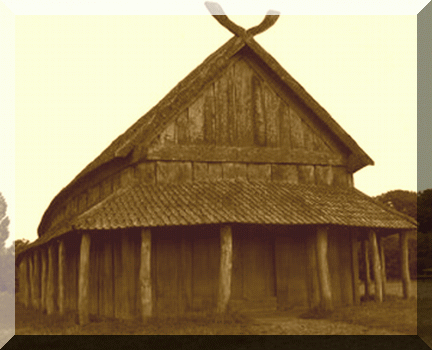
Throughout the Norse world, houses were built on a similar floor plan - the longhouse. The basic structure was a long thin rectangle, divided into rough thirds by two long lines of roof posts. The central floor area would be the location for a large fire, usually set on a raised hearth several inches high. The fire was the source of heat and most of the interior light, as well as serving as the kitchen. The area along each wall was typically made into a wide bench formed of wooden planks. These were the major furniture, used for seating during the day and sleeping pallets at night. The interior of the house might be broken by a few partition walls, but normally everyone lived together in the single main room or hall. The roof could be pierced by rectangular smoke vents, sometimes only gaps in the gable walls served to clear the smoke. The actual construction materials varied by what was locally available. In southern areas, walls of woven saplings plastered with mud, called 'wattle and daub' were common. In heavily forested areas, the side walls might be made of planks or even squared timbers. In either case, the roofing material was likely to be thick straw thatch. In the close packed towns, narrow lots left almost no space between houses. The combination of open fires and thatch roofs resulted in wide ranging fires as a common hazard. To the North, and later to the West, the walls were composed of thick piles of turf blocks, both sturdy and an excellent insulator. Poles set over the roof timbers supported more turf covered with living grass sod to stabilize it. Looking more like a low hill with short earthen walls, such turf longhouses would be the standard in Iceland and Greenland - and were the type built by Leif in Vinland.
Though the hall of Ivar Forkbeard was built only of turf and stone, and though he himself was outlaw, he had met me at its door, after I had been bidden wait outside, in his finest garments of scarlet and gold, and carrying a bowl of water and a towel. "Welcome to the hall of Ivar Forkbeard," he had said. I had washed my hands and face in the bowl, held by the master of the house himself, and dried myself on the towel.�
Marauders of Gor, chapter 6
'The Forkbeard greets you!,' shouted Ivar.� I blinked. The hall was light. I had not understood it to be so large. At the tables, lifting ale and knives to the Forkbeard were more than a thousand men.
Marauders of Gor, pg 194
�I had learned, much to my instruction, that my conception of the northern halls left much to be desired. Indeed, the true hall, lofty, high-beamed, built of logs and boards, with its benches and high-seat pillars, its carvings and hangings, its long fires, its suspended kettles, was actually quite rare, and, generally, only the richest of the Jarls possessed such. The hall of Ivar Forkbeard, I learned, to my surprise, was of a type much more common. Upon reflection, however, it seemed to me not so strange that this should be so, in a bleak country, one in which many of the trees, too, would be stunted and wind-twisted. In Torvaldsland, fine timber s at a premium. Too, what fine lumber there is, is often marked and hoarded for the use of shipwrights. If a man of Torvaldsland must choose between his hall and his ship, it is the ship which, invariably, wins his choice.
The hall of Ivar Forkbeard was a longhouse. It was about one hundred and twenty Gorean feet in length. Its walls, formed of turf and stone, were curved and thick, some eight or more feet in thickness. A fire, in a rounded pit, was at its center. It consisted, for the most part, of a single long room, which served for living, and eating and sleeping. At one end was a cooking compartment, separated from the rest of the house by a partition of wood. The long room, besides being low, is dark. Too, there is usually lingering smoke in it. Ventilation is supplied, as it is generally in Torvaldsland, by narrow holes in the roof. The center of the hall, down its length, is dug out about a foot below the ground level. In the long center are set the table and benches. Also, in the center, down its length, are two long rows of posts, each post separated from the next by about seven feet, which support the roof. At the edges of the hall, at ground� level, is a dirt floor, on which furs are spread. Stones mark sections off into sleeping quarters. Thus, in a sense, the hall proper is about a foot below ground level, and the sleeping level, on each side, is at the ground level, where the walls begin. The sleeping levels, which also can accommodate a man's gear, though some keep it at the foot of the level, are about eight feet in length. The hall proper, the center of the hall, is about twelve feet in width."
Marauders of Gor, pgs 90-91
The hall of Svein Blue Tooth was of wood, and magnificent. The interior hall, not counting rooms leading from it on various sides, or the balcony which lined it, leading to other rooms, was some forty feet high, and forty feet in width, some two hundred feet in length. It, on the western side, was lined with a great, long table. Behind this table, its back to the western wall, facing the length of the hall, facing east, was the high seat, or the rightful seat, the seat of the master of the house. It was wide enough for three or four men to sit together on it, and, as a great honor, sometimes others were invited to share the high seat. On each side of this high seat were two pillars, about eight inches in diameter, and some eight feet high, the high-seat pillars, or rightful-seat pillars. They marked the seat, or bench, which might be placed between them as the high seat, or rightful seat. These pillars had been carved by craftsmen in the time of Svein Blue Tooth�s great grandfather, and bore the luck signs of his house. On each side of the high seat were long benches. Opposite, on the other side of the table, too, were long benches. A seat of honor, incidentally, was that opposite the high seat, where one might converse with the host. The high seat, though spoken of as �high,� was the same height as the other benches. The men of Torvaldsland, thus, look across the table at one another, not one down upon the other. The seat is �high� in the sense of being a seat of great honor. There was, extending almost the length of the hall, a pit for a �long fire� over which food was prepared for re-tainers. On the long sides of the hall, on the north and south, there were long tables, with benches. Salt, in its bowls on the tables, divided men into rankings. Those sitting above the salt were accorded greater prestige than those sitting below it. If one sat between the salt and the high seat, one sat �above� the salt; if one sat between the salt and the en-trance to the hall, one sat �below� the salt. At the high-seat table, that at which the high seat sat, all counted as being �above the salt.� Similarly, at the tables parallel to the high-seat table, smaller tabies flanking the long fire on both sides, the tables nearest the high seat counted as being above the salt, those farthest away being below the salt. The division, was made approximately at the third of the hall closest to the high seat, but could shift, depending on the numbers of those in attendance worthy to be above the salt. The line, so to speak, imaginary to be sure, but definitely felt as a social reality, dividing those above from those below the salt, was uniformly �drawn� across the width of the hall
The hall was ornately carved, and, above the shields, dec-orated with cunningly sewn tapestries and hangings. On these were, usually, warlike scenes, or those dealing with ships and hunting. There was a lovely scene of the hunting of tabuk in a forest. Another tapestry, showing numerous ships, in a war fleet, dated from the time of the famine in Torvalds-land, a generation ago. That had been a time of great raids to the south
He, with his high officers, retired to the back of the dais.
The smoke from the fire found its way high into the rafters, and, eventually, out of the holes cut in the peaked roof. Some of these were eighteen inches square. Light was furnished from the cooking fire but, too, from torches set in rings on the wall, backed with metal plating; too, here and there, on chains from the beams, high above, there hung large tharlarion oil lamps, which could be raised and lowered from the sides. At places, too, there were bowls, with oil and wicks, with spikes on their bottoms, set in the dirt floor, some six inches from the floor, others as high as five feet; this mode of lamp, incidentally, is more common in the private chambers. It was not unusual, incidentally, tha the floor of the great hall, rich as it was, was of dirt, strewn with rushes. This is common in the halls of Torvaldsland. When the Forkbeard, and I, and other followers, many oi them bearing riches, entered the hall , we had been given a room to one side, in which we might wash and dry ourselves before the feast. In this room, unusual in halls, was a win-dow. I had put my finger against it, and pressed outward. I was not paned with glass, but with some sort of membrane but the membrane was almost as clear as glass. �What is this?� I had asked the Forkbeard. �It is the dried afterbirth membrane of a bosk fetus,� he said. �It will last many months, even against rain.� Looking out through the window I could see the palisade about the hall and its associated buildings. The palisade inclosed some two acres; within it were many shops and storage houses, even an ice house; in the center, of course, reared the great hall itself, that rude high-roofed palace of the north, the house of Svein Blue Tooth. Through the membrane, hardly distorted, I saw the palisade, the catwalk about it, the guards, and, over it, the moons of Gor. In the far distance, the moonlight reflected from its snowy heights I saw, too, the Torvaldsberg, in which the legendary Torvald was reputed to sleep, supposedly to waken again if needed once more in Torvaldsland.
Male thralls turned the spits over the long fire; female thralls, bond-maids, served the tables
Then we were standing on the wooden-shingled blazing roof of the hall of Svein Blue Tooth. I looked up and saw the stars and moons of Gor. �Follow me,� cried Ivar. In the distance I saw the Torvaldsberg. There was moon-light reflecting from its snows. He sped to the northwest corner of the hall. He disappeared over the edge of the roof I looked over and saw him, in the moonlight, making his way downward, hand by hand, foot by foot, using the clefts projections and niches in the ornate carvings of the exterior corner beams of the Blue Tooth�s hall. Swiftly, my arm scorched from the fire which had torn at my sleeve, hear pounding, breathing heavily, I followed him.
Chapter 13 Marauders of Gor
