 Gettysburg Heroine
 Gettysburg Heroine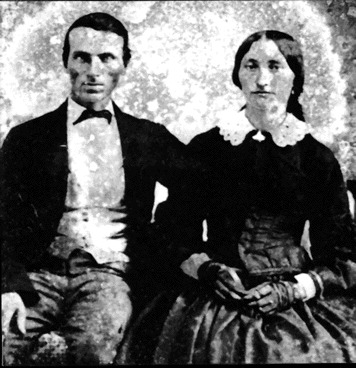
The battle was on Wednesday, the 1st of July, and it was on the Friday before that I first saw the rebels. As the rebels came to Gettysburg, we were all scared and wished for them to go.
Six of them came up the Baltimore Pike. Before they came into the Cemetery they fired off their revolvers to scare the people. They chased the people out and the men ran and jumped over fences. Then they came back. I was a piece away from the house when they rode in on their horses to get after a man who had run away from town. When they rode into the Cemetery I was scared, as I was afraid they had fired after my mother. I fainted from fright, but finally reached the house.
As they could not catch the man they came back soon again. They said we should not be afraid of them, they were not going to hurt us like the Yankees did their ladies.
They rode around the house on the pavement to the window, and asked for bread and butter, and buttermilk. The biggest man must have been a high officer. My mother went and got them all she had for them and just then a rebel rode up the pike and had another horse beside his. The ones who were eating said to him: "Oh, you have another one." And the one who came up the pike said: "Yes the _____ _____ shot at me, but he did not hit me, and I shot at him and blowed him down like nothing, and here I got his horse and he lays down the pike." (The man whom the rebel had killed was Sandoe, who had composed a company in Gettysburg.)
He turned around to me and asked me: "Is that a good horse over there? It was our neighbor's horse, and I said "No it ain't. It is a healthy enough horse, but he is very slow in his motion." Well, it would not suit. I knew if the horse was gone the people could not do anything, so I helped them.
Soon they were sent to different places where they destroyed the telegraph and the railroads. Evening came on and they had destroyed a good many of the cars, and burned the bridge and seven cars on it. This was the Rock Creek Bridge. We could see the cars drop down from Cemetery Hill. Next morning we heard that there was a small battle at York. Everywhere they destroyed all they could.
Nobody felt like work any more, and on Wednesday morning they came with big forces, and the battle began above Gettysburg, near the Springs Hotel on the Ridge in the morning early on Wednesday.
As I went upstairs so often I saw them come in on the ridge near McMillan's house, near where the Spring Hotel now is they came and got more help. While they were fighting on the ridge the Union soldiers came from all directions.
We were trying to feed them all we could. I had baked in the morning and had the bread in the oven. They were hungry and smelled the bread. I took a butcher knife and stood before the oven and cut this hot bread for them as fast as I could. When I had six loaves cut up I said I would have to keep one loaf for my family, but as they still begged for more I cut up every loaf for them.
We had all the glasses and tins and cups and tubs and everything outside filled with water. All the time our little boys were pumping and carrying water to fill the tubs. They handed water to the soldiers and worked and helped this way until their poor little hands were blistered, and their bread I had given away on Friday.
When our men lost and the rebels had driven them more this way, they put their cannons on Cemetery Hill and threw some shells over toward Coon Town. And as they fired towards the direction of the Poor House they were firing at our own men, but they did not know it, and I heard them say this amongst themselves, that they did not know it.
So at last they came to the Cemetery House and wanted a man to go along over to show which was which of two roads. As there was no man who could go along out with them (a young boy was there about thirteen years, and I thought he was too young, and my father was too old) I offered myself to go along. He refused at first, but I thought there was danger all around, and said I wasn't afraid, so he said "Come on."
We walked through flax, and then through a piece of oats, and then we stood in a wheat field. They all held against me coming through the field, but as he said I was all right, and it did not matter, why they gave three cheers and the band played a little piece, and then I walked a little past a tree to where I could see the two roads. I showed him the Harrisburg Road, the York Pike, and the Hunterstown Road. It was with one of General Howard's men that I went. Then he took me back home. He said, "They will commence very heavy firing now, walk on the other side of my horse." And so as soon as I jumped on our porch he went back again.
I wanted to go upstairs once more to see if our men gained, but when I came on the stairway a shell had cut in the window frame, then jumped a little, than went through the ceiling, so I would not go up any more that day.
Soon one of General Howard's men came and ordered me to have supper for General Howard. I complained I had no bread, for I had given it all away in the morning. But I said I could make cakes, and he said they were good enough for war times.
They did not come for so long, it was near twelve o'clock. It was General Howard, General Sickles, and General Slocum.
The house was so full of soldiers that the boys had to lay on the floor in the kitchen, on feather beds. And as they saw the children lying there, they said it was very sad.
After they had had some supper and I found they were going to leave I asked them if they thought I should leave the house in the night. General Howard rubbed his forehead and said: "Leave the house? Leave the house?" Then he looked towards the others and said: "Comrads, I say stay. Then he said we should take our best things and pack them up and in two hours he would send two men to carry them to the cellar. Than he smiled and said: "I guess you call all best." But I said: "Some I call better then others." He said they would begin hard fighting about day-break, near four o'clock, and then we should go to the cellar.
About two hours after they left the men came and took the things to the cellar. General Howard said: "When I give you orders to leave the house don't study about it, but go right away."
About four o'clock we went to the cellar, There were seventeen of us. Among them were, Mrs. Cook and one child, Mrs. Barbehann and four children, and our three, myself, my father, and others. We were in the cellar about two or three hours. The noise of the cannonading was terrible. At last the door flew open and someone said: "This family is commanded by General Howard to leave this house and get as far in ten minutes as possible. Take nothing up but the children and go." They said we should keep on the pike, where the soldiers could see us, and that would save us. When we were a little way down the pike a shell bursted back of us, and none of us were killed, but we commenced to walk faster. We went down the pike one and one half miles when we began to feel weak and sick, we were so hungry, for we had eaten nothing the day before we were so scared when the battle commenced. So we went into a farm house to buy bread. The woman baked just like we did and we smelled the bread. She sold me a loaf for 25 cent, and Mrs. Cook another loaf for 30 cent, and another at 35 cent, (The same woman charged all these prices.) But the bread was doughy and we could not eat it. Later we stopped at a farm house, Musser's. We did not feel like going further as it was full of soldiers and army wagons and provision wagons.
Near midnight, when everything was quiet, my father and I undertook to walk home to the Cemetery House. As we left the house we had to pass through a room where the Union soldiers were sleeping, lying in two rows, with only one candle to light the whole room. About the middle of one row a man raised himself on his elbow and motioned me to come to him, my father signed I should go to him, and he took a picture out of his pocket and on it was three little boys, and he said they were his, and they were just boys like mine, and would I please let him have my little boys sleep near him, and could he have the little one close to him, and the others near him? And so, he took them and had them lying by him.
When we got out on the pike we had an awful lot of trouble to get up, because the guard was not going to let us through. But as they listened to what I had to say, that we wanted to look after our things in the Cemetery House, they let us pass. We had fat hogs and we wanted to look after them. When we got to the stable we could hear the wounded men holler and go on, laying around the house, in the cellar too, and there is where we had carried our good things, that General Howard had told us to leave there. We could not get near the house for wounded and dead. They had been brought there from the first days fight.
My father went to the pig pen and said: "The pigs are gone." My father got a man to take us into the cellar where six wounded men were, and they had our bed clothes spread all around. We went to the cellar thinking we could get a pillow and quilt, but all I could find was my mother's shawl and no pillow. The poor wounded men were crying and going on so that we did not want anything then. They called their wives and children to come and wet their tongues. Then we went down the pike again. We had no trouble with the guards going back. And when we came again to the farm house we picked up our little boys out of the soldier's arms, and got ourselves ready, and about three o'clock in the morning we started on another journey, and went down the pike to the White Church, and then it was daylight, and we stopped a little bit there and saw some of our neighbors; then we went into a big farm house. We wanted water but there was none to be got, the pumps were all broken, and we were tired and hungry again, and still had nothing to eat.
They had there a big wagon shed where they brought the wounded and took off their limbs, and threw them into the corn crib, and when they had a two horse load they hauled them away.
Another lady and myself went upstairs in the house to where our officers were. We rapped at the balcony door and an officer came out and asked us what we wished. I told him I lived in the Cemetery House and we were drive away from home and had nothing to eat or drink, and we thought we would lay in complains.
He laughed and said: "You want to live on the army then?" Then he asked me if I knew Jenny Wade. I told him I did, and he said she was killed, and he asked me if I knew Maria Bennet, and he said she was killed (but that was not true.) Then he wrote us an order on the official paper to go to the provision wagon a mile away. We went over and we got our aprons full of coffee, sugar and hard-tack. (I have some of that coffee and sugar yet.)
When we got back we hunted for milk in the cellar and we found two crooks full. I opened a crook. The woman with me could not see, so she got her hand in the soft soap. We took one crook of milk up to our sick people and we hid the other one. But they wanted it soon, and when we came in the cellar again somebody else had found it and we had none. But we found the woman's yeast and we bought flour and we baked bread that night. The woman had gone away and had taken the family to Littlestown. (Han Beitler lived there.) Then he came home and asked us what we were going to do. And he said he had a barrel of flour nailed in a closet, and he would take this barrel out and give it to us on the garret where we were, so he did. He got a man to help and rolled the barrel upstairs. We were to watch his part and he to give us a dollars worth. So when we had bread in the morning the soldiers found it out. Some came and threw down a dollar for a loaf, and another three dollars. Monday we had no bread to give them and they were so hungry they could not wait. We hid two loaves, but we baked the next night again. The house was full of soldiers. In daytime we were watching the sick and wounded, and they were calling for water and screaming all the time.
We saw some of our furniture going on some of our wagons down the pike, and my boys wanted me to go out and stop it.
We stayed at this farm house, I believe three nights and then we went home.
We were down the country four days and the fifth we went home. On the way home we met Mr. David McConaughy. He was the president of the Cemetery at that time and he said to me: "Hurry on home, there is more work for you than you are able to do." So we hurried on home. When we looked at the house I could only say "O my!" There were no window glass in the whole house. Some of the frames were knocked out and the pump was broken. Fifteen soldiers were buried beside the pump shed. I went to the cellar to look for the good German linen, others packed with other good things, everything was gone, but three featherbeds and they were full of blood and mud. After I had dragged them out of the cellar I asked an officer who was riding by, if I would ever get any pay for things spoiled like this. He asked me what it was, and I told him bed clothes that were in the cellar and he said in a very short way: "NO!"
So as soon as the pump was fixed I sent for three women and we washed for four days before we got them clean.
Then I got a note from the president of the Cemetery, and he said: "Mrs. Thorn, it is made out that we will bury the soldiers in our Cemetery for a while, so you go for that piece of ground and commence sticking off lots and graves as fast as you can make them."
Well, you may know how I felt, my husband in the army, my father an aged man. Yet for all the foul air we two started in. I stuck off the graves and while my father finished one, I had another one started.
This lasted for days, until the boys sent word, if I couldn't get help at all I should telegraph to some of my friends to come and help me. Two came, but one only stayed two days, then got deathly sick and left. The other stayed five days, then he went away very sick, and I had to pay their fare here and very good wages for their work. By that time we had forty graves done. And then father and I had to dig on harder again. They kept on burying the soldiers until they had the National Cemetery ready, and in that time we buried one hundred and five soldiers. In front of the house there were fifteen dead horses and beside the Cemetery there were nineteen in that field. So you may know that it was only excitement that helped me to do all that work, with all that stench. And in three months after I had a dear little baby. But it was not very strong, and from that time on my health failed and for years I was a very sickly woman. In my older days my health has been better, but those hard days have always told on my life.
Elizabeth Caterine Maser Thorn

 Get your own Free Home Page