 |
|
|
|
|
|
|
|
|
|
|
|
|
 |
 |
|
|
|
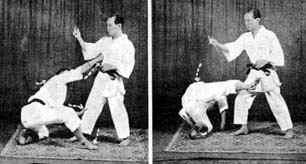
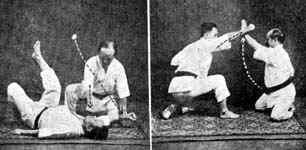
Funakoshi and Otsuka in the latter's Karate-do Kyohan, demonstrating defense from sitting position |
|
|
| In 1929, Sensei Otsuka opened his first karate school at Tokyo University. For the next 5 years, he stayed under the direction of Master Funakoshi and became his best student. During that time, he had started to learn Okinawan tode karate (Okinawate) where he worked with karate stylists of the time like Kenwa Mabuni (Shito-Ryu) and Choki Motobu (Naha-te). He put emphase on fighting and the kata Naihanshi. |
|
|
| It is during that period of time that the differences between Sensei Funakoshi and Sensei Otsuka regarding the methodology of teaching and training in martial arts began to become insurmountable, although the two remained on good terms throughout their lives. Whereas for Sensei Funakoshi's karate training involved mainly kata, Sensei Otsuka was brought up with the close contact of Jujitsu pair work and sparring. While still with Sensei Funagoshi, he introduced yakusoku kumite or "prearranged sparring" to their karate.That is when Sensei Funakoshi disagreed with Sensei Otsuka because Sensei Funakoshi beleived that it would be too risky to get hurt since the nature of karate was based on mortal techniques. Having a student like Sensei Otsuka was enriching for Sensei Funakoshi but the diversities between their two personalities is present from the beginning and the compromise they make at the beginning will not last for long. The balance between the two is broken from the moment that Sensei Funakoshi beleives, from his point of view, that Sensei Otsuka is pushing the limits a little too far. In fact, Sensei Otsuka felt the need to do free sparring exercises and incorperating even box and kendo in it too. This evolution appeares normal to Sensei Otsuka who had already practiced Jujitsu for 17 years and where the katas are a preperation for a fight, but Sensei Funakoshi didn't find them acceptable. Master Funakoshi then started to criticize Sensei Otsuka: " He modifies the esssence of karate by incorporation too many elements of Jujitsu". The seperation between Master Funakoshi and Master Otsuka became foreseeable. |
|
|
| At the end of the 1930's, Sensei Otsuka decided to make a trip that will allow him to work with the people hwo had taught karate to Master Funakoshi and found that this last one had simplified and modified too much the karate techniques and katas in order to teach them to a bigger beginner group. Otsuka also trained with Motobu Choki, the Okinawan who was renowned for wandering the red-light districts in search of fights in order to test his technique. Motobu was a bitter enemy of Master Funakoshi and held him in little esteem. It is said that Motobu and one of his students once turned up at Sensei Funakoshi's dojo one day in search of a contest (c.f. Ajari's "Wado Ryu" video). In the fracas Master Funakoshi was hurled helplessly against a was ans only Sensei Otsuka's Jujitsu skills prevented the fight from continuing. |
|
|
| At this time Sensei Otsuka invested time and thought into an idea that would come to affect karatekas of almost every style. He began the study of jui-kumite (free fighting) for competitive purposes, laying the foundation for today's free style karate kumite tournaments. Many Students decide to join Sensei Otsuka, they want to try the efficacity of karate in fighting exercises which was forbiden by Master Gichin Funakoshi. That is how Master Funakoshi's school was divided in two groups. The group that followed Master Otsuka will later form the Wado Ryu school. During its formation, Sensei Otsuka adapted atemi techniques that he had learned with Master Funakoshi and incorperates them them into Okinawan karate and Jujitsu, modifying karate techniques and therefore invented his own karate style. |
|
|
| Master Otsuka then meets an experienced Kendo practitionner named Y. Konishi who follows a similar path and tries to advance in karate by incorperating what he had acquired in Kendo. Both then become good friends and their collaboration will continu during their whole lives. Y. Konishi will later open the Ryobukai karate school which activities will perpetuate and keep its quality without having any major expansion. It is because of Y. Konishi that Master Otsuka gets the chance to meet K. Mabuni who had just arrived from Okinawa. Sensei Otsuka exposes to him his problems concerning the katas that Master Funkoshi had taught and his attemps to find a more satisfactory form for the kata. For Sensei Otsuka who had not been able to make a trip to Okinawa to make researches, the knowledge of Mabuni was revealing and made him advance even more in his reflesion on his katas. In May 1934, at the age of 43, Sensei Otsuka openned his own school called the Dai Nippon Karate Shinko (Dai = great, Nippon = Japan, Shinko = to promote, bu = martial, kai = association) who then changed its name to Dai Nippon Karate-do Shinbu Kai then was made shorter to Ko-Shu Wado Ryu Karate Jutsu, then was made even shorter to Wado Karate Jutsu and then finally was named Wado Ryu. Here would be the centre of Sensei's teaching of his new systems of Wado Ryu Karate Jutsu and Wado Ryu Jujitsu Kenpo, merging okinawan karate with traditional Japanese Jujitsu. They say that it was the chaiman of the Dai Nippon Karate Shinko, Eriguchi Eiichi who thaught of the name Wado Ryu. Besides of his medecine work, Sensei begins to teach karate in his dojo and in a few universities clubs. In 1938, after the attribution os his title of Renshi (Master of third rank) by the Butoku-Kai, he ceased to practice traditionnal medecine and concentrates on karate. He then changes the name of his style to Wado Ryu, following his students advise, or Eriguchi Eiichi, the chairman of the club's advise as some say. Four years later, in the middle of WWII, he receives the tile of Kyoshi (Master of second rank). It is in 1940 that Sensei Otsuka registered at the Butokukai of Kyoto and became one of the four major styles of Japanese karate; Shotokan, Shito-Ryu, Goju-Ryu and now the Wado-Ryu. In the same year, Sensei Otsuka organizes the All Japan Karate-do Federation who's karate is present all over the world. |
|
|
|
 |
|
| Back |
|
|
|
|
| Next Page |
|
|
|
|
| Home |
|
|
|
|
|
|
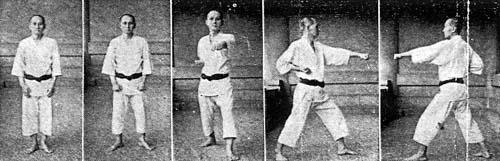
Sensei Otsuka demonstrating a Junzuki (Oi tsuki) |
|