
|
|
|
|
|
|
|
|
|
|
|
|||||||||
| At that time, in 1921, Master Choku Motobu, also former student of Itosu, was theaching that art in Japan already. Sensei Funakoshi taught initially in Meisojuku, a pension for students in a dojo of 40 m2. Later he shared the dojo of Hakudo Yaka-hama, master of kendo. In 1935, Sensei openned his own shotokan dojo in the district of Meijiro. In 1936, Sensei openned more than 30 dojo in universities and companies. | |||||||||
| It is at that time that the kata was revised on the form. The old Chinese names disappeared for Japanese names. In the same way that karate changed its meaning from "Chinese hand" to "empty hand" in reference to the notation of "empty" of Zen. Master Gichin Funakoshi only taught 15 katas to his students. The other katas were taught by other masters of Okinawa or friends of a Sensei that came to Japan to organize seminars.By 1940, the dojo run by Sensei Funakoshi was filled with persuasive young men. Soon after the Pearl Harbor attack by the Japanese, his dojo was incredibly crowded. It is obvious that, after Japan's defeat in World War II, practically all types of matial arts saw a halt in their development, but this only lasted for a short period of time. | |||||||||
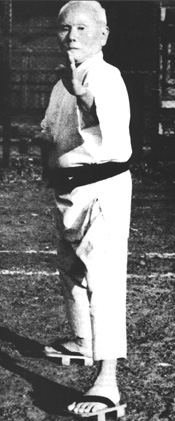
| Master Funakoshi performing a shuto | |||||||||
| In 1949, Master Gichin Funakoshi is named chief instructor of Japan Karate Association. By the time Sensei reached 70 years of age, karate-do was taught in universities and dojos openned everywhere in Japan. Sensei Passed away in Tokyo on April 26th 1957, ten years after his wife, who had never left Okinawa, had died. | |||||||||
| Home | |||||||||
| Back | |||||||||