






Creating
and Executing a Segmented Customer-Based "Life Stage" Marketing Program
Summary
| Strategic Considerations | Tactical
Considerations
Description of the Financial Wisdom Strategy | Integrating the Life Stage Concept | The Importance of "Production Values" | Customization is Critical
Pricing | Items Needed for Implementation | Timing
Examples of Newsletter Content | About Financial Wisdom Marketing Services, Inc.
Summary
Effective marketing is becoming the key to success in the financial
services industry. Quality products, proper pricing and operational
efficiencies have become just the "price of admission" to the market.
Effective marketing will determine the ultimate winners.
The Financial Wisdom marketing communication program can help your bank respond to your marketing challenges. This strategy takes the form of personal letters to customers with highly customized newsletter inserts. The program provides useful financial education and information on your products and services in a personal manner. Tailoring the customer messages based on their life stage makes the whole communication process more effective. The FinancialWisdom program adds value to the customer relationship.
-
Personalized communication is more effective than non-personalized communication. Generic messages are ineffective and often lost in the clutter of competitive messages.
-
Customers put a high value on their personal time. Most are forced (or choose) to spend available time at work or with family. Time for their financial issues is usually short.
-
Life stages or life events are excellent indicators of financial needs and service preferences.
-
Information about customers can be used to create segments that have common financial concerns and interests. This information (mainly age, homeownership and presence of children) can be found in the bank's MCIF system or purchased relatively inexpensively.
-
The content of the newsletters can be created to provide financial education and bank product information that is very relevant for each and every customer.
-
Individual printing of cover letters enables further refinement of content and personalization of the message.
Description
of the Financial Wisdom Strategy
Each quarter, customers receive a personal letter from my bank. The
"letter" consists of a cover letter from the president with a four-page,
four-color newsletter insert. Both the cover letter and the newsletter
are highly customized. The cover letter is written in a somewhat "chatty"
way and serves to demonstrate your commitment to each customer's financial
well being. The letter is personally addressed and signed by the president.
The front page of the newsletter features an article about the competitive advantages of your bank. It is attractive to use this article to describe a customer situation and tell how your organization helped resolve an issue. "Success stories" are very readable and often portray the very situation of the reader. The front page also includes a commentary on some timely financial issue - Social Security, consolidation in the financial services industry or other such topic.
The second and third pages focus on the member's total financial picture. They include educational articles that will help customers make better financial decisions on important issues. The articles are not full of confusing financial jargon; rather, they present useful ideas in an attractive, interactive format. Subjects include retirement, college funding, investing, mutual funds, home mortgage refinancing and the general topic of "Mistakes to Avoid."
The back page includes a bank product article and a "State of the Markets" section. The article is chosen to make sure it is timely and perhaps can be the focus of other marketing efforts. The "State of the Markets" section includes information on the financial markets in general and also lists some of the bank's loan and savings rates.
Integrating
the Life Stage Concept
The financial services needs and wants of individuals change as they
pass through different stages of life. Younger individuals usually have
greater credit needs. As they age and begin accumulating assets, savings
and investment products take on a greater role. Saving for children's
college education, planning for retirement, minimizing taxes and estate
planning issues are usually associated with different times of one's
life.
The Financial Wisdom marketing program can be enhanced by taking steps to make the content of the newsletter and the cover letter more relevant for each customer. This is done by grouping customers with common financial needs, focusing the messages for each group and then making sure the messages are delivered in as personal of a manner as possible. Consider the importance of -- segmentation, relevancy and personalization.
- Segmentation
In general, the customer base would be divided into three age-based
groups:
|
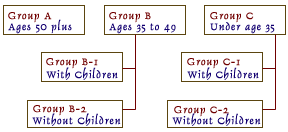 |
In addition, Groups B and C would have subsets of those with and without children. It may also be beneficial to consider children only under age 15.
This segmentation scheme provides five groups, each of which have some characteristics that are particular to that segment. There are also some characteristics that are shared by some or all of the groups. Each quarter, these five groups would be combined into two larger groups that would receive separate newsletters. By only having two versions of the newsletter, the printing costs would be reduced.
- Relevancy
Age and presence of children are two of the most important determinants
of financial services needs and customers' desired way of doing business.
Older customers usually have more assets and are more interested in preserving their assets as well as growing them. Older customers are usually less inclined to change long standing banking relationships unless their normal way of doing business is disrupted. These relationships must be strongly defended.
Younger customers are usually accumulating assets and growing assets. Preservation may be a secondary objective. They tend to be fee sensitive, are more apt to change relationships and may be receptive to alternative ways of doing business -- electronically or with a financial consultant.
A child in the household, especially younger children, often indicates a need or desire to accumulate funds for college education. Children leaving the household will often result in increased assets for saving.
Each quarter combining the five segments into two groups would allow for newsletter topics applicable to each reader. To economize newsletter printing, it would be important to have the two large groups either be roughly equal in size or one being three times the size of the other.
In one quarter the grouping would be based primarily on age. The first large group consisting of Group A (ages 50 plus) and Group B-2 (ages 35 to 49, without children) would receive a newsletter with articles on laddering CDs and the value of having a comprehensive financial plan. The second group consisting of Group C (under age 35) and Group B-1 (ages 35 to 49, with children) would receive a newsletter with articles on direct deposit and low fee checking accounts. In this case the two large groups would be about the same size.
Another quarter, the grouping would be based on the presence of children. The first group consisting of Group A (ages 50 plus), Group B-2 (ages 35 to 49, without children) and Group C-2 (under 35, without children) would receive a newsletter with articles on dollar cost averaging of mutual funds and IRA alternatives. The second group consisting of customers with children, Groups B-1 and Group C-1, would receive a newsletter addressing college funding issues. This could include worksheets for estimating college costs and help in designing a saving strategy. In this case, the former group would probably be significantly larger than the latter.
- Personalization
Personalizing the marketing messages is critical. Consumers are overloaded
with financial services messages from dozens of competitors. A letter
from my bank probably "gets the benefit of the doubt" and is opened.
A personal letter from my bank makes the customer feel "special" and
is more likely to be read.
The personalization of the mailing package has three components -- the envelope, the form of the cover letter and the content of the cover letter.
-
The envelope itself is of high quality stock. The name and address is printed on the envelope instead of using a window format. Postage is affixed with a stamp avoiding out of town postmarks and the stigma of bulk mail.
-
The letter is printed on high quality letterhead and bears "from the office of the president." The name and address of the customer is printed on the letter. The salutation is courteous. "Dear Mr. Franklin" is more meaningful than "Dear Customer." The president signs the letter.
-
The content of the cover letter, while somewhat "chatty," expresses appreciation for the relationship and demonstrates the bank's concern for the customer's financial well being. The letter can also include the address and phone number of the customer's specific branch. If the customer has a personal banker, the letter from the president would serve as an "endorsement" of the personal banker. Cover letters are laser printed individually. This enables the insertion of names, addresses, phone numbers and even different messages at the individual customer level.
The
Importance of "Production Values"
The appearance of your message says as much about your organization
as the content. The "production values" of your communication must measure
up to what customers expect to see from a quality provider of financial
products and services. You are competing with other banks, credit unions,
brokerage firms insurance companies and mutual fund companies. For that
reason, the Financial Wisdom program uses a four-color printing process,
printed envelopes, and stamps for postage. The Financial Wisdom program
was created on the belief that personal correspondence is the most effective
form of communication other than one-to-one conversation.
Customization
Is Critical
The entire package must be consistent with the other messages and activities
of your organization. Along with your envelope, letterhead and any photographs,
we work with you to ensure that the content of the cover letter and
the newsletter is indicative of your organization. The topics of articles
are agreed on and the tone of the articles is carefully selected.
Pricing
The pricing of the Financial Wisdom personal communication strategy
is all-inclusive. All content creation, design, printing, mailing and
postage are included. Letters are mailed using presorted postage rate
stamps. The price for executing this program is $1.25 per piece with
a minimum of 5000. Quantity discounts apply for 20,000 or more.
-
Customer name and address file. If available, use of a householded file ensures only one letter per home. This looks good and saves money.
-
Artwork for letterhead and envelopes.
-
Signature of president for digitization.
-
Photographs.
-
Ideas for articles about your bank and its products and services.
Timing
The Financial Wisdom program can be implemented quickly and efficiently.
Once the proposal is accepted, we visit your offices to better understand
your organization. Letterhead and envelopes are ordered. Cover letter
and newsletter content is determined. Of course, you have final approval
on all content.
The first issue of your Financial Wisdom would be mailed to customers within 60 days and quarterly thereafter.
Examples
of Newsletter Content
Below are some of the topics that can be included in your FinancialWisdom
newsletter. Other articles can be written to suit your organization
and your needs.
- Mistakes to Avoid
-
Not taking full advantage of company retirement plans.
-
Choosing the wrong retirement assets.
-
Choosing an inappropriate mix of stock, bond and cash investments.
-
Ignoring the long-term potential superior returns historically found with equity investments.
-
Delaying to start to save for children's college education.
-
Choosing the wrong types of investments for college funds.
-
Not understanding the values of bonds and bond mutual funds can fall when interest rates rise.
-
Choosing mutual funds based on short-term performance.
-
Not using diversification in your investment portfolio.
-
Using the wrong investment advisor or the wrong type of advisor.
- Educational Articles
-
Asset Allocation
-
Planning for a Financially Secure Retirement
-
Preparing and Updating a Personal Balance Sheet
-
Measuring the Performance of Your Investments
-
Understanding Financial Market Indicators
-
Funding a College Education
-
Fixed versus Variable Rate Mortgages
-
Choosing a Mutual Fund
-
Evaluating Stocks to Buy
-
Building a Ladder of Maturities with Certificates or Bonds
-
Individual Retirement Plan Options
-
Should You Refinance Your Mortgage
-
Financial IQ Test
About
Financial Wisdom Marketing Services, Inc.
Financial Wisdom Marketing Services has extensive experience and expertise
in the areas of financial products, services and relationship marketing.
While the company is young, the principals have decades of experience
dealing with the issues that are critical to the success of your marketing
efforts.
Mike Patterson, a graduate of Marquette University, is a Certified Public Accountant with extensive experience in the financial services industry. After four years as a tax accountant with Price Waterhouse, he spent 15 years in the securities brokerage industry as a product manager, marketing director and executive with Blunt Ellis & Loewi and its successor, Kemper Securities. While with Blunt Ellis & Loewi, in Milwaukee, he created continuing education programs for brokers, accountants and attorneys. Mike was also a frequent public speaker, presenting over 100 seminars and workshops to individuals and professional advisors.
Larry Rine holds an MBA from the Kellogg Graduate School of Management of Northwestern University with a concentration in marketing. He attended undergraduate school at Northwestern with a major in organizational behavior and was an accepted Ph.D. candidate in the marketing department at the University of Illinois. Larry spent 19 years as the owner/operator of an advertising agency, concentrating since 1988 on database marketing. In that role, he became experienced in the design and implementation of preferred customer programs. He has further training and experience in the areas of relational database design, computer application development, networking and computer telephony. He has consulted in the area of automated bulk mail preparation.
Financial
Wisdom Marketing Services, Inc.
42 Sherwood Terrace Suite 6
Lake Bluff, IL 60044
Fax: 847/604-8405
Contact Us.

FW
OnLine for Consumers | FW OnLine for Small
Businesses and their Owners
FW Newsletter Strategy for Consumers | FW
Newsletter Strategy for Small Businesses and their Owners
Download Quarterly Marketing Insights for Bank
Marketing Executives
Main Menu | Solutions
for Banks | About Us | Contact
Us
© 2000 Financial Wisdom Marketing Services, Inc.