| Earth History |
 |
 |
 |
| This terrific FOSS kit uses the Grand Canyon as a model for studying and exploring the earth's geologic history and the sedimentary rock cycle. The canyon's distinct rock layers consist mainly of three sedimentary rock types: shales, sandstones, and limestones. Geologists recognize many distinct rock types in the canyon, however, they are usually grouped into ten major layers. Click on this link to see a diagram of the layers. |
| Here is an easy way to learn and remember the ten layers, from the top of the canyon to the bottom: "Know the canyon's history. Study rocks made by time." Know Kaibab Limestone The Toroweap Limestone Canyon's Coconino Sandstone History Hermit Shale Study Supai Formation Rocks Redwall Limestone Made Muav Limestone By Bright Angel Shale Time Tapeats Sandstone V Vishnu Schist [Only the bottom layer, the Vishnu Schist, is not included in the mnemonic device--you have to remember to add it!] |
 |
| Here are some of the BIG IDEAS of this kit: > The rock in the Grand Canyon is very, very old. > The oldest rock is at the bottom of the canyon. As you hike down into the canyon, it's like you are going back in time. Newer rock is on top. This is an important principle in geology. > Most of the rock is formed in horizontal layers, so most of the rock is sedimentary--formed from sediment over millions of years. > The rock layers listed above were laid down in the same order all over the Colorado Plateau. It's K-T-C-H-S-R-M-B-T-V in the Grand Canyon, to the north at Bryce Canyon & Zion, and to the south in the San Francisco Peaks. It's everywhere! > Scientists can examine the rock layers to find out about the past. They can make observations, gather data and collect evidence to infer the age of each rock layer and how it was formed. > Fossils found in the rock layers provide a lot of important information about the past. > The canyon has formed as the result of massive weathering and erosion. The canyon will continue to change--deepening at the bottom and widening at the top. *Follow this link to find out more about what we are doing and learning in class. |
|
 |
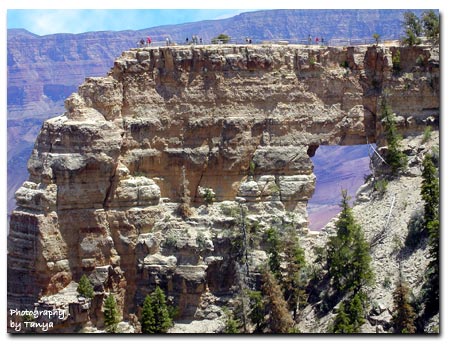
| This is Angel's Window on the North Rim. Uneven erosion caused this special effect. You can walk out over the window. Those are people on top! |
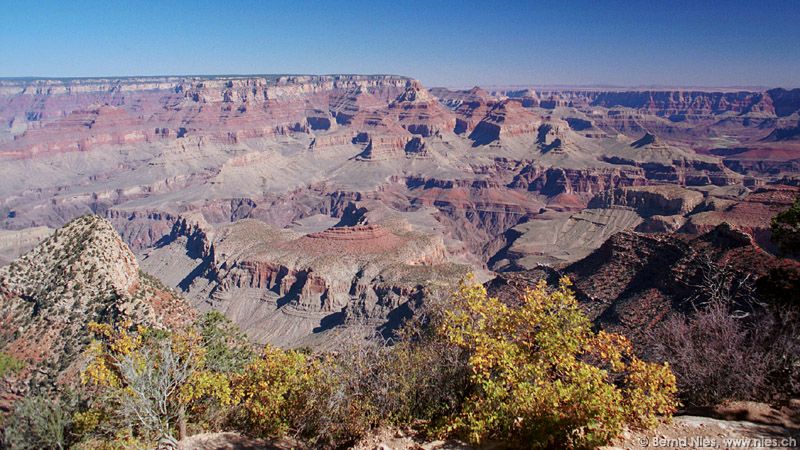
| This view across the canyon from the South Rim shows the whitish layer of the Coconino sandstone in the distance, a.k.a. "The Bathtub Ring." |
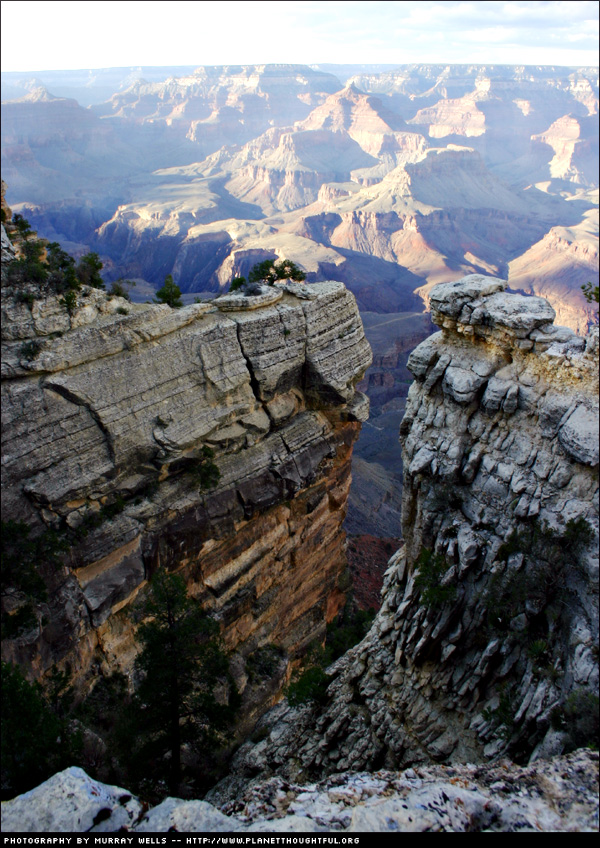
| In the canyon you see a lot of over-lapping rock formations, a.m. and p.m. shadows, changing light, and many signs of weathering & erosion. |