
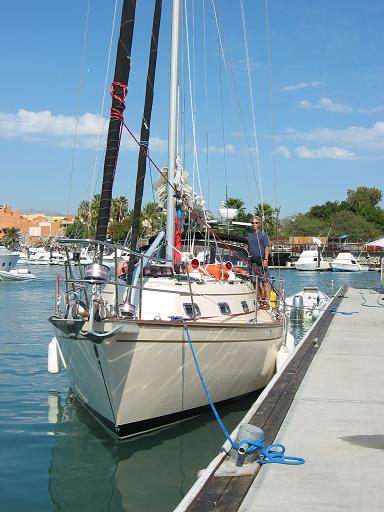
Now I am not saying that we do not enjoy life on our boat, it is just that many of our friends and acquaintances want to believe that we have a completely care-free and easy life. I must admit, from an outsider's perspective, this would appear to be the case, and therefore we would like to give everyone some insight into our "simple and easy" life.
Living and traveling on a boat is a bit like living in an RV but without the option of pulling into the nearest KOA when you are tired, or calling AAA on your cell phone when you run out of gas, break down, or have locked yourself out once again. Fuel, food, water or a good mechanic are generally not just down the road. On passages, we are moving 24 hours a day and at least one of us is awake at all times. Underway duties like watch standing, navigation, and sail trimming require constant attention. When we stop, and are at anchor, we are monitoring the wind and seas to ensure we don't drag and end up parked on the beach or in the rocks. Marina's are the exception but they are expensive, noisy and too crowded for our tastes.
Cruising provides many challenges and compromises that you would not normally encounter living ashore. Think of it as running a tiny city in which you are the City Manager, overseeing Water, Power and Sewer Departments, a Phone Company, and, not least of all, Transportation. You must learn all of the intricacies of these services, keep them maintained and in good operating order at all times and perform repairs as necessary.
Services you take for granted and never give a second thought too at home require never ending attention aboard a sailboat. Water does not flow endlessly from faucets for washing, cleaning, drinking and cooking, and long hot showers are something to be relished at infrequenmt stops in marinas. Electricity must be conserved jealously, lest you run out. You do not just pick up the phone to call a repairman or the pizza delivery guy. The trash man does not come on Friday, or any other day of the week, to pick up that smelly garbage that is accumulating. Even flushing the toilet becomes a process of adjusting valves, manual pumping, and never flushing anything you did not personally expel. Yes, there is even a small container for used toilet paper (to be discreetly disposed of later), as it has a bad habit of clogging the finicky plumbing.
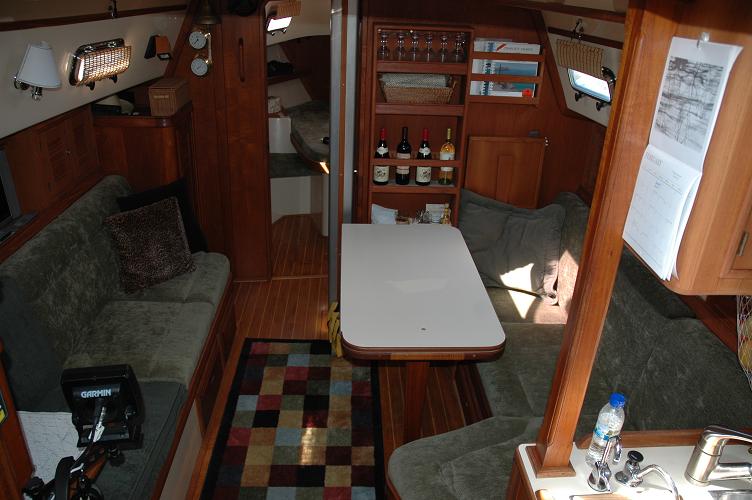
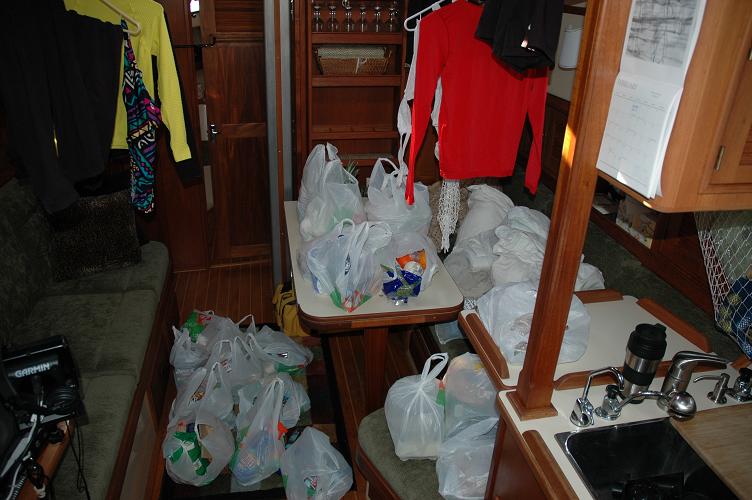
COOKING Our galley space (kitchen) is small but adequate, with a 2-burner propane stove and oven unit, a very small microwave, a 2-compartment sink with both fresh and salt water, and an 8 cubic ft. refer/freezer box. The 2-burner stove and lack of counter space does, however, provide certain challenges when preparing even the most basic meals. In our boat's galley, the French culinary practise of "mis en place" (things in place) rises to a whole new level of importance. It is inevitable that once the top of the reefer has been turned into a work area (which, by the way, comprises more than half of our usable galley counter space), you discover that there is something else required from the reefer. This process is generally repeated several times during the preparation of a meal or until you give up and leave that particular ingredient out. (Honey, why is there no shrimp in the shrimp scampi?)
Our refer/freezer is not your typical large side-by-side, built-in ice-maker, purified water at the door, runs forever without a thought home unit. No, this is a delicate little system that revolts by raising it's temperature when over-loaded with items that are not already cold and, if not properly charged and maintained, will suck up more of your electrical budget than trying to heat an Olympic-sized swimming pool with an electric coffee-pot. The refer/freezer unit on a small boat is really not for freezing items or even making them cold, as it's name implies. In reality, it is more of a space to keep things that are already frozen or cold in such a state. Add to that, all those items are stuffed into a space equivalent to about 2 medium-sized ice chests, where everything is piled on top of everything else, with the constant rule that whatever it is you need is always at the bottom.