 |
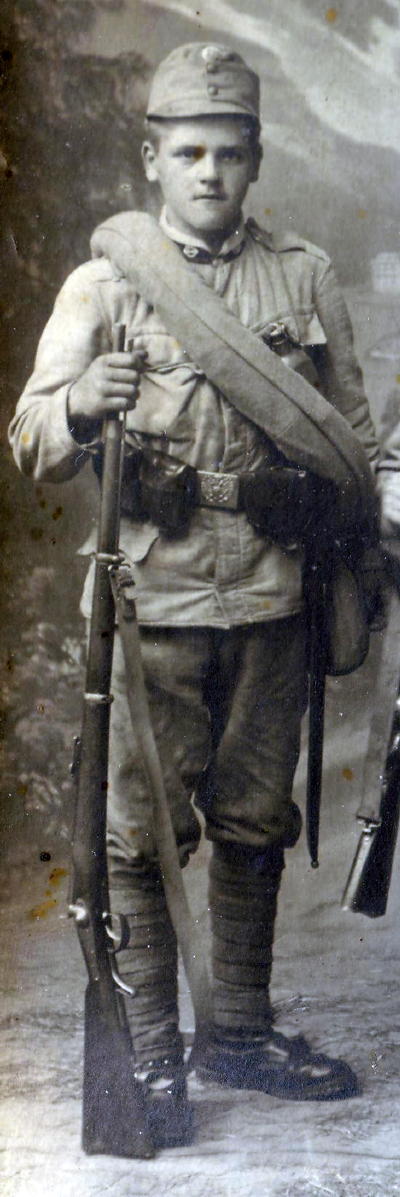
| Soldier carries a Werndl rifle and bayonet. |
| Josef Werndl was born on the 26th of February 1831 at Steierdorf in Upper Austria as the son of an old established family of gunsmith's. His father Leopold had transformed the family business from tool manufacturing into a company for weapon parts, especially for rifles, in 1821. After school Josef Werndl learned the profession of a gunsmith and worked at Prague as well as in Vienna. As was usual at the time he traveled widely to gain experience which took him to Th�ringia, England and at last to the USA where he would gain valuable experience at the famous companies of Colt and Remington. He returned to Steyr in 1853 and started to work in the family business - at this time a manufacturing concern with 500 employees - which he had to take over after the sudden death of his father in 1855. Josef Werndl started to reorganize the firm following modern practices and specialized in producing high quality barrels and other parts for small arms. Following the spirit of the time he also started to develop, together with his foreman Karl Holub, a modern breech loading rifle system. For the distribution of such a rifle he founded with his brother the "Josef und Franz Werndl & Comp. Waffenfabrik und S�gem�hle" on the 16th of April 1864, registered with the commercial register of the city of Steyr on the 13th of August of the same year. The continually growing company delivered their breech loader to several foreign countries. In July 1867 he took out the patent of an easy to use breech loader with a unique tabernacle gun lock (Wellblockverschluss mit Lademulde) which finally won the competition against the Remington System with the k.u.k. Army. Josef Werndl offered the Army his rifle for use without any patent fees free of charge- of course not out of any "patriotic feelings" as he officially announced, he simply knew that his firm was at this time the only company which was able to produce the Werndl rifle in the necessary quality and quantity for the whole army and both Landwehrs. |