| In 1885 there were major advancements in artillery. Heavier and more advanced shells with calibers over 150 mm made the old rock and stone fortifications obsolete. As a result, all new Austrian fortifications were to be built partially underground or in rock with roofs made of concrete 2 to 5 meters thick and reinforced with steel. Austrian fortifications had some interesting characteristics. They were always defensive in nature and designed to help control the surrounding territory. Most were armed with 100 mm howitzers in steel turrets, 6 or 8 cm guns, and lots of heavy machine guns. Shooting distance was short and calibers were too small to inflict and damage on the distant Italian fortresses. Each Austrian fortress was designed to be completely independent. They had large underground ammunition supplies, food, water and generators added to produce electricity. Troops were specially trained for living long periods of time underground and in complete darkness. They could even load, aim and fire weapons in the dark because of a �brail� type touch system of markings on the guns, shells and detonators. Two major military schools, Festungsari Trient (an artillery school) and Pioniergenie Trient (a fortification school) were responsible for planning the defense of the Southern Front. From 1900 to 1915, in Trento (which was strategically located), a defensive system was developed consisting of over 70 forts and 60 armored positions all able to resist sustained shell fire for long periods of time. Another strategic area, Lavorone- Sperrgurtel was also protected in a similar manner. |
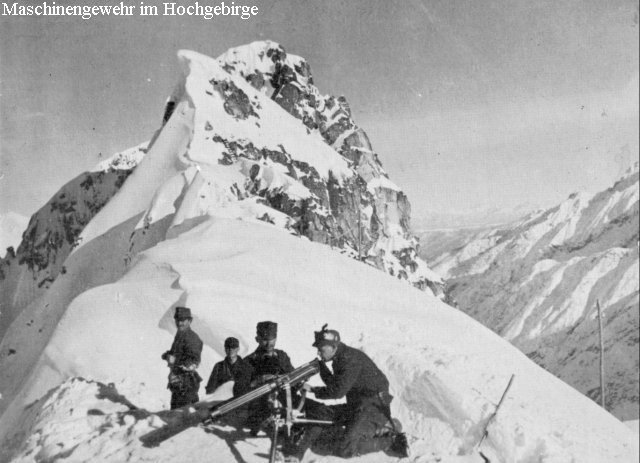
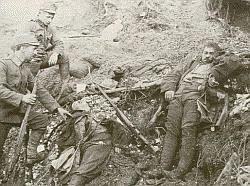
| On May 23rd 1915 the Italian Fort Verena fired the first shots aimed at Austrian Fort Luserna. Fort Verena ,higher in elevation and armed with 149G long range cannons was unable to direct fire with precision due to high altitude winds and poor quality weapons. Many shells fell on the small town of Lusern . The people of Lusern suffered many casualties and the women, children. and elderly had to be hastily evacuated. At the start of the Italian/Austrian war most Austrian units were already fighting on the Russian front. As a result, the Austrian border with Italy was protected mostly by volunteers who were not even part of a regular army unit. Soldiers ages ranged from 16 to 80, oldest being Farmer Senn of Meran volunteer battalion. They were often armed with older rifles and equipment and logistics so terrible that many times soldiers wives would bring food to the men in the trenches. The opening battle started with 40,000 old men and boys against 230,000 regular Italian troops. Wave after wave of Italian attacks were halted by just a few Austrian defenders situated on top of the mountains. Italian troops were especially vulnerable to Austrian machine gun fire and sharp shooters. Most of the Italian soldiers knew it was hopeless yet were forced to certain death by their commanders. Almost every attack turned into a massacre. In one attack on Mt. Pasubio the Italian army lost 39,000 men! Afterwards Austrian soldiers had difficulty returning to their forward positions because of the thousands of dead bodies heaped in front of them. A captured Italian officer was found with a document warning him about the Austrian sharp shooters of the Meraner Standschutzen battalion. After the tragic and completely avoidable losses Italian commanders decided to try to destroy the Austrian defenses with heavy artillery. In one month 25 to 30 thousand shells of all calibers rained down on the Austrian positions. At the Austrian Fort Lusern communications were destroyed, there was no electricity, water and food was in short supply and the troops hadn�t slept in days. Lieutenant Commander Nebesar lost his nerve and put up a white flag despite the objections of his well trained squad. When volunteers on an overlooking hill saw the white flag all the Austrian forts in the area started firing on Fort Luserna!! A young 18 year old volunteer riding on a bicycle went to the fort under heavy enemy AND friendly fire, and removed the white flag from a building rooftop. About the same time volunteer units halted the Italian attack. Austrian pioneers entered the fort and removed Nebesar and his officers from power. Nebesar was put before a tribunal but the war ended before he was condemned. The young volunteer who took down the white flag (Otto Jochler of the Meraner Standschutzen battalion) received a silver medal for his act of bravery. The new Italian strategy of raining massive amounts of artillery shells on Austrian positions created a grave situation. Austrian commanders concluded the solution to the problem would be using the Top Secret M11. |
| WW1 Austro-Hungarian Artillery and Fortification History |
| This information courtesy of Volker Jeschkeit and Uli Moesslang.( language advisor Jim Haugh) |
 |
 |