| |
|
Efes Villas
|


|
| KYRENIA - GIRNE |
|
Kyrenia is founded in the 10th Century BC. , by Achaean settlers and was for many Centuries one of the 10 Kingdoms of Cyprus. In the 7th Century it was fortified by Byzantine who built the original Castle later expanded first by the Lusignans and then by the Venetians. Under Ottomans the town had remained a minor port. The British built a harbour and a Quay. Under British Empire the Town was an en-route resting place for officers, captains and their families for its picturesque situation, its beautiful harbour and leisurely and romantic atmosphere.
The Town still retains its character with many restaurants and bars by the Harbour and small hotels spreading east and west of the town, along the coastline which raises to form an impressive backdrop with the mountains behind.
The region now an attractive holiday resort boasts many historic sites worth visiting. Among these the Harbour Castle and the Shipwreck Museum, The St. Hilarion Castle, The Bellapais Abbey, the Folk Art and the Icon Museums are the most important.
|
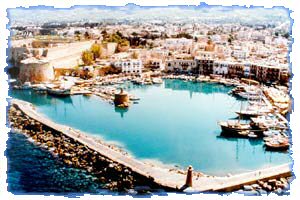
Girne Yacht Harbour: It is undoubtedly one of the most enchanting sites of the oriental Mediterranean. The marina is surrounded by old Venetian houses, restaurants and taverns. It attracts numerous colourful fishing boats as well as elegant yachts. Girne was founded by the Myceneans towards 1600 BC.
|
|
| CYPRUS |
|
|
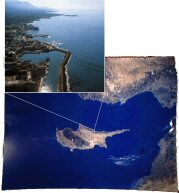
Cyprus is located at the Eastern end of the Mediterranean which has made it a strategic crossroads between Europe, Africa and the Middle East. It lies 70 kms. from Turkey, 100 kms. from Syria and 320 kms. from Egypt. It is the third largest Mediterranean island after Sardinia and Sicily.
Evidence of Assyrians, Phoenicians, Macedonians, Hellenists, Persians, Romans and Egyptians, Byzantines, Crusaders, French Lusignans, Venetians, Ottomans and the British has been found on Cyprus.
Northern Cyprus is unspoilt by commercialism and high rise buildings. The coastline with its backdrop of beautiful mountains enjoys sandy, uncrowded beaches.
|
|
| WEATHER |
|
|
One of the benefits of being a Mediterranean island is
plentiful sunshine throughout the year, and Cyprus is no exception. Summer
stretches from mid-May to mid-October and means high temperatures, normally
cloudless skies and cooling breezes from the sea. Even in the height of summer
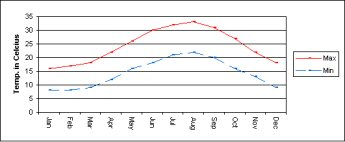
when it's 32�C at the beach (and warmer inland), temperatures are refreshingly
cooler in the Troodos, making the mountains ideal for hiking or simply relaxing.
|
|
|
December to February are the winter months, bringing the
possibility of rain, but still an average of six hours of bright sunshine a day.
At this time of year smaller Mediterranean destinations shut down for the
season, but not so Cyprus. The many important heritage sites and museums are all
at their least crowded in winter. Into early February there is occasional rain.
|
|

|
The first orchids bloom in January, and by mid-February the
countryside is alive with fresh green meadows and almond trees in bloom. March
days can still be cool (daytime temperatures around 18�C) but steadily
moderate. Early spring is a wonderful time to visit to Cyprus, with pleasant
daytime temperatures and many of the ancient ruins framed by a carpet of red
anemones and other wildflowers. If in summer Cyprus is the place to bask in the
sun, then spring is the time to savour the natural beauty of the island in
bloom.
|
|
|