 |
|
|
|
|
|
|
|
|
|
|
|
|
|
|
|
|
|
|
 |
 |
|
|
Leeches |
|
|
|
|
|
Copyright to all photographs: Hartwig Dell'mour |
|
|
|
|
|
|
Leeches of Southeast Asia and Australia
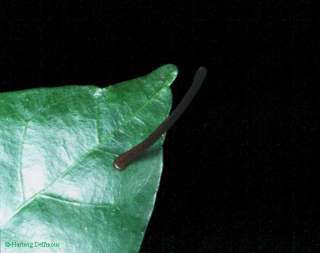
Leeches are a typical phenomenon of South East Asian, Indonesian and Australian rainforests. Unlike mosquitoes, which will gall you at any time of the year (in dense rainforests also during daytime), they are only active during and shortly after rainfalls, when air humidity is still high. If you walk an Australian rainforest during heavy downpour, they will come at you in large numbers. But if you chose the dry season (May to October), you probably won't even realise that leeches occur in these forests. Leeches are rather "primitive" animals. They are related to earthworms and, of course, belong to the same class as our aquatic leeches. Altogether, they are not considered dangerous. Their senses are few, but highly specialized to detect warm blooded animals. For them, you are just delicious food. They will actively seek you out and move towards you at an amazing speed. They move like inchworms, using their two suckers for locomotion. |
|
|
 |
|
 |
|
|
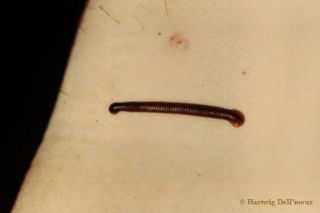
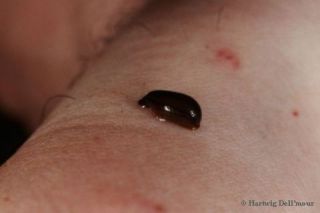
While it rains, leeches lurk around in large numbers on the ground and on vegetation, "sniffing" for 37�C warm animals. Normally, they "board" your shoe and squeeze their way through clothing until reaching the skin. But you can also pick them up from leaves. Some people wear nylon panty hoses which are allegedly "leech proof" (for the lower part of your body). Once the leech reaches his destination, he will stretch as far as possible and firmly secure both suckers on the skin (thus becoming "flat" making it difficult to pick him up). He will apply a substance which acts both as an anesthetic and anticoagulant. Therefore, you do not feel the bite. |
|
|
 |
|
 |
|
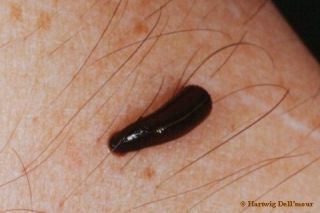
| The leech will cut open the skin, applying a Y-shaped incision, and start sucking blood with his "mouth" in the center of the front end sucker. It only takes half an hour (sometimes even less) until the leech is filled up with blood and now looks really fat. He will let go and make back for the leaf litter, where he hides away, looking forward to a long period of lazy digesting. The next meal is only due in a couple of months. The little wound he made with his razor sharp "teeth" continues bleeding for several minutes. Bushwalkers' clothes are usually bloodstained in the rainy season.. |
|
 |
|
 |
|
|
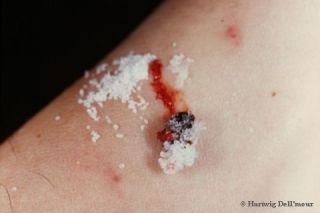
If you walk through Australian rainforests during the rainy season, I advise you to always carry with you a small waterproof container (e.g. a film box) filled with salt. Apply some of the salt to the leech immediately after you discovered it (you don't have to wait until it is filled with blood like I did for the above photo series). The leech will let go instantly. If you have a soft spot for parasites or are an animals rights activist, you must rinse off all |
|
salt. Throwing away the leech together with the salt crust, he will die. (Which is fine with me - the fellow must suffer for his impudence!)
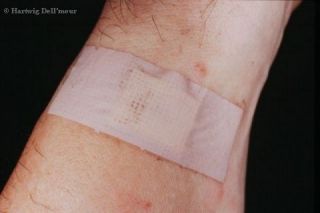
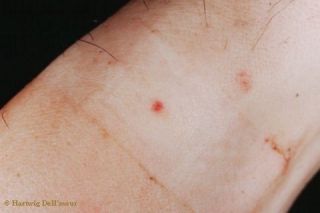
Due to the anticoagulants that were injected with the bite, the wound will continue bleeding for quite a while which can be rather messy. To prevent this, I apply some sticking plaster (but there is no medical necessity for it). Eventually, all that's left is a small circular red spot, which itches mildly. Ignore it. Don't scratch! By scratching, you might provoke a superinfection which could be a lot more harmful than the whole leech encounter. |
|
 |
|
|