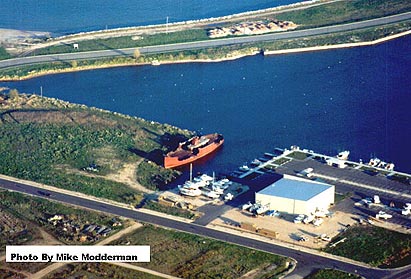
Jeffrey Rogers began photographing THE STRAITS OF MACKINAC in 1996. He has visited her perhaps a dozen times since, and is currently writing a book about the vessel, from the time the keel was laid through her present status in Kewaunee Harbor, Wisconsin. He later plans on producing a follow-up book about the Intentional Sinking Project mentioned on a previous page.
In the fall of 1968, after forty years of service between St. Ignace, Mackinaw City and Mackinac Island, THE STRAITS OF MACKINAC was finally taken out of service. She spent a year at Cheboygan, Michigan before being moved to the Peterson Shibuilding facility in Sturgeon Bay, Wisconsin. Peterson's plans were to use her for floating storage.
The 1970's were busy years at Peterson. With many ships being built for the U.S. Navy, the STRAITS, as a floating warehouse, began to deteriorate at her moorings. Raw materials, loose parts and subassemlies were stacked on the foredeck and inside the promenade deck. This brought more dirt and debris on board and accellerated the deterioration of the vessel's interior. Her upper superstructure, built largely of wood, soon showed signs of neglect. The paint bleached and peeled and was stained by gulls and other visiting birds. Exposed metal began to rust. Dust and dirt found its way through hatches and portholes. The STRAITS began a slow, lingering process of decay that would continue for another twenty years.
The STRAITS was serving a useful purpose, however, so she was not sent to the breaker's yard. In the mid-1980's, after almost fifteen years of exposure to the elements, the upper superstructure was no longer sound. Because of the risk to personnel, the pilot house, boat deck, promenade deck and related supportive structure were all removed. This left the hull essentially configured as it is today. The ship continued to be used for storage, although by this time the workload had decreased significantly.
In 1994 or 1995, a Greek shipping company bought THE STRAITS OF MACKINAC and it was towed to Kewaunee, Wisconsin where, after four months, the owners stopped paying their slip fees and vanished. Thus began the final phase of the ship's life.
Rogers first found the old ferry on Easter Sunday of 1996. It was a rusty-red hull nearly 200 feet long, with a thick plank spanning the gap between dry land and foredeck. He invited himself aboard and his fascination with the ship and her history began.
On this first visit he found the crew quarters to contain bunks, mattresses, some clothing items, shoes, magazines, newspapers, dressers, chairs, even a life jacket. The engineers' quarters aft housed a collection of catalogs for various mechanical parts, stacks of blank inspection forms and numerous technical manuals.
Lockers outside the quarters held boxes and boxes of spare parts, seals, packings, light bulbs, cable and hardware of all sorts. The galley and pantry had been stripped of cookware, dishes and utensils, but a mop and pail, several dish towels and some kitchen cleaning products showed that people had worked there at one time.
The private dining room was still dominated by the large rectangular table with the vertical support pole poking right througgh it from floor to ceiling, along with the very elegant, well made sideboy and mirror against the inner wall.
The engine room was intact, although cluttered. The removal of the upper structure had opened the engine room to the elements and he found that water and snow had accumulated in the engine room to a depth of a foot or more, then froze.
The upper decks are basically featureless, other than to be expanses of open space which, to Rogers, seemed to invite a large volley-ball game and perhaps a cook-out. The five portholes on each side of the ship were intact, with only minor damage to the glass on one or two.
Rogers returned to Kewaunee and the hulk perhaps a dozen times by land, and half a dozen more by air. Sadly, hes' found that more of the ship has been vandalized between his visits. He can't understand why someone would deliberately smash the porcelain sink in the engine room, and tear ventilation pipes from the upper bow and throw them onto the foredeck. All of the portholes have been smashed now and many parts of the ship that can be removed without tools have been taken.
THE STRAITS OF MACKINAC was relatively safe at Sturgeon Bay. The move to Kewaunee made her vulnerable to bored people who have no idea of what the ship was or the history she made.
In these photos the old ferry is both adrift and aground, depending on which part of the vessel one is looking at. Her forward starboard quarter is pulled up against pilings, with her keel in the mud at her bow. Her port side and stern are clear of the shore and harbor bottom. There might be one or two feet of water in her bilge, but Rogers thinks the hull is still sound.
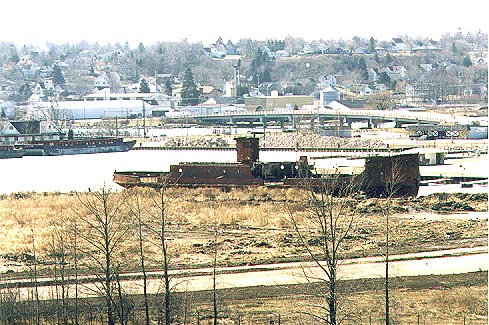
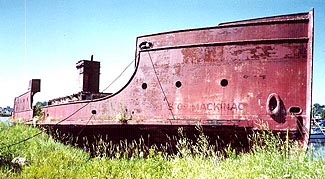
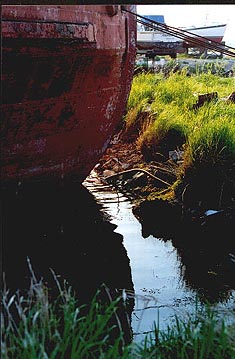
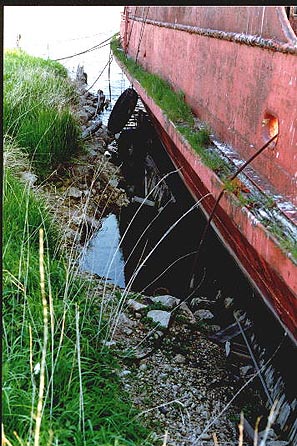
More views of THE STRAITS OF MACKINAC snapped in Kewaunee by Jeffrey Rogers can be seen on the next page.
Or if you'd rather do so, you may return toTHE INDEX PAGE.