TRINIDAD TOBAGO
I am a citizen of the sovereign democratic
Republic of Trinidad and Tobago,
and I solemnly pledge to dedicate my life
- To the service of my God
And my Country.
I will honour my parents,
My teachers, my leaders and my elders,
And those in authority.
I will be clean and honest in all my thoughts,
My words, and my deeds,
I will strive, in everything I do,
To work together with my fellowmen,
Of every creed and race,
For the greater happiness of all,
And the honour and glory of my Country.
GrantedIndependenceon August 31, 1962and became a Republicon August 1, 1976. |
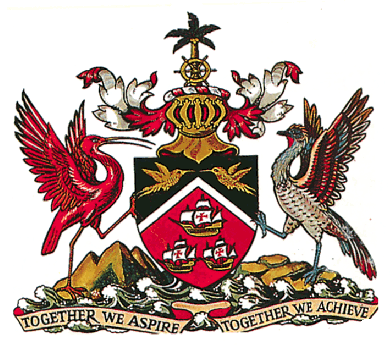 Coat of Arms Coat of Arms
Together we achieve". Other features: |
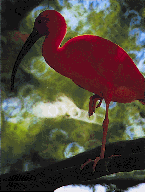 The Scarlet Ibis The Scarlet Ibis
Ibis, the latin word meaning religious worship, sacred bird"Sacred Ibis" as part of their religion. The birds were mummified and buried in temples with the Pharaohs. Whether the Amerindians dicovered the Ibis, is not known, although they knew of the Humming Bird. The bird itself, as the name implies is scarlet in color and can be seen early mornings or late afternoons flying in triangular formation from or towards the swamp where they nest and feed. |
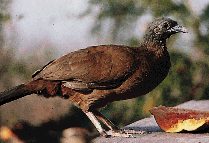 The Cocorico The Cocorico
It is truly the National Bird of Tobago. |
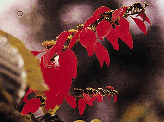 The Chaconia .. the National Flower The Chaconia .. the National Flower
The name itself, Chaconia is in honour of the Governor, Don Jose Maria Chacon, under Spanish rule. This variety with double flowers is called Warszewiczia after the Polish botanist who discovered it in Central America. It was discovered in Trinidad in 1957 by David Auyong. |
 The National Flag The National Flag
Red is the color most expressive of this nation and represents the vitality of its land and its peoples; it is the warmth and energy of the sun, the courage and friendliness of the people. Black represents the dedication of its people joined together by strong bond. White is the sea by which these lands are bound; the cradle of the nation's heritage; the purity of aspirations and the equality of all men under the sun. The colors, red, black and white represents then fire, earth and water which encompasses all past, present and future and inspires its people onward. |
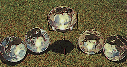 The Steel Pan The Steel Pan
The history of pan can fill volumes although no single person could claim to be its "inventor", yet there is no doubt that Trinidad is where it started. To some. it was at one time the source of many bloody gang wars, particularly in north Trinidad. It is as good a "rag to riches" story as any .. for it started with discarded pieces of pipes and old tins and pans as revellers improvised on the streets and worked itself to international recognition and the emergence of a million-dollar business. Today, the steelpans reproduced in hundreds of ways and forms, even as souvenirs and can be found in most countries. |
Trinidad and Tobago Map
Forward any views, comments and/or suggestions to
E-MAIL ME
