THE QURAN ON CLOUDS
Scientists have studied cloud types and have realized that rain clouds are formed and shaped according to definite systems and certain steps connected with certain types of wind and clouds.
One kind of rain cloud is the cumulonimbus cloud (pictured above) associated with thunderstorms. Meteorologists have studied how cumulonimbus clouds are formed and how they produce rain, hail, and lightning.
They have found that cumulonimbus cloud go through the following steps to produce rain:
1) The clouds are
pushed by the wind: Cumulonimbus clouds begin to form when wind pushes some
small
pieces of clouds (cumulus) clouds to an area where these clouds converge.
2) Joining: Then the
small clouds join together forming a larger cloud.
3) Stacking: When the
small clouds join together, updrafts within the larger cloud increase. The
updrafts near the center of the cloud are stronger than those near the edges.
These updrafts cause the cloud body to grow vertically, so the cloud is stacked
up. This vertical growth causes the cloud body to stretch into cooler regions of
the atmosphere where drops
of water and hail
formulate and begin to grow larger and larger. When these drops of water and
hail become too heavy for the updrafts to support them, they begin to fall from
the cloud as rain, hail, etc.
Allah said in the Qur'aan: (Notice the great detail) Have you not seen how Allah makes the clouds move gently, then joins them together, then makes them into a stack, and then you see the rain come out of it...? [Qur'aan 24:43]
Meteorologists have only recently come to know these details of cloud formation, structure, and function by using advanced equipment like planes, satellites, computers, balloons, and other equipment to study winds and its direction, to measure humidity and its variations, and to determine the levels and variations of atmospheric pressure.
The preceding verse, after mentioning clouds and rain, speaks about hail and
lightning: 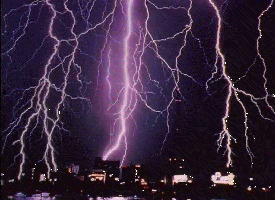
And He
sends down hail from mountains (clouds) in the sky, and He strikes with it
whomever He wills, and turns it from whoever He wills. The vivid flash of its
lightning nearly blind s the sight. [Qur'aan 24:43]
Meteorologists have found that these cumulonimbus clouds, that shower hail, reach a height of 25,000 to 30,000 feet (4.7 to 5.7 miles), like mountains, as the Qur'aan said, And He sends down hail from mountains (clouds) in the sky...
This verse may raise a
question. Why does the verse say ...its lightning in reference to
the hail? Does this mean that hail is the major factor in producing
lightning? Let us see what the book entitled Meteorology Today, says on
this. It says that clouds become electrified as hail falls through a
region in the could of supercooled droplets and ice crystals. As liquid droplets
collide with hail, they freeze on contact and release latent heat. This keeps
the surface of the hail warmer than that of the surrounding ice
crystals. When the hail comes in contact with and ice crystal, and
important phenomenon occurs. Electrons flow from the colder oblect toward
the warmer object. Hence, the hail become negatively charged, The same
effect occurs when super cooled droplets come in contact with piece of hail 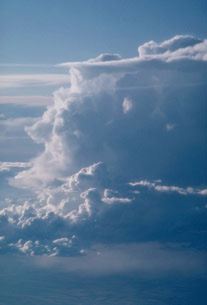
& tiny splinters of positively charged ice break off. These lighter,
positively charged particles are then carried to the upper part of the
could by updrafts. The hail, left with a negative charge, fall
toward the bottom of the cloud, thus the lower part of the cloud becomes
negatively charged. These negative charges are then discharged to the ground as
lightning. We conclude from this that hail is the major factor in producing
lightning.
This information on lightning was discovered recently. Until 1600
A.C., Aristotle's ideas on meteorology were dominant. or example, he said that
the atmosphere contains two kinds of exhalation, moist and dry. He also said
that thunder is the sound of the collision of the dry exhalation with the
neighboring clouds, and lightning is the inflaming and burning of the dry
exhalation with a thin and faint fire. These are some of the ideas on
meteorology that were dominant at the time of the Qur'aan's revelation, fourteen
centuries ago.