| Hymn of Pan by Percy Bysshe Shelley
FROM the forests and highlands We come, we come; From the river-girt islands, Where loud waves are dumb, Listening to my sweet pipings. The wind in the reeds and the rushes, The bees on the bells of thyme, The birds on the myrtle bushes, The cicale above in the lime, And the lizards below in the grass, Were as silent as ever old Tmolus was, Listening to my sweet pipings. Liquid Peneus was flowing, And all dark Tempe lay In Pelion's shadow, outgrowing The light of the dying day, Speeded by my sweet pipings. The Sileni and Sylvans and Fauns, And the Nymphs of the woods and waves, To the edge of the moist river-lawns, And the brink of the dewy caves, And all that did then attend and follow, Were silent with love, as you now, Apollo, With envy of my sweet pipings. I sang of the dancing stars, I sang of the daedal earth, And of heaven, and the giant wars, And love, and death, and birth. And then I changed my pipings-- Singing how down the vale of Maenalus I pursued a maiden, and clasp'd a reed: Gods and men, we are all deluded thus! It breaks in our bosom, and then we bleed. All wept--as I think both ye now would, If envy or age had not frozen your blood-- At the sorrow of my sweet pipings. |
| Hymn to Pan by Aleister Crowley
Thrill with lissome lust of the light, O man! My man! Come careering out of the night Of Pan! Io Pan! Io Pan! Io Pan! Come over the sea From Sicily and from Arcady! Roaming as Bacchus, with fauns and pards And nymphs and satyrs for thy guards, On a milk-white ass, come over the sea To me, to me, Come with Apollo in bridal dress (Shepherdess and pythoness) Come with Artemis, silken shod, And wash thy white thigh, beautiful God, In the moon of the woods, on the marble mount, The dimpled dawn of the amber fount! Dip the purple of passionate prayer In the crimson shrine, the scarlet snare, The soul that startles in eyes of blue To watch thy wantonness weeping through The tangled grove, the gnarled bole Of the living tree that is spirit and soul And body and brain --- come over the sea, (Io Pan! Io Pan!) Devil or god, to me, to me, My man! my man! Come with trumpets sounding shrill Over the hill! Come with drums low muttering From the spring! Come with flute and come with pipe! Am I not ripe? I, who wait and writhe and wrestle With air that hath no boughs to nestle My body, weary of empty clasp, Strong as a lion and sharp as an asp --- Come, O come! I am numb With the lonely lust of devildom. Thrust the sword through the galling fetter, All-devourer, all-begetter; Give me the sign of the Open Eye, And the token erect of thorny thigh, And the word of madness and mystery, O Pan! Io Pan! Io Pan! Io Pan Pan! Pan Pan! Pan, I am a man: Do as thou wilt, as a great god can, O Pan! Io Pan! Io Pan! Io Pan Pan! I am awake In the grip of the snake. The eagle slashes with beak and claw; The gods withdraw: The great beasts come, Io Pan! I am borne To death on the horn Of the Unicorn. I am Pan! Io Pan! Io Pan Pan! Pan! I am thy mate, I am thy man, Goat of thy flock, I am gold, I am god, Flesh to thy bone, flower to thy rod. With hoofs of steel I race on the rocks Through solstice stubborn to equinox. And I rave; and I rape and I rip and I rend Everlasting, world without end, Mannikin, maiden, Maenad, man, In the might of Pan. Io Pan! Io Pan Pan! Pan! Io Pan! |
| How do they make you feel? Which one do you like best? I tend to be drawn to Crowley's Hymn, likely because of it's homoerotic tone and steady tempo. Shelley's best captures Pan as god of the woodland, the pipe-player who sits on a rock and allows his music to wash over the valley around him. Crowley's captures the orgiastic flavor of this randy goat-god. It is also said to be somehow offensive to some people, especially some women, without their knowing why. I think it has something to do with the way it repeats and rythmically moves on, almost like multiple linguistic orgasms, and the fact that Victorian sensiblilities are still present in our "modern" culture. |
| Pan |
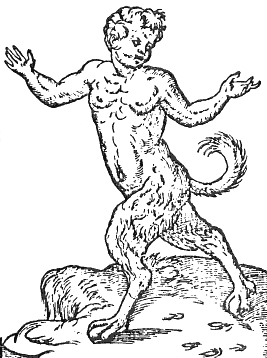
| How can you not like Pan? Greek god of the woodlands, he has goat legs and likes to sit and play the panpipes, which he invented. Following are two poems devoted to the Lord of Satyrs. |
 |
 |