|

Further Sketches In The Life of...
Part V
Written By Himself.
[pg 68 continued] It will be admitted, perhaps, by
all whose freedom from educational bias, and habits of close and independent thought, prepared
them fully to appreciate the preaching of Elder Leland, that he was more than usually successful
in reconciling those apparently convicting portions of the system of gospel truth, which have
been the theme of so much controversy in all ages of the Church. This was mainly owing to the
care he took, never to "mix law and grace together;" or, in other words, never to
confound the "system of God's moral government," with the "scheme of grace through a
Mediator." He viewed the line of distinction, as commencing at the "covenant of peace," formed
in the counsels of eternity, and continuing for ever. He did not, therefore, apply to the
unregenerate, the promises and precepts addressed to the penitent and believer, nor hold forth the
terrors of the law to "them who are in Christ Jesus." Yet that he did not pretend to understand the
whole mystery of the gospel, may be distinctly seen in the following detached paragraphs, from
which, with other of his writings, may be gathered the fundamental points of his belief.
"The gospel is so internally profound, and the minds of men so limited, the obstructions to
science so many and great, that it is but a little of the gospel that men understand; and yet, no
scheme, fraught with fewer incomprehensibles, could have brought relief to fallen man. The
unsearchable riches of Christ, which pass knowledge, will be continually unfolding
themselves to the saints in light."
"To reconcile the eternal designs of God with the freedom of the
human will, is a question that puzzles all men. That both are true, admits of no
reasonable doubt; but there is a great doubt whether the mind of man is large enough to reconcile
the question: if it is, why is not the matter settled long ago? It appears to be one of the deep
things of God, which we are to believe without comprehension. Should the Lord use ever so
many words to elucidate the subject, still, the mind of man is so limited, that the matter would
remain in the profound. That God is good, and that men are rebellious; that salvation is of the
Lord, and damnation of ourselves, are truths revealed as plain as a sunbeam."
"The preceptive part of the gospel addresses men as able to do, and
commands them to do; but the gracious part considers men as
weak and polluted, and reveals what God does for them. The
former shows holy authority, the latter gracious benevolence."
[pg 69] "Repentance for bad works, and the practice of good
works, I strive to preach; but, as repentance will not expiate crimes, and the deeds of the law will
not justify, redemption by Christ is essential. The salvation of God includes three things: first,
something done for us, without us; second, something done for us,
within us; third, something done by us."
"The moral insolvency of man, has not destroyed the equity of God's law, nor canceled the
demand."
"The sinner, until he is changed by grace, never feels guilty because he has not the holy
unction, but for the sins he has committed. The prayer of his heart is not for internal holiness, but
for deliverance from punishment."
"Adam, in innocency, with his life of natural purity, was happy on earth, but not fit for heaven.
Had he never sinned, he must, nevertheless, have been born of the Spirit, (received the holy
unction,) to have prepared him for heaven."
"Grace and effort. Some preachers fix their eyes so steadfastly upon the
unchangeable nature of God, his immutable decrees, his personal and unconditional election of
some unto eternal life, that they leave themselves but little liberty to preach, 'Repent, for the
kingdom of heaven is at hand' --'Repent, and believe the gospel'--'Repent, and be converted, that
your sins may be blotted out'--'Labor not for the meat that perisheth, but for that which endureth
unto eternal life'--'While ye have light, believe in the light, that ye may be children of the light,'
etc. Others place their minds on the rebellion of man, the necessity of repentance, and the
willingness of Christ to save sinners, so strongly, that they overlook such passages as these: 'As
many as were ordained to eternal life, believed'-- 'The election hath obtained it, and the rest were
blinded'--'No man can come unto me, except the Father draw him'--'Thou hast hidden these
things from the wise and prudent, and revealed them unto babes'-'Then shall ye seek me and
shall not find me'--'Not according to our own righteousness, but according to his own mercy he
saved us, 'etc."
Though his sermons, conversation and writings, were characterized by perspicuity and
simplicity, it must be supposed that he was sometimes misunderstood; for he was claimed, by
some sectarians, as the advocate of doctrines which he considered fundamentally opposed to the
truth. He incurred, also, the censure of many, by carrying farther than they thought necessary the
Protestant sentiment, of the sufficiency of the Scriptures as a guide to Christian faith and
practice, and by questioning the propriety of measures for which Scripture authority could not be
adduced. Some of this class of individuals, however, while they could not but acknowledge the
sincerity of his desires to be "made right," and of his fervent prayers to be enabled to
discern the truth, sought for other motives than love of truth, to which they might attribute his
dissent from their own views.
[pg 70]This was entirely uncalled for; for if ever there was a
man, who, in his search after truth, was honest, unbiased by sectarian partialities, unshackled by
previously formed opinions, uninfluenced by any selfish considerations, none who knew him
well, will hesitate to aver that John Leland was that man. There is evidently a wide difference
between searching the Scriptures to find a system of truth, and searching them for
evidence to support one already adopted. That the latter was not the course pursued by him, the
candor evinced in all his researches fully proves. His object being not so much to convince
others as to discover truth for himself, he avoided those sophistical methods of reasoning which
too many employ to bring the unwary and unreflecting to their own views, nor did he resort to
denunciation and fiery zeal, or to quibbling and evasion, to cover the weak part of an argument.
He did not undervalue the importance of the objections that might be urged against his opinions;
but giving them their full weight, he advanced his own arguments to meet them; following, in
this respect, the example of Madison, whom he often quoted as a model of candor and fairness in
debate.
With regard to his writings, it may be well to remark, that he never rewrote his pieces;
whatever they are, they were in the original draught. This consideration, while it accounts for
many inaccuracies in language both historical and grammatical, shows, at the same time, the
systematic order in which his thoughts naturally arranged themselves, following one upon
another with such method, that it would be difficult, if not impossible, to find an instance where
any important proposition was assumed without proof, or a succeeding one in a series taken as
proof of a preceding.
His views, in relation to the office and work of the ministry are contained in various parts of
his writings. It was never either his principle or practice to set a price upon his labors, nor to
demand or receive a fixed salary.. But though he never solicited, or made money a
condition of preaching, he never refused what any chose to give him; and he received it,
not as alms, but as a gospel debt. It was his counsel to one who was about to engage in the work
of the ministry, never to make any dependence upon what he expected to receive for preaching;
"if you get anything," said he, "you can work it in afterwards." Such was his own
practice. His own hands, and those of his family, who were all trained to habits of active
industry, supplied their wants, and he had the pleasure of knowing that whatever he did receive,
was given, "not grudgingly, but with free will, and of a ready mind."
His practice with regard to baptism was in accordance with the views expressed in the letter
found on page___ of volume___. He considered baptism a duty plainly enjoined on all the
followers of Christ, by an express command; but connection with a church to be a matter of
choice and expediency. Accordingly he always baptized such as gave evidence [pg 71]of piety, if they desired it, and left them to connect
themselves with whatever church they pleased, or with none, if such was their preference. He
thought the First Epistle of Peter, to the "strangers scattered" through various places,
was, probably, addressed to such as, from local situation, or other causes, were not numbered
with any of the churches.
His preaching, in latter years of his life, was almost entirely of the expository kind. He would
frequently, after naming his text, go back a number of verses, or to the beginning of the chapter,
and comment upon each clause in succession, and sometimes the close of the sermon would
come without his having reached his text at all. But " it is no matter," he would say, "so long as I
keep within the lids of the Bible. Indeed, it makes but little difference what text I take, I must
come to the third of John before I close. If I take an Old Testament text, I must preach a
New Testament sermon.
It was equally true of him as of Mr. Haynes, that "though he seldom held a congregation long
without exciting a smile, yet the predominant influence of his preaching was to produce
solemnity of feeling, and deep conviction of truth. His eccentricities would have been faults in
any other man, but in him they were so inherent and essential to his character, and his wit was so
spontaneous, and came, as it were, without his bidding, that they neither interrupted the current
of his own piety, nor often weakened the religious influence of his discourses upon
others."19
___________________________
19___Reminiscences of Rev. Samuel Haynes.
Many anecdotes and amusing incidents have been related of him, some, probably, without
foundation in truth. Want of space forbids the introduction of more than two or three in this
place. The following, cut from a newspaper, is judged to be authentic, from the fact that it is
characteristic of him. Riding one day in company with Elder Hull, they were overtaken by a
slight shower. Elder Leland was for seeking a shelter, but the other remarked, "Brother, I am
ashamed of you--a Baptist minister, and afraid of a little water!" "Ah! Brother Hull," replied he,
"I never like these sprinklings."
Calling one day on a Baptist minister, to whom he was not personally known, said the latter,
after the first salutations, "by what name shall I call you?" He replied, "Why askest thou thus
after my name, seeing it is secret?" "Well," said the other, "is this all the answer I am to have?"
"It is the answer of an angel, what better can you wish for?" "If you are an angel, doubtless you
are a fallen one."
On another and similar occasion, being asked the same question, he replied, "call me Leland."
"Ah!" replied the minister, "There are many who come along, wishing to be called by that name.
I have been tricked in that way several times." But after looking steadily at him a few moments,
his doubts seemed to yield to the conviction that he was indeed no[pg
72] other than he pretended, and he exclaimed, "Is it possible that the Almighty has
placed such a soul as Leland's in such an insignificant body!"
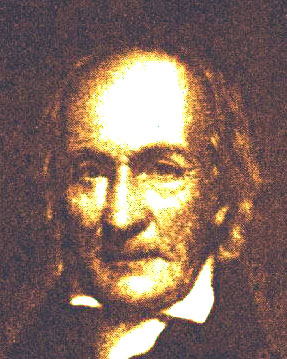
Should this expression convey the idea that he was small of stature, the impression will be
incorrect. His height was not far from six feet, though as he advanced in years, his form became
more stooping, and his stature, consequently, somewhat less. In flesh, he was rather thin and
spare. Of his personal appearance, generally, the accompanying portrait will furnish a more
correct and definite idea than any language can convey.
Perhaps these sketches cannot be more appropriately closed, than by the following brief extracts
from the concluding part of the funeral sermon : "Great and good man, he is gone! The tender
and affectionate father, the kind husband--the wise counselor-emphatically the peace-maker--
the social, warm-hearted friend--the sage--patriot--the lover of sound doctrine--the eloquent and
unusually successful minister of Christ, is no more! Is no more? He still lives, we doubt not,
where his intellect has found congenial spirits, and a wider range in the upper empire of Jehovah.
He lives below in the affections of thousands, and 'his works do follow him.'" "To live like him,
is to mourn over the sins of earth, and hold up God's everlasting truth to a dying world. To die
like him, is to stand on the confines of earth, looking off into eternity, and depart with the
'prospect of heaven clear.' To rest, at last, like him, is, we doubt not, to rest forever in the
Paradise of God."
...so ends the "Further Sketches" of a venerable soldier of freedom as well as the cross .
|

 A
CHARGE TO DEACONS
A
CHARGE TO DEACONS