Theobald Wolfe Tone
1763-1798
The Father of Irish Republicanism
| "That the influence
of England was the radical vice of our government, and
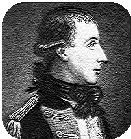
that Ireland would never be either free, properous or happy until she was independent, and that independence was unattainable whilst the connection with England existed."--Theobald Wolfe Tone. Those are the words of the "father of Irish Republicanism". I would call him a "hardliner, "wouldn't you? No wishy-washy stuff affecting his attitude. He believed that "independence was unattainable whilst the connection with England existed." He endeavored to disconnect it. Reading about Tone, I get the impression that he was destined to be connected to the cause to free Ireland. He was born in 1763, and was the oldest son of a Dublin coach builder. He was associated with the Protestant Ascendency, and was well-educated. He became a teacher and a lawyer. As his education increased, he became more intolerable to the British occupancy of his country, and knew something must be done to combat it. He helped found the Society of United Irishmen in Belfast in 1791. "Its founders were middle class radicals who sought to unite catholics and protestants in a campaign for parliamentary reform" (The Rebellion of 1798, Facsimile 1). Realizing by 1796 that it was useless being civic-minded with an expansionist, capitalist republic, they turned militant, and began promoting revolution against the haughty British. He was exiled to America because of his association with the United Irishmen, which was banned by Britain in 1794, and in 1796, was in France. He said of being both in the United States and France, "I have now seen the Parliament of Ireland, the Parliament of England, the Congress of the United States of America, the Corps Legislatif of France and the Convention Batave. I have likewise seen our shabby Volunteer Convention in 1783, and General Committee of the Catholics in 1793 so I have seen in the way of deliberative bodies as many I believe as most men, and of all those I have mentioned, beyond all comparison, the shameful profligate and abandoned all sense of virture, principle or even common decency, was the legislature of my own unfortunate country. The scoundrels! I lose my temper every time I think of them!" (Theobald Wolfe Tone on the Irish Parliament) His thinking turned to action in 1798 during the Rising. The English troops overwhelmed the Irish and French troops in numbers and guns. During one battle, it was 30,000 English regulars versus 2,000 revolutionaries. Tone was in France, and yearned to be in Ireland. France aided him with eight frigates and 3,000 men. They were stopped by an English fleet. Tone was captured, and scheduled for a quick trial. At his mock trial in 1798, Tone expounded the initiative of the United Irishmen: "To subvert the tyranny of our execrable government, to break the connection with England, the never failing source of all our political evils, and to assert the independence of my country-these were my objects. To unite the whole people of Ireland, to abolish the memory of all past dissentions, and to substitute the comman name of Irishman in place of the denominations of Protestant, Catholic and Dissenter. These were my means." A study of these beautiful words translates to the doctrine of Irish Republicanism. Tone spoke it, and lived it to the hilt. Of course, the British court found him guilty, and pronounced him to hang. Instead of giving the British the pleasure of seeing him hanging from a rope, on November 12, 1798, Tone cut his own throat with a penknife. It has been written, "He died in great agony" (Theobald Wolfe Tone:1763-1798). He also died a hero. |