

| The Rising of 1916 was
planned two years prior to the actual battle. One of the
reasons for the Irish Rising was the postponement of the
Home Rule Bill which the British parliament had finally
passed in 1914. Another reason was that Britain had
entered WWI, and several Irish leaders felt it would be
an opportune time to fight for freedom from the British
occupancy of their land. Some felt Britain would grant
them Home Rule after WWI if they fought with England in
the war. Those that did fight were gallant in action, and
prepared to fight to the death for freedom's sake in
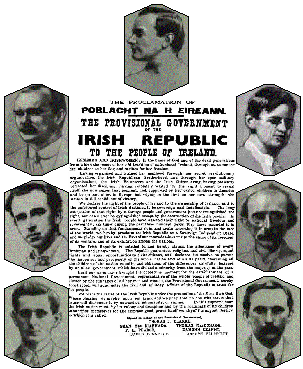
Ireland. Shortly before the battle, Roger Casement, an Englishman, was dispatched to Germany to purchase weapons. Germany spared rifles, but on early arrival, the British sank the ship and captured Casement. The Rising was delayed one day which would be Easter Monday. H-hour was high noon on April 24. Crowds of people were assembled on the streets. Small remnants of Irish Volunteers and the Citizen's Army marched by, armed and ready, to their seperate strongholds. Several buildings were possessed including the General Post Office on Sackville Street. Padraig Pearse, commander of the Irish Volunteers, read the Proclamation, which had been signed in blood, outside the post office. Besides the GPO, four advantageous positions were manned by the freedom fighters: the South Dublin Union, an assembly of houses for the poor (led by Eamoun Ceannt); St. Stephen's Green, where trenches were dug, and barricades were were erected (Michael Mallin and Countess Markiewicz, commanders); the Four Courts, legal profession headquarters. Large, heavy law books were utilized as sandbags. (Commanded by Eamoun Daly); and Boland's Flour Mill which guarded the incoming roads from Kingstown. The fighters were practically certain Britain reinforcements would disembark in this area (Eamon de Valera). The fighting would become intense and horrific. The Irish rebels attempted to seize Dublin Castle but to no avail. Only a few rifles and ammo were taken from the Magazine Fort in Phoenix Park, but they cut telephone lines and when a group of British Lancers attacked down Sackville Street, their assault was repelled. By Tuesday, the fighting was relatively calm. The Irish Volunteers and Citizen's Army had shown tremendous courage and disicipline under fire so the British moved very cautiously until reinforcements arrived. The strategy of the British was to surround the Irish patriot's strongholds, and then divide and conquer. They already were superior to the freedom fighters in numbers and weapons, but the Republican warriors fought like devildogs and negated every British advance. Man to man, the English imperialists had not a chance. When Wednesday came, Pearse, Connolly, Clark and their men were outnumbered twenty to one. Being far superior in numbers, the British attacked in a different mode. Shells from the gunboat, Helga, were aimed at the brave Irish men and women's strongholds. The shellfire by the British was inaccurate, and several unoccupied buildings were hit. Many civilians were slaughtered because the English soldiers couldn't have cared less. It was impossible to get food to the people because of the British bombardment of Dublin. The GPO was hit, and began to burn from the top toward the bottom. Connolly was wounded twice. One of his feet was crushed, and he suffered excruciating pain. Morphine killed the pain enough that he could still fight. On Wednesday also, twelve of de Valera's men defended the Mount Street Bridge for nine hours against two battalions of Brits. A last-ditch battle occurred on King's Street. Five thousand British soldiers, with the aid of armored cars and artillery, could only advance 150 yards in 28 hours against 200 Irish freedom fighters. The cowardly British shot and bayoneted Irish civilians who were hiding in basements. The massacre of civilians by the British soldiers, and the far superior numbers of British personnel and weapons prompted Pearse and Connolly to surrender on Saturday morning. When the brave Irish fighters were taken to prison, the citizens of Dublin booed, screamed and jeered at them. It was devastating to the rebels because all they had done was fight for their freedom, but the people were hungry because of the lack of their food supply during the battle. On the other hand, if the people had helped the fighters, therae would have been the distinct possibility that the British troops would not have overwhelmed them. Now, they were prisoners. London ordered swift trials. The defendants were without lawyers. All were found guilty. Pearse, Connolly, Clarke, MacDonagh, MacDermott, Plunkett and Ceannt were shot to death. Connolly was dying, but was propped up in bed in a hospital room for his trial. He couldn't stand, and was shot in a chair. When the people heard about the mock trials and brutal punishment, they changed their minds and the fighters became heroes to them. They remain heroes today. Because of their brave stand, the people wanted the British defeated and driven from Irish soil. It established a precedent for the future defense of Ireland. Pearse's and Connolly's goal had been achieved. Their blood sacrifice's had inspired the Irish people. Long live The Rising! References: The Easter Rising in Ireland, 1916. A Tribute to Patrick Pearse and the Easter Rising. Patrick Pearse, Ireland's Rebel. 1916, The Rising. |