|
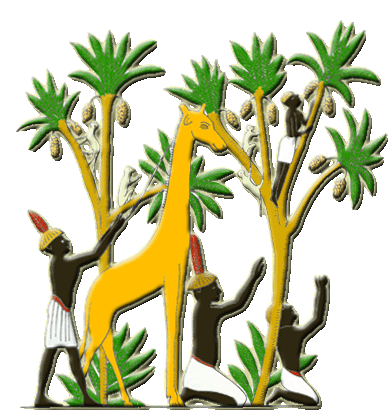
Hatshepsut, daughter of Ahmose and Thutmosis I, first came to power as the wife of Thutmosis II, her half-brother who was the son of a lesser queen, Mutnofret. Hatshepsut bore Thutmosis II one daughter, Neferura. After the death of Thutmosis II, Hatshepsut became coregent alongside her step-son, Thutmosis III, who was the son of Thutmosis II's lesser wife, Isis. Because Thutmosis III was too young to reign himself, Hatshepsut served his administative duties. Possibly as early as Year 2, Hatshepsut began her slow transformation into pharaoh. For a while, at least, she maintained her feminine titles, was referred to by feminine pronouns, and was still being depicted as clearly female. In a bid to legitimize her reign, Hatshepsut deepened her ties to the powerful priesthood of Amun, Egypt's state god. She repaired parts of Karnak, brought in two obelisks to adorn Amun's temple, and built the recently reconstructed Red Chapel. The Red Chapel served as a barque shrine made from red quartzite. To reciprocate Hatshepsut's generosity, the priesthood of Amun fabricated a story that made Hatshepsut the undeniable heir to Thutmosis II's throne. The story, which is etched in the walls of her mortuary temple, details Hatshepsut's divine origins. Ahmose supposedly conceived Hatshepsut with the king of gods himself, Amun. Amun tells Ahmose she will bear his daughter and heir, who will be named Khenemetamun Hatshepsut, "She Whom Amun Embraces, Foremost of Noble Ladies." After the inscription of her parentage was commissioned, Hatshepsut began taking on male attributes. She adopted all of the titles of the male pharaoh, except "Might Bull," wore the false beard, was depicted with a male physique, wore the nemes adorned with the protective uraeus, and even began to omit the feminine ending of her name, thus becoming Hatshepsu. The mortuarty temple on which this tale is shown, is in Deir el-Bahari. This beautiful example of Egyptian architecture, known by the Egyptians as Djeser-Djeseru, "Wonder of Wonders," was influenced by the design of Montuhotep I's temple. Djeser Djeseru is in the Theban necropolis, seemingly carved from the cliffs which are guarded by the goddess MerytSeger, "She Who Loves Silence." Another inscription on the walls of the mortuary temple depicts the expedition which Hatshepsut ordered to Punt, during the 9th year of her reign. Punt was a land so rich in resources that the Egyptians called in "God's Land." It was a foreign land probably situated in modern day Sudan, near the Somali border. The main purpose behind the expedition was to bring back valuable myrrh. In the inscriptions, the homes of the people of Punt are shown as beehive-like huts. The most peculiar inscription is that of the Queen of Punt; she is depicted as a squat, comical looking fat woman. The Egyptians returned from the expedition with ships loaded with ivory, ebony, animal skins, monkeys, and 31 incense trees, which Hatshepsut had planted in her mortuary temple. It is said that some of the animals brought back from the expedition went to Hatshepsut's own collection of exotic animals, an early proto-type for a zoo.
 Hatshepsut's reign, although not entirely remarkable, was peaceful and prosperous. She focussed her attention towards building projects and trade. Some scholars believe that because she was supposed to be co-regent, she concerned herself with adminstrative duties while allowing Thutmosis III to control the military. Hatshepsut could have quite possibly been very reluctant to relinquish her throne to her step-son. Inscriptions depict her daughter as a young prince, with a beard and side-lock; it seems Hatshepsut wasn't grooming a daughter - rather a future king. After Year 11, Neferura seems to disappear. She is no longer mentioned in Egypt's historical record. One notable character from Hatshepsut's reign was Senenmut. Senenmut came from humble beginnings, but was quickly promoted to numerous lucrative and prestigious posts within Hathshepsut's court. He is mentioned as Hatshepsut's chief architect, however it is doubtful on whether he actually performed any real duties under this title. It is known that he left his likeness behind the doors of the numerous storerooms of Hatshepsut's temple. An attempt to erase these images was made, however not all were discovered, leaving some for posterity. Senenmut is also mentioned as the tutor of Princess Neferura. One famous statue shows Senenmut embracing the young princess, leaving many scholars to believe that he was a trusted confidante of the royal family. Graffiti discovered in a workers' quarry show the female pharaoh and a figure which many believe is Senenmut in a position that is a little more than compromising. Hatshepsut is seen as the submissive partner in a sexual act, perhaps also making the statement that although she has made painstaking effort to represent herself as king, she still finds herself being dominated because she has dared to take on a role reserved for only men. This graffiti lends credence to the belief that Senenmut could have been Hatshepsut's lover. However, some dismiss this claim as unsubstantiated heresay and fantasy. Like Neferura, Senenmut also disappears before the end of Hatshepsut's reign. After at least 20 years of leadership, Hatshepsut either died or was deposed. Her cartouches seem to have been hacked at, with the names of Thutmosis I, II, and III replacing her own name. Her likeness was also systematically destroyed. Many theories surround the deliberate vandalism of her image and name. Kurt Sethe believed Thutmosis I or II briefly returned to the throne after Hatshepsut's death, making them responsible for defacing her name and likeness. E. Naville argued that the defacements are of Ramesside date. In reality, some really are. However, Ramesses was known for "stealing the thunder," so to speak, of other pharaohs by claiming credit for their building projects. W.F. Edgerton maintained Thutmosis III was the culprit. Most scholars will agree that a large amount of the vandalism took place during Thutmosis III's reign. The reason behind this act of excluding Hatshepsut from history, however, remains the true mystery. Some think Thutmosis III eradicated Hatshepsut's legacy out of revenge for never relinquishing Thutmosis III's rightful place on the throne. The only problem with this theory is that Thutmosis III began to erase Hatshepsut later on in his reign. Why, then, would Thutmosis III wait so long if he wanted revenge? By erasing her name and evidence of her existence, he is condemning her soul to oblivion. But if he acted out of malice, surely he would have obliterated her memory early in his reign. Perhaps he tried to erase her memory to reclaim the years he should have been pharaoh. By erasing her reign, he effectively gains what he was denied back. It was not at all uncommon for Egyptian kings to rewrite history to their favor. It should also be noted that the inscriptions depicting the story of Hatshepsut's conception were partially hacked away. It is possible that Thutmosis III or subsequent pharaohs saw her reign as an upset to the balance of ma'at. The role of pharaoh was a role strictly reserved for men, even in a society that offered considerable freedoms to women. By claiming her father was Amun and then coronating herself, Hatshepsut essentially commits blasphemy. The tomb of Hathsepsut and Thutmosis I was found in the last century. Their tomb, KV20, yielded no body that could be identified conclusively as that of Hatshepsut. Her body and the body of her father were probably moved to a royal cache by the priesthood, so they would not be violated by greedy tomb robbers.
|