|
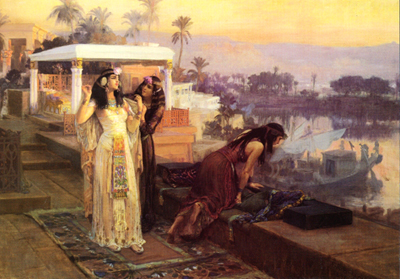 Cleopatra is a name which has evoked powerful images of sovreignity, femininity, beauty, and cunning throughout history. Cleopatra is perhaps one of the most famous queens of all time. She has been immortalized by Shakespeare, Horace, Plutarch, painters and sculptors, and various historians alike. Yet, despite her infamous reputation as a power-hungry seductress, Cleopatra was a proud and greatly ambitious ruler. Cleopatra was born during the winter of 69-68 B.C.E. in Alexandria, Egypt. Unlike common misconception, Cleopatra was not Egyptian. She was the daughter of a Macedonian-Greek, King Ptolemy XII. The Ptolemies had taken control of Egypt after the death of Alexander the Great, who split his empire amongst his generals. Her name, Cleopatra, was even Greek for "Her Father's Glory", which would prove to befit her for the rest of her days. Her older siblings were Berenice and Cleopatra VI; her younger siblings being a sister named Arsinöe and two brothers, Ptolemy XIII and Ptolemy XIV. Among many things, she was educated in Greek literature, art, and rhetoric. Cleopatra was also extremely gifted with languages. It is known she spoke Greek, Persian, Hebrew, and possibly more. What is even more impressive is that she was the first Ptolemy to learn the native language of the Egyptians. Oddly enough, some scholars say she didn't know Latin, the language of her famous lovers. Ptolemy XII, because he was a tyrant, was overthrown by the Alexandrians and exiled. This left Cleopatra's eldest sister, Berenice, the throne. During Berenice's short reign, Cleopatra VI died of unknown causes. Unfortunantly for Berenice, her father regained the throne in 55 B.C.E. and had Berenice beheaded. In 51 B.C.E., Ptolemy XII died and Ptolemy XIII and Cleopatra VII, now his only children of reigning age, were named as his successors. According to tradition, the eighteen-year-old Cleopatra had to marry her brother, who was only ten at the time. With her marriage to Ptolemy XIII, Cleopatra was able to rule as she saw fit and received the ancient title of "Mistress of the Two Lands". Together, Arsinöe, Ptolemy XIII and his council, now weary of Cleopatra's independence, exiled her to Syria. In 37 B.C.E., Caesar and Pompey became involved in a bitter feud, each vying for power over Rome. Pompey tried fleeing to Egypt to escape Caesar's troops, but was killed by the order of Ptolemy XIII, who thought it wiser to side with Caesar. Upon Caesar's arrival in Alexandria, he was shown the head of Pompey. Instead of being grateful, he was outraged and disgusted at the barbaric way in which Pompey had been killed. Although Pompey was his political rival, he had once been Caesar's son-in-law, married to his only daughter, Julia. Julia's death prompted the beginning of the end of Caesar's alliance with Crassus and Pompey, know as the First Triumverate, or the factio in Roman times. Knowing she could possibly gain support from Caesar to regain the throne, Cleopatra secretly entered Alexandria where she was smuggled into Caesar's palace inside an oriental rug. That very night, she seduced Caesar and found a political alliance that would last long enough to see Ptolemy XIII deposed and have Cleopatra reinstated as the Queen of Egypt. After Cleopatra received the throne once more, she married her other brother, Ptolemy XIV. The body of Ptolemy XIII was later found in the Nile's mud. It is believed he had been drowned in the river while trying to escape Caesar's henchmen. His golden armor was later put on public display for all to see. Arsinöe was exiled and later made to walk in chains behind Caesar's chariot through the streets of Rome. After restoring order to Egypt, Caesar returned to Rome; what he was unaware of was that he had left the young queen Cleopatra pregnant with his child.
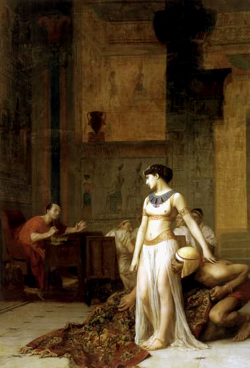 On June 23, 47 B.C.E., Caesarion "Little Caesar" was born. Cleopatra claimed he was fathered by Amun-Ra, the supreme Egyptian diety. Soon, statuettes were being made which depicted Cleopatra and Caesarion as Isis sucking Horus the Younger. In 46 B.C.E., Cleopatra and Ptolemy XIV set out for Rome at the request of Caesar. While Cleopatra stayed in his villa, Caesar showered her with gifts. It was there that Cleopatra would stay for two years with young Caesarion. Romans were outraged at the fact that Caesar allowed Cleopatra and their bastard son to stay in Rome all that time, while Caesar was married to another woman. Caesar was assassinated on the Ides of March in 44 B.C.E. by his own Senate under the suspicion he would marry Cleopatra and take the title Rex, "King", a term that had been hated since the time of the last King of Rome, Tarquinius the Proud. Before Cleopatra was forced to leave Rome, Ptolemy XIV died under mysterious circumstances before they set sail. It is believed he was poisoned under the instigation of Cleopatra herself. The Queen was not about to lose
her status in Mediterranean politics because of the death of Caesar. She had
to come up with something else to give her substantial power. During the time
following Caesar's death, Octavion, Caesar's adopted successor, Lepidus, and
Antony had formed the Second Triumverate. Antony had been proclaimed Triumvir
of the East. In 37 B.C.E., Antony summoned Cleopatra to Tarsus to see if she
had supported his enemies. Cleopatra, using her wit and charm, came to Tarsus
in the midst of an impressive display of luxury and power. She was at the epicenter
of the magnificent occassion, dressed as the divine Aphrodite. Anytony was immediately
impressed with what he saw and was smitten by the queen.
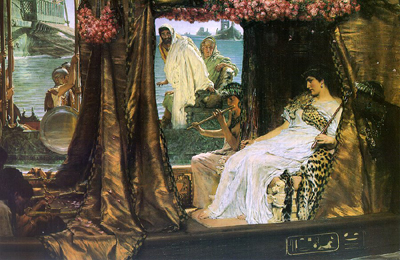 He, too, was seduced by Cleopatra. This was beneficial to her because it would once again give her power and political stance in the Roman Empire. Of course, news of Antony's dealings with Cleopatra did not go over well with the Roman public. Antony was married to a woman named Fulvia. After his brief affair with Cleopatra, Antony returned to Rome. He, too, had left Cleopatra pregnant with his child. Six months after Antony's departure, Cleopatra gave birth to twins-Alexander Helios "Sun", and Cleopatra Selene "Moon". By the time the twins were toddlers, Antony had divorced Fulvia and married Octavia, the half-sister of Octavion. In 36 B.C.E., Antony returned to Egypt for Cleopatra and married her. Five years after the marriage, the Queen of Egypt gave birth to another son, Ptolemy Philadelphus. By 34 B.C.E., Antony and Cleopatra VII had proclaimed Alexander Helios the King of Armenia, Cleopatra Selene the Queen of Crete and Cyrenaica, Ptolemy the King of Spain, Ceasarion the "King of Kings", and Cleopatra the "Queen of Queens". In reaction, Octavion and the Senate declared war on Antony and Cleopatra. The Battle of Actium was the end for Cleopatra and her husband. After she and Antony were defeated by Octavion's naval fleet commanded by Agrippa, Cleopatra began experimenting with poisons and had her mausoleum constructed. Antony and Cleopatra had been separated during the retreat, Antony believing Cleopatra had betrayed him by abandoning him and his troops during the battle. Octavion was now closing in on Alexandria and Cleopatra had barricaded herself inside her mausoleum. Antony had heard a false report that Cleopatra had died and upon receiving the news, fell on his own sword. He was still alive when one of Cleopatra's servants informed him that she was still living, and he then carried himself all the way to the mausoleum. He was then hoisted up by a rope to Cleopatra. Plutarch described the pitiful scene as follows:
Antony died in her arms. After his
death, Octavion held Cleopatra captive. She was under constant guard because
Octavion feared she would take her own life. Cleopatra remembered what Caesar
had done to her sister when she was captured. She couldn't let the same happen
to her. In order to trick Octavion into loosening the guard on her, she would
have to convince him that she wanted to live and her attempt was one Octavion
would have to pity. During her dramatic display to Octavion, she as described
"her hair and face were in a terrible disarray, her voice tremulous, her eyes
sunken". She had succeeded and gained the trust of Octavion.
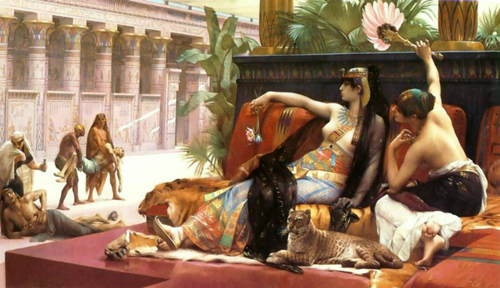 Afterwards, she managed to have a basket of figs smuggled into her apartments; this basket contained a poisonous asp. She then wrote a letter to Octavion asking to be buried by Antony's side. Realizing what she was going to do, Octavion sent his men to stop her, but they were too late. They found Cleopatra dead on her gilded couch with her two faithful servants, Iras and Charmion, dying by her side. After Cleopatra's suicide from the asp bite, Egypt fell into the hands of Octavion, and became a Roman province. This was the end of true Egyptian culture and independence. Not much us know about the fate of Cleopatra's children. It is thought that Cleopatra Selene was married off to the King of Numidia. Caesarion us believed to have been murdered because of his birth right. The other children were ironically raised by Antony's Roman wife, Octavia. Clearly, Cleopatra was proud and ambitious. Her attempts to keep power exhibited her wit, cleverness, and strong will. The woman who has gained immortality in art and literature, was also a woman nonetheless. She loved, lived, made mistakes, and eventually met a tragic end. Cleopatra still lives on in the human imagination today.
|