|
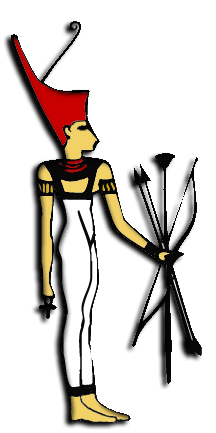
Neith (Nit, Neit, Net) is a goddess, perhaps of Libyan origin, who had
several divine attributes. She is largely considered a war goddess and the goddess of the hunt.
Early in Egyptian history, perhaps starting in the First Dynasty, Neith was symbolized by a shield and two
crossed arrows. As a war goddess and huntress, she is shown with this symbol crowning her head, or
holding these weapons, sometimes grasping a harpoon or spear in the other hand. Neith also presided
over the art of weaving. A hieroglyph for a loom is even in her name, further denoting her association
with weaving. The woven mummy wrappings of the deceased were given by Neith. She also is considered to be the guardian of Duamutef, one of the four Sons of Horus.
Other funerary responsibilities she had included looking after the corpse of Osiris, alongside
Isis and Nephthys. Also in the Oriris myth, it is the goddess Neith whom Banebdjedet, the ram-god, appeals to in order to settle the quarrel between Horus and Seth. Neith recommended the gods bestow the crown of Egypt to Horus, lest she be angered. However, Neith also told the gods to double Seth’s property, and give him Anathe and Astarte as consorts to compensate for his loss of the throne.
During the New Kingdom, Neith is regarded as a primeval goddess who arose from the watery chaos. In this role, it is said Apep came from the saliva she spat into the waters of Nun. She is also seen as the mother of Ra during this time. Nevertheless, she is almost always identified as the mother of the crocodile-god, Sobek, during all periods of Egyptian history.
In her capacity as “She of the Lower Egyptian Crown,” Neith becomes the patron of Lower Egypt and the guardian of the Fifth Nome of Lower Egypt. As the goddess of Lower Egypt, she sometimes is drawn wearing the Red Crown, or Deshret.
|