|
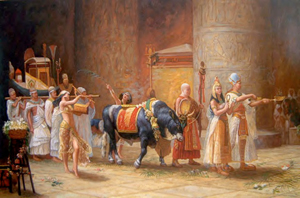 Considered the sacred incarnation of Ptah and Osiris on earth, the Apis bull had several distinguishing marks including a black body, a white triangle on its head, white markings on its back, and a knot under its tongue. The Apis bull, known to the Egyptians as Hap, was worshipped from the earliest times in Egyptian history. Manetho places the beginning of its residency in Memphis at around the 2nd Dynasty. Old Kingdom texts mention how the Apis was caught, drowned, and eaten, after which he transformed into the god Osiris. The Apis bull cult originally centered around a yearly festival that reaffirmed solidarity in the kingdom and the power of the pharaoh. The procession of the festival, where the Apis was led to the Nile or cattle, also illustrated the fertility of the Nile and its yearly renewal. During the day, the Apis was let out so that visitors could see him. He was considered a sort of oracle and provided answers to yes-no questions either depending on which stall he later went into, or whether or not he received food from the questioner. Later in history, the festival at Memphis began using substitute sacrificial animals, instead of slaughtering the Apis. However, the Apis was never to live beyond 25 years. If it did live after its 25th year, it was drowned and embalmed. Early history did not place nearly as much importance on the cult as the New Kingdom. During this time, the Apis evolved into the ba of Ptah or Osiris, instead of merely a counterpart of the god on earth. The Apis became Ptah, Osiris, Ptah-Sokar-Osiris, Horus, Geb-Shu, Ra, and Atum; sometimes it was an assimilation of all of these dieties. After the death of an Apis bull, much pomp and circumstance ensued. Mourners and worshippers flooded the city as the embalmed bull was taken on a funeral procession to its final resting place in Saqqara, in a place known as the Serapeum, found in 1851 by Auguste Mariette. During the 19th Dynasty, additions were made to the necropolis. Royal tombs were constructed, making the king associated with the power of the Apis. A separate area for burnt offerings to Osiris-Apis (Ausar-Hap) was constucted; this place is where many oracles were interpreted. Apis became inextricably associated with the god Osiris. *Ahmose II (Gr. Amasis) was responsible for rebuilding the shrine known as the Apieion, which was the supposed "birthplace" of the Apis god, and its stall. The mother cows, the Sechathor goddess associated with Isis, were entombed in Saqqara North. Alexander the Great set the example for the Greek rulers of Egypt by making sacrifices to the Apis. The Ptolemaic Greeks further popularized the cult of the Apis. They created their own god, a corruption of the original Egyptian Ausar-Hap and the Greek Osoroapis, named Serapis. This is where the Serapeum gets its name. The Ptolemies still honored the Egyptian tradition, which lasted even into the 4th Century C.E. Under Julian, the procession, which brought a lot of wealth from tourism into Egypt's economy, briefly revived but eventually failed. *From research, I believe the Amasis referred to is indeed Ahmose II.
|